Invoking Gandhi and Buddha, Modi casts India as a moral guide in a fractured world; yet it is a mere symbolism for Western applause, not leverage on Russia
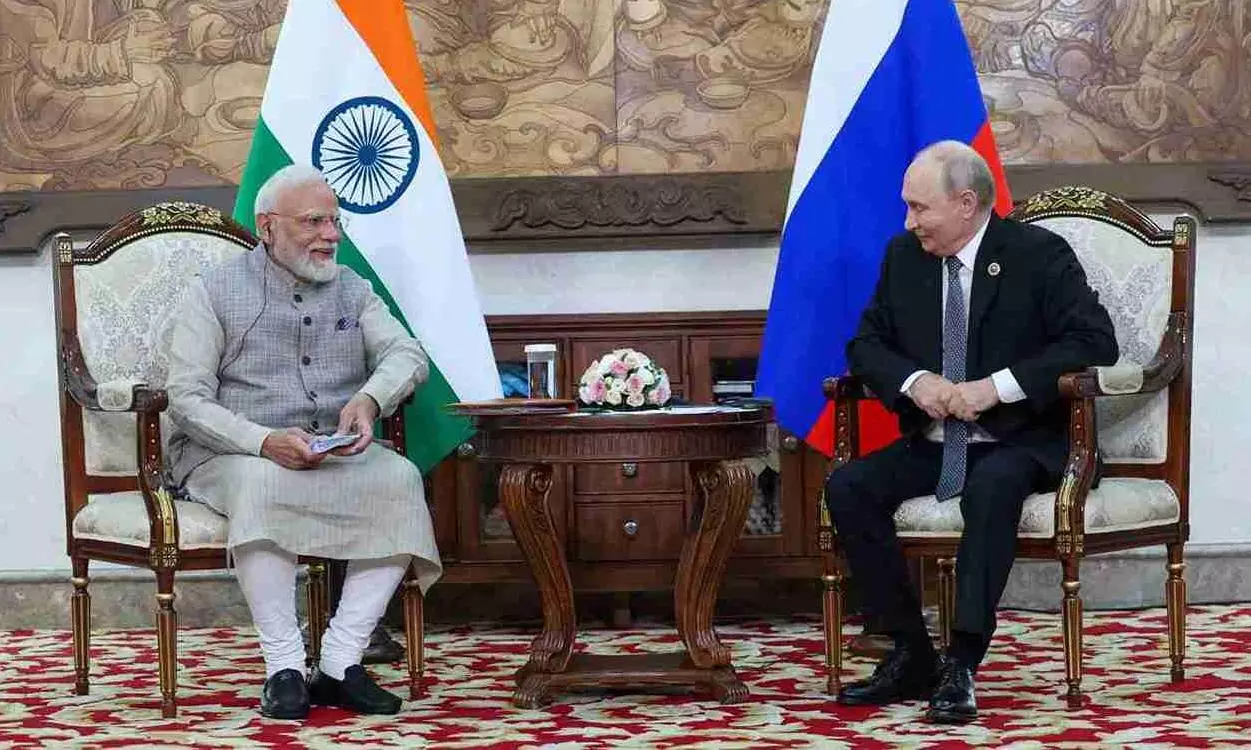
While meeting Russian President Vladimir Putin on the sidelines of the Samarkand Shanghai Cooperation Council (SCO) summit in September 2022, Prime Minister Narendra Modi told him, “I know that today’s era is not of war and we have spoken to you many times on the phone that democracy, diplomacy and dialogue are such things that touch the world.”
At that time, the Russia-Ukraine war was in its eighth month and Modi’s words had resonated especially in the Western world. They were interpreted as Modi chiding Putin for the war. The Russian president did not respond because he had many interests in India. He took Modi’s words in his stride; they made no difference to his policy of continuing the Ukraine war till he had achieved his objectives.
Modi’s words were wise but they did not make any impact on Putin. In conventional diplomacy, the leader of a country avoids advising that of another country publicly. This is especially so if it is unlikely that his views will make a difference. However, Modi has not been constrained by diplomatic conventions. That became clear when four years later, again on the sidelines of an SCO summit, Modi reiterated his ideas, only more forcefully, to an impassive Putin during his meeting with him in Bishkek on August 31.
Lecturing Putin to score brownie points with West?
Modi said India supported all efforts for peace in Ukraine. He invoked the impact of the war on humanity saying “every single day spent in war pushes humanity backwards” while every step towards peace brings hope. Going further, he said, “We must move from an endless war to the end of the war which is very important for all of humanity.” Finally, invoking Gandhi and the Buddha, he said their land had only one message—the “path of peace”.
Modi’s words have naturally been favourably received by the Western media, where they are being looked upon as a rebuke to Putin. If Modi’s purpose was to impress the West for giving Putin a public dressing down or to show the supporters of the Sangh Parivar that “Vishwaguru” India under Modi’s stewardship speaks truth to power openly and publicly, then his purpose was obviously served.
Also read: US efforts to curb India-Russia ties will backfire, says Putin in strong remarks
However, if his objective was to persuade Putin to end the Ukraine war, this was hardly the way to do so. Diplomacy should never embarrass an interlocutor because it pushes his back up. This is particularly so when the dignity of a longstanding leader of a major world power is concerned. In any event, India has no leverage over Russia on the issue of the Ukraine war. It can, therefore, be concluded that apart from the Vishwaguru syndrome, Modi was seeking to win brownie points with the West, especially Europe, before the BRICS summit in India later this month.
Bhagwat’s Vishwaguru pitch
Significantly, on the very date that Modi was preaching the virtues of peace to Putin, the Sarsanghchalak of the Rashtriya Swayamsevak Sangh, Mohan Bhagwat, spoke to a gathering of Indians in Toronto, Canada, on the God-given duty of Hindus to show the path of Dharma to the world. He spoke on the Sangh Parivar’s usual themes about the Hindu way of life and outlook towards the world and humanity—that all humankind was one.
He also spoke about how Hindus had always sought the betterment of humanity as vishwa bandhus (global friends). Indeed, it was the duty of Hindus to serve others and gain happiness by doing so. This is what Hindus had to give to the world as their duty. Indeed, this was the Hindus national duty too. Therefore, when Bharat became big, it did not become a superpower but by “its own character it became Vishwaguru and not Mahashakti; so the rise of Bharat would mean more united and more emancipated humanity”.
Also read: Rare interview provides insights into Putin’s closely-held worldview
Bhagwat’s subtext was clear: that as Bharat was now rising, it should act as a Vishwaguru. Modi’s advice to Putin was, therefore, coming from a Vishwaguru.
Righteousness versus realpolitik
The Sangh Parivar’s vision of India obviously means ancient India. It is shared by many Hindus. They believe that India was a virtuous land which always sought peace with other countries. It never attacked foreign countries or sought to extend its territory. But how far does this vision correspond with reality?
The fact is that essentially for ancient Indians, the world consisted of the subcontinent and, while Buddhism and Indian culture spread to many lands, ancient Indian polities simply did not venture politically or strategically beyond the subcontinent. And, the history of the subcontinent in ancient times and later was hardly peaceful. History bears that out. The Rishis may have given the message of the oneness of humanity and the value of peace but was that practised by the Hindu political and social elites?
It is true that the world was struck, despite the horrors that accompanied Partition, that the Indian freedom struggle was, under MK Gandhi’s leadership, based on non-violence. That imparted it with a moral authority which was relied upon by Indian diplomacy in the first decade after independence. Thus, India was called upon to maintain peace in the aftermath of the Korean war as a neutral party.
Also read: India keen on expanding ‘trade basket’ with Tehran: PM Modi to Iranian President
This was also the time when India pursued a non-aligned policy, though even then, non-alignment did not mean abandoning Indian interests. Indeed, the moral halo wore thin after accusations of leaning towards the Soviets during the Hungarian uprising in 1956 and after the military action to throw Portugal out of Goa in 1961. This shows that at all times Indian foreign policy was based, as it should have been, on a pursuit of its interests.
Mission against vision
Many peoples think they have a special mission in the world. The Jews believe they are the chosen of God. During the colonial period, the European powers justified the horrors they inflicted on the colonised as part of the process of civilising them. The fact is that the entire colonial enterprise was based on the ruthless exploitation of the colonies. The Chinese have traditionally believed that the rest of the world is barbarian. History teaches that all peoples have their ups and downs and those who succeed the most are those who believe in not their national destinies but in rationality, science and technology.
And, if India is the land of Gandhi and the Buddha, it is also that of Chanakya who taught us the virtues of realpolitik.
Also read: Five ways the Russia-Ukraine war has changed the world forever
A final word. In his Toronto address, Mohan Bhagwat interestingly quoted from Pakistan’s national poet Allama Muhammad Iqbal’s Sare Jahan se Achchha Hindustan Hamara: “Yunan o Misr o Roma sab mit gaye jahan se/ kuch baat hai ki hasti mitti nahi hamari”. (Ancient Greek, Egyptian and Roman civilizations have all disappeared from the world; there is something in us that we continue to flourish). Bhagwat did not mention that these lines were penned by Iqbal.
(The Federal seeks to present views and opinions from all sides of the spectrum. The information, ideas or opinions in the articles are of the author and do not necessarily reflect the views of The Federal.)