Over the past 12 years, the arc of Modi’s leadership has shifted from broad-based nation-building and cross-party symbolism into a platform for self-referential executive dominance
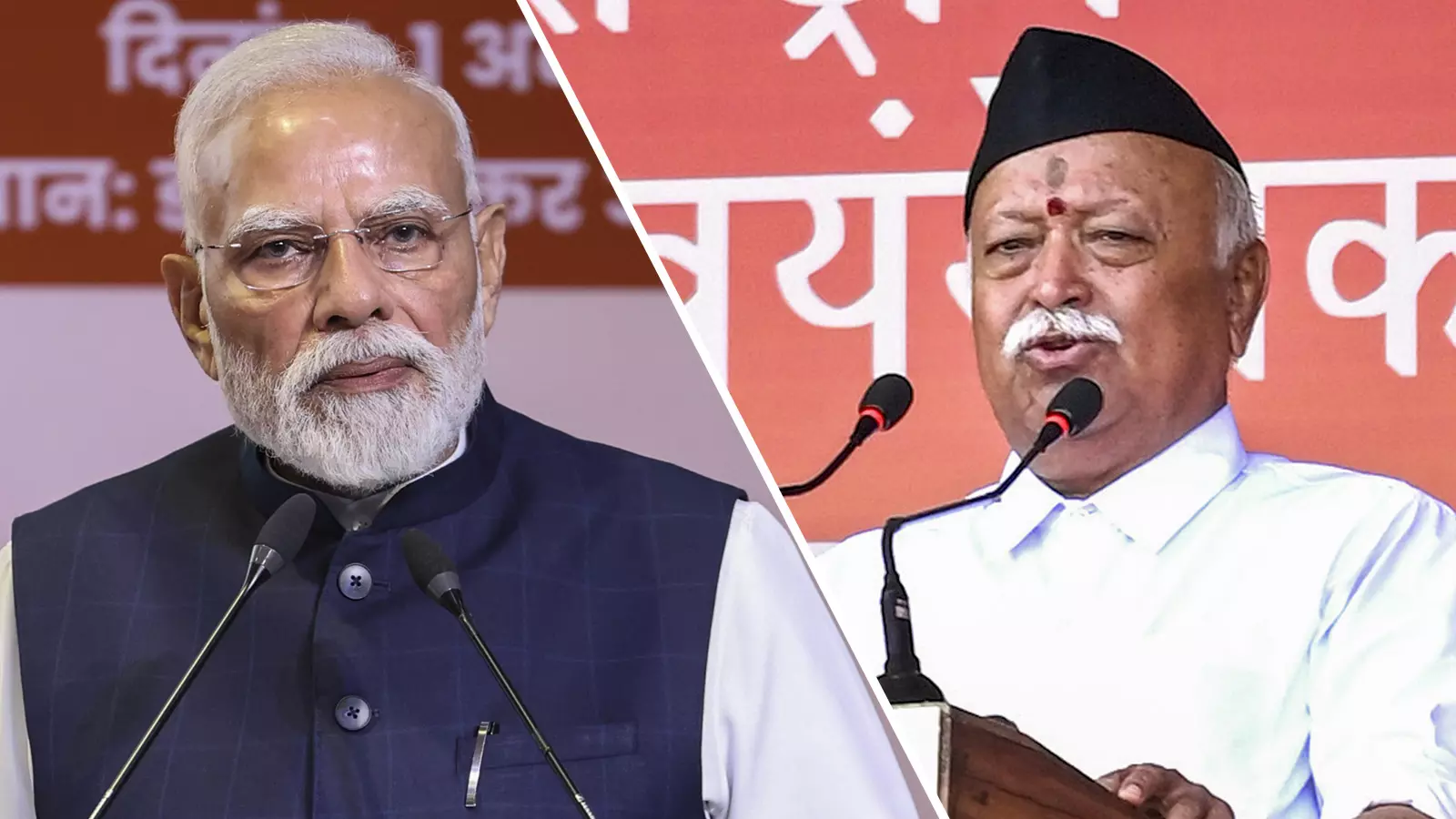
On October 20, 2026, the twin operational hubs of Hindutva – the Rashtriya Swayamsevak Sangh (RSS) headquarters at Reshimbagh in Nagpur and the political epicentre in New Delhi – delivered their annual Vijaya Dashami addresses almost in tandem.
Prime Minister Narendra Modi got up to speak past dusk after symbolically firing an arrow at the effigy of the demon king Ravana in an East Delhi park. In contrast, Mohan Bhagwat, the RSS chief, delivered his sermon in the morning after the ritualistic shastra puja (offerings to firearms). Understandably, his words led news bulletins through the day. The time gap between the two events meant that Modi’s speech was not scrutinised in the same manner as Bhagwat’s.
Reading the Modi-Bhagwat subtext
Twelve years and several months ago, when he assumed the PM’s office, no speech by Modi was missed, including by this writer. With the passage of time, as themes became repetitive and the sheer volume of his speeches increased, some of them, including significant ones, were left unexamined. This was the case with the Dussehra speech and this article is an effort at rectifying the anomaly.
Also read | Bhagwat’s Dasara speech: A truce with Modi, but not a surrender
At the outset however, it must be noted that Vijaya Dashami or the festival of Dasara has long served as the ideological bulletin board for the Sangh Parivar – whether the ideological fountainhead and the political powerhouse are in conjunction or not.
Since 2014, the speeches of the two leaders reflected the intra-organisational ties. There was keen interest over whether the power duo conveyed a convergence of viewpoints or divergence on key matters, political as well as organisational.
This time additionally, the addresses were delivered at a critical moment in the Sangh Parivar’s history: the festival, which celebrates the victory of the good over evil, coincided with the culmination of the RSS’s centenary year and was observed amid a climate of heightened domestic political friction between the supporters of the government and its opponents. The contents of the two speeches were particularly anticipated due to multi-layered barbs hurled from Nagpur and structural barricades raised in response in Delhi over the past couple of years, especially since early 2024.
Opposition framed as a threat
Most crucially for the RSS fold is the fact that this important milestone also coincided with Modi completing 25 years in public office barely a fortnight ago. Paradoxically, however, on the flip side, the twin signposts were also accompanied by the moment when Modi had plummeted politically to his weakest, despite having recently led the BJP to a stunning victory in West Bengal, besides exercising absolute control over the state’s autonomous institutions and state wings.
For most uninitiated observers, the Bhagwat-Modi speeches offered a seamless exhibition of civilisational pride, invocations of Ram Rajya, calls for national self-reliance and importantly provided a framework to meet the political challenge from a diverse set of adversaries, cutting across ideologies and demographic groups.
Bhagwat enacted the part of the ideological and societal patriarch whereas, Modi, despite possibly wanting to be simultaneously seen in Bhagwat’s role, was left donning the garb of the chief political executive.
But a more penetrating perusal reveals an intricate division of labour, tactical alignments, and subtle rhetorical divergences between the ideological parent and its executive offspring.
Like always, because his position demands, Bhagwat enacted the part of the ideological and societal patriarch whereas, Modi, despite possibly wanting to be simultaneously seen in Bhagwat’s role, was left donning the garb of the chief political executive. The RSS chief could, as a result, be philosophical, cautious and structural, while Modi had little choice but to be combative and urgent.
However, both were united in their viewpoint of India being crowded at the moment by Fifth Columnists and jeopardising internal stability. Both leaders systematically conflated domestic democratic opposition and civil society agitations with existential threats to the nation. Just as the Sangh Parivar ceaselessly projects the nation as a single monolith and not as one which sits easy on its diversity, the adversaries too were projected by the two as a seamless file united with and in their deviousness.
Dissent through a nationalist lens
Much to the relief of Modi and his aides, Bhagwat issued a stern warning against alleged foreign-inspired ‘regime change’ tactics. He elaborated that “aasuri” (demonic/evil) global forces with links to forces behind recent and ongoing protests and political upheavals, previously in South Asia and now across Europe, were assisting elements and groups within India. These groups, the RSS leader said, had “low intelligence” and “a thirst for power” but were out to exploit local grievances.
Significantly, there was one crucial issue on which the two disagreed – Bhagwat accepted that dissent is in one way a regular feature, if not the essence, of democracy. Modi, however, has consistently depicted any form of dissent as nothing but treason.
This divergence between the two leaders, over legitimate existence of dissent is however conceptual because Bhagwat immediately reined in protestors. He called for caution, and not to permit the agitation to spiral into chaos or lawlessness.
Furthermore, Bhagwat put the onus for reforms on the doorsteps of dissenting forces, but did not spell out how this could be done with policy decisions remaining in the hands of political powers.
Also read | Protests are inevitable, but regime change is no solution: Mohan Bhagwat
Modi has rarely been nuanced in public utterances. Unity is necessary (among Bhakt Brigades) in the face of “enemies of Maa Bharati.” He termed those protesting and categorised by the two as internal adversaries, into three personifications: Forces targeting national honour and dignity; those who divide society; and the ones harbouring hatred towards “our culture”.
Protest recast as anti-national
Although no names were taken, the ones who were singled out were seamlessly identifiable – any form of political dissent and calls for rights-based demonstrations, were projected as manifestations of “anti-cultural hostiles” or “tools for regime change”, the new “proof” against adversaries to underscore that India too had rioters and other seditionists in action.
Both leaders converged in not framing the current set of public grievances, articulated through protests, as signs of administrative failure. Instead they were highlighted as national security vulnerabilities and articulating these was nothing but an anti-national act.
Two days later, speaking at the NDTV World Summit, the Prime Minister spoke as if in continuation of his East Delhi address. The Opposition, he claimed, through ongoing protests, “were bent on tarnishing India’s reputation. They travel abroad to defame India and plead for foreign intervention. One wonders how long Congress will continue to wager the nation’s interests just to launch its failed (sic) product. In an entire year, Sriharikota does not attempt as many launches as Congress makes failed attempts to launch its leader.”
Both leaders converged in not framing the current set of public grievances, articulated through protests, as signs of administrative failure. Instead they were highlighted as national security vulnerabilities and articulating these was nothing but an anti-national act.
In political discourse, it is universally accepted that politicians target those who pose an immediate electoral or institutional risk. Clearly, the fact that the BJP and Modi no longer use the slur ‘Pappu’ against Rahul Gandhi is also telling. A sense of worry was palpable in the Bhagwat-Modi speeches, one couched in philosophy, the other in the language of realpolitik.
To counter the Opposition campaign that the government has not succeeded in delivering on many of its promises, Modi, strategically did not present Ram Rajya as an abstract spiritual concept, despite recalling his 2024 slogan at the Ayodhya temple’s inauguration where he questionably spoke of administrative objectives framed within a religious template: From “Ram to Nation” and “From Divinity to National Duty”.
From nation building to executive dominance
Instead, the PM described an idyllic nation where people can “stand with truth and humanity”, and where welfare is delivered without discrimination, opportunities are equal, and the marginalised are served (Nagrik Devo Bhava). Very significantly, Modi does not speak about deliveries on the front of civic and human rights which remained enshrined in the Constitution, not effectively.
Over the past twelve years, the arc of Modi’s leadership has transitioned from broad-based nation-building and cross-party symbolism into a platform for self-referential executive dominance.
After all, he started with a focus on civic duties and shifted to forging bipartisan unity alongside Opposition leaders in his first speech in 2014 on this festive occasion. Undeniably, what began as a call for collective civic action has increasingly become an annual report card on executive prowess and, of course, a means of running down all those who disagree with him.
Also read | Bhagwat's global tour is all about image management, not ideological change
As a reminder, at the notable October 3, 2014 Vijaya Dashami event in New Delhi, a day after the launch of the Swachh Bharat Mission, Modi shared the stage with then President Pranab Mukherjee and Vice-President Mohammad Hamid Ansari, alongside then Congress chief Sonia Gandhi and former Prime Minister Manmohan Singh.
Together, they performed the ceremonial aarti, and released white pigeons as a symbol of peace, unity, hope and reconciliation. That rare display of cross-party camaraderie has given way to a platform for one leader.
Despite the strings of digs or taunts over the past two years, on this most crucial occasion, Bhagwat chose to showcase a parallel alignment between Nagpur and New Delhi so that the emanating message was that of a calculated tactical truce.
(The Federal seeks to present views and opinions from all sides of the spectrum. The information, ideas or opinions in the articles are of the author and do not necessarily reflect the views of The Federal.)