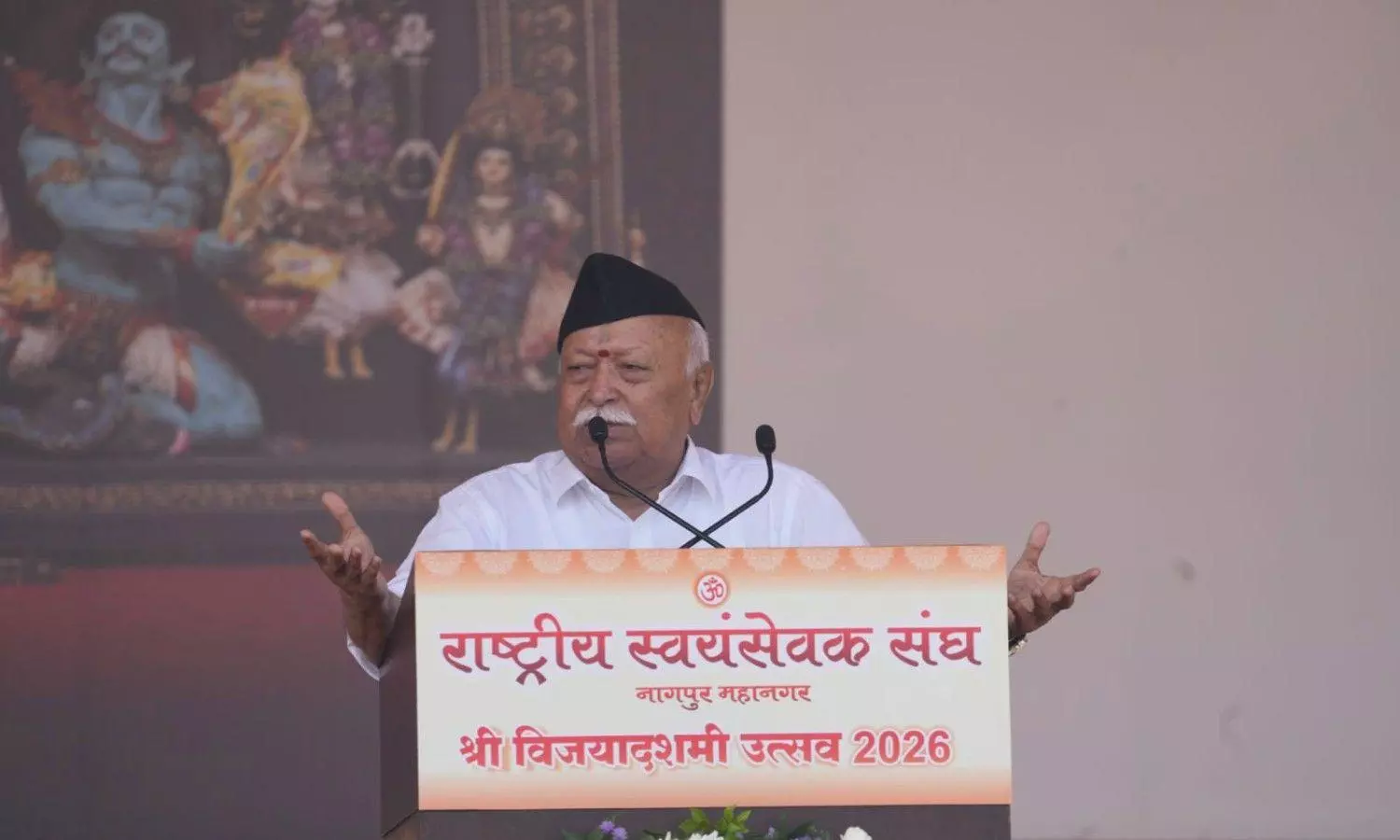
RSS Sarsanghchalak Mohan Bhagwat addresses the 'RSS Vijayadashami Utsav' in Nagpur, Maharashtra on Tuesday (October 20). Photo: PTI
The RSS chief’s Vijaya Dashami address endorsed the Modi govt’s policies while signalling Nagpur’s pragmatic retreat from confrontation, even as the Sangh seeks to retain its ideological authority
Every autumn, for 100 years since 1926, Rashtriya Swayamsevak Sangh’s (RSS) functionaries have gathered at a chosen place in Nagpur, and over the past six decades at the Reshimbagh ground, part of the memorial for the founder, KB Hedgewar, for the annual Vijaya Dashami address by the Sarsanghchalak.
A normal event, largely overlooked by the media initially for decades, India’s political establishment, media, political commentators, and even civil society have held their breath since 2014 for what the position’s occupant since 2009, the mercurial Mohan Bhagwat, would say.
This year was particularly important, given the structural tensions, strategic compromises, and deep power dynamics that have played out between Nagpur (the ideological fountainhead) and New Delhi (the seat of political power) over the past couple of years.
To the politically uninitiated, the RSS chief’s speech sounds like a pious discourse on cultural nationalism, civic duty, and civilisational glory. But, to those who have spent decades decoding the carefully calibrated vocabulary and real intentions of the Sangh Parivar and its brass, the annual speech is never merely a moral sermon. Instead, it has evolved into an intricate exercise in ideological posturing, organisational balancing, and strategic political signalling.
Political duality
Bhagwat’s latest address is a classic instance of political duality. Seemingly, the speech serves as a firm endorsement of the Narendra Modi-led government’s foreign policy, economic trajectory, and national security posture. Yet beneath this guise of showcased unity, lies a complex, evolving narrative, one that reveals the discordance between the two power centres within the Sangh Parivar.
Also Read:Protests are inevitable, but regime change is no solution: Mohan Bhagwat
Bhagwat’s speech underscores his realisation that the moral leadership of the RSS, unquestioned prior to 2014, even during the years when Atal Bihari Vajpayee was Prime Minister and Lal Krishna Advani was the undisputed charioteer of the Hindutva bandwagon, has yielded its position to Narendra Modi who has insisted, secured, and enforced functional autonomy, not just as Prime Minister, but also the Bharatiya Janata Party’s (the seat of political power) effective chief without holding any office within it.
(Importantly, after the 2024 parliamentary election, he was not formally elected as the leader of the BJP’s parliamentary party and instead was elected head of the National Democratic Alliance in Parliament).
Praises India’s ‘global stature’
A primary focal point of Bhagwat’s speech was his explicit acceptance of the BJP’s claims of the Modi government’s success in advancing India’s global stature and its push for self-reliance. Specifically, he referred to a storm which has “swept in from the West, driven by a demonic resolve to destroy and devastate all that is decent, auspicious, and rooted in cultural and human values” across the world, including India.
Yet, he asserted, India had “carved out a place for itself in the world through its own strength and sound policies” and that the nation’s growth is evident in every sector, as it is “driven by strong policies, leadership (sic), national pride, and an awakening of its awareness of its responsibilities towards the world”.
Also Read: Bhagwat's global tour is all about image management, not ideological change
Bhagwat specifically lavished praise on the government for projecting India as a global peacemaker, or Vishwaguru, offering moral leadership by staying grounded in Sanatan values, rather than wanting to turn hegemonic, even within the neighbourhood where there was ample reason for acting in that manner.
Double-speak on protests
The RSS chief also provided clear approval to the regime for warding off external subversion and alleged foreign plots aimed at engineering "regime change" or social instability. In double-speak, Bhagwat acknowledged that debate, dissent, and raising questions are intrinsic components of a democracy.
Yet, by his eventual framing of the protests and heavy cautioning against letting dissent descend into chaos or lawlessness, and that opposition should be framed within a template of reforms, the Sarsanghchalak seamlessly aligned his arguments with the current BJP/government contentions: that the current instances of political opposition, domestic dissent, civil society agitations, and rights-based movements are manifestations of an external, Western-inspired conspiracy to weaken India.
Also Read: 'World needs India’s knowledge’: Mohan Bhagwat says Dharma and Rashtra are linked
Bhagwat completely disregarded the contentions of protestors that the essence of political opposition in a democracy is either to force the government to change decisions or alter policy, and in the face of its refusal to do so, campaign to strengthen itself for the next round of national (or state) elections and electorally defeat the ruling party and form a government, either on its own or in partnership with like-minded parties.
Sangh Parivar internal dynamics
However, given such sweeping support for the power centre, a question arises – what does this overt support mean for the internal dynamics of the Sangh Parivar?
We can recall – leaving out the history of ties between the RSS and the Bharatiya Jana Sangh from 1951 to 1980 when the BJP was established – ‘Nagpur’ acting, as it is informally named by most of the media, like Big Brother. In this role, it maintained a transactional, often contentious relationship with its political arm, never helping its position at the expense of other Sangh Parivar affiliates.
Also Read: 75-year retirement to caste census: Decoding Mohan Bhagwat’s speech
In fact, during the Vajpayee era, the RSS leadership – led by Rajendra Singh first and later, KS Sudarshan, acted as an unsparing internal opposition. It not only routinely pulled up the government for diluting Hindutva principles or bowing to foreign capital, but it even played a decisive role in the ministers Vajpayee wanted to choose and the portfolios he wished to allocate to them.
Calibrated pragmatism
In the absence of any such role for the RSS leadership now, it can be argued that Bhagwat’s posture reflects a calibrated pragmatism. Despite the disinterest displayed by the RSS leadership during the campaign for the 2024 Lok Sabha elections (because it was “Modi’s guarantee” to secure the party’s victory) and continued personal barbs without naming the target although the identity was evident, Bhagwat cannot push the Sangh coalition towards greater fragility at this stage.
Undeniably, the Nagpur-centred leadership cannot afford to publicly destabilise its own political vehicle, especially when it has in the past twelve years gained materially as well as by securing placements for numerous functionaries of the RSS and its affiliates in innumerable government-controlled institutions, or those over which it has direct influence.
Core agenda
Bhagwat has been aware that, given the indoctrination Modi underwent, he has remained committed towards its core agenda – social engineering, cultural hegemony, and institutional alignment. Towards this, the government’s unflinching pursuit of the SIR, with the aim of expunging the so-alleged “foreigners” or “infiltrators” remains an undeniable proof of the Modi government’s commitment to pursue all objectives of the Sangh Parivar, even beyond those that were framed in the 1990s as the three “contentious” demands – construction of Ram temple, abrogation of Article 370, and introduction of Uniform Civil Code.
Also Read: RSS chief Mohan Bhagwat: Gen Z is highly emotional, easily drawn to 'visibly authentic' causes
Quite clearly, Bhagwat has made his tone towards the leadership more harmonious, signalling a truce born out of necessity. However, though the RSS chief may have offered an olive branch to Modi, he also projected the RSS in its continuing role as the moral guardian of national character and family values. Quite clearly, the Sarsanghchalak conveyed that the government may execute policy, but the ideological compass remains vested in his position, not as individual but custodian of his office. In its choice of former Vice President Jagdeep Dhankar as a guest for the event, Bhagwat also sent the message of a modicum of autonomy.
Glaring absence in the speech
It is undeniable that the most scrutinised aspect of Bhagwat’s recent public utterances – and its glaring absence in his speech – is the question of leadership succession and the unwritten but strategically weaponised rule within the BJP to ease out party veterans, the "75-year retirement rule”.
Over the past two years, as both Modi and Bhagwat neared the age of 75 (both were born six days apart in September 1950), the RSS leader spoke in two voices – one called for a person to declare his time was over and the other stating that there was no such norm and the choice was with the person and the organisation.
With his silence, Bhagwat has decoupled the RSS from the BJP’s internal administrative norms. But more importantly, he has removed the issue of retirement and succession from the discourse within the BJP as well as the RSS.
Reference to Captain Smit Machchhar
Importantly, the reference to the Flydubai pilot, Captain Smit Machchhar, clearly an atypical mention of an individual in a speech of ritual import within the Sangh Parivar, cannot be seen as an isolated anecdote of personal courage, but as a calculated ideological illustration.
Bhagwat’s attribution of the Captain’s composure, bravery, and selflessness directly to his "Hindu temperament" and “consciousness" is an instance of the RSS utilising modern, individual acts of civic or professional heroism to validate ancient ideological, cultural, and religious assertions.
It cannot be denied that Machchhar’s act was comparable to a universal virtue – of acting with bravery while being dutiful. However, by taking a universal virtue and labelling it as uniquely “Hindu”, Bhagwat sought to present a core Sangh ideological abstraction through popular and heroic narratives.
Also Read: Mohan Bhagwat tells Gen Z: Shed prejudices to understand ‘dharm’
There can be little contestation of the view that courage in the cockpit is a product of professional aviation training, personal bravery, and international safety protocols. But Bhagwat framed this through a cultural-religious lens and inappropriately presented this as professional excellence to further his ideological thesis.
Duty and selflessness, at personal risk, cannot be monopolised or said to originate solely from one cultural or religious ethos while implicitly suggesting that other religions or cultural traditions are inimical to such attributes. Such assertions do not behove the position Bhagwat holds, and the occasion too, for its resemblance to a rabid declaration during an electoral rally.
Against regime change efforts
In summation, Bhagwat’s address has to be viewed as an exercise in maintaining a delicate equilibrium. The message to the world is that India’s two most powerful political establishments have common goals and assessments of global challenges.
To the domestic socio-political (also economic) communities, the message is that the RSS remains against any efforts to destabilise the current regime by political agitations. For this, Bhagwat reiterated Modi-speak – that dissent and movements against the PM and his government are inspired, like in the past too, by foreign subversion.
(The Federal seeks to present views and opinions from all sides of the spectrum. The information, ideas or opinions in the articles are of the author and do not necessarily reflect the views of The Federal)