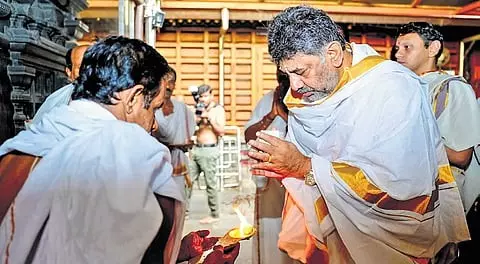
DK Shivakumar has not missed a chance to make an ostentatious spectacle of being a religious entrepreneur. His temple runs, meetings with Nagasadhus make it to front pages in the media. File photo
State Congress's silence on religious issues and public life leaves Karnataka trapped in corrosive discourse; not revoked acts on conversion, cow slaughter etc
The discussion around the passage of the Karnataka Hate Speech and Hate Crime (prevention) Bill, which was passed in the Karnataka Legislature yesterday, proceeded along predictable lines.
The ruling Congress presented the new law, by pleading that existing provisions against hate speech have been violated with impunity, particularly in the volatile coastal Karnataka region, where some perennial hate mongers have routinely been given station bail over and over again. The government now hopes to open the door to a new jurisprudence.
The Opposition, particularly the BJP, trotted out its (richly ironic) defense of ‘freedom of speech’, with MP Shobha Karandlaje even inviting the Governor and President to stop the act from becoming law. Some others saw this as a ‘raid’ on the rights of Kannadigas to defend their beleaguered language. It appears as if the media too has been more or less disapproving of the government’s move, predicting almost certain misuse against critics.
Vague, emotion-based
The Campaign Against Hate Speech, which has done the most systematic documentation and compilation of hate speech and hate crimes in Karnataka, has welcomed the new legislation, though cautiously. While agreeing that this legislation is long overdue, it has pointed out several concerns which needed urgent addressal.
It shows that the law makes no attempt to specify legally the quantum of harm done by speech to those structurally at risk from hate speech: Dalits, women, religious minorities, people of different sexual orientation in particular.
Also read: Karnataka Assembly passes country's maiden anti-hate speech Bill
Importantly, ‘it does not recognise hate crimes of punitive demolitions, social and economic boycotts’. But apart from pointing out possible misuse, and blurred distinctions between hate speech and hate crime, CAHS points out one very important problem with the new bill: the definition of hate speech is ‘vague and emotion-based’, which had been the very reason for the lack of accountability under the IPC and BNS.
The time has come to ask a pertinent political question: what has the Congress done in the last two and half years, despite its decisive majority in the Legislature, (and hopefully on the ground) to shift or alter the poisonous ‘emotion-based’ discourse that currently rules the waves and results in crimes against vulnerable groups?
How has it replaced the rich soil in which ‘hurt sentiments’ have thrived to become one of the biggest challenges to governance, finding ready support and sympathy among enforcers of the law itself – the police and the judiciary? Might the recourse to a new law be a sign that it has actually abdicated its public political responsibilities?
No active intervention
To be fair, the Karnataka Government has indeed initiated a strong emphasis on constitutional values in the schools and colleges, and has placed important checks on the police, at least insofar as attitudes that are openly or avowed majoritarian. But on matters of religion and religious practices, particularly as they affect and shape public life, there has been no creative response from the state or the party.
Certainly, not even a patch on the multiheaded hydra that constitutes the Hindu Right today. Indeed, the Congress government has not even fulfilled the legislative changes promised before the election: the controversial acts and GOs against ‘conversion’, ‘cow slaughter’ and hijab use in educational institutions, passed swiftly by the previous BJP government, remain in place.
Also read: DK Shivakumar defends bill to curb hate speech, hits out at BJP
Silence has been the Congress’ preferred strategy; active intervention and support, such as it is, has come to the rescue of prominent mathas – such as the Murgi Matha and Dharmasthala – and other institutions which have been shaken lately by criminal accusations.
Religious entrepreneur
The public face of the espousal of Hindu religion, particularly in public worship, is that of DK Shivakumar. Not only does his personal temple run, which erupts as frequently as his lunge at the Chief Minister’s seat, take frontstage – and occupy front page – he has added to the alarming proliferation of public forms of worship which ignore ecological responsibility and public peace.
His personal beliefs are a source of continuous media comment, whether he entertains Naga Sadhus, mathadhipathis, religious entrepreneurs – or abandons civic duties to God. He has not missed a chance to make an ostentatious spectacle of being a religious entrepreneur himself.
For instance, during the Dasara festivities in September this year, ignoring all technical and environmental objections, he ostentatiously inaugurated a five-day Cauvery Aarthi inspired by the Ganga Aarthi at Brindavan Gardens. His fan club has gone a step further: the Akhila Karnataka DK Shivakumar Abhimani Balaga called for divine intervention in ensuring his place as CM, with 18 days of rituals in Mysore. The bankruptcy of the imagination is evident everywhere.
For its part, Dalit groups have repeatedly called for declaring the Constitution a ‘pavithra grantha’, a holy book. Other ideas rooted in Karnataka’s rich plural past have been nostalgically summoned at every gathering of litterateurs and cultural activists. But ideas of constitutionalism, as an active reimagining of our social, and indeed religious future, so crucial to our times, must take root differently, and not through being elevated as an alternative ‘holy text’ for worship.
Maybe, the time has come to put religion in its place, as a mighty force that no doubt provides solace and comfort to large sections of people. But disruptions of public order and tranquillity, personal rights to religious belief and practice, and also permanent intrusion into woefully inadequate public spaces (footpaths, roads, and empty spaces) must be rethought.
Can the Congress in Karnataka develop a new charter that focuses on people’s livelihoods and reimagined wellbeing that assures a future to all its citizens to live, love, work, and worship in peace?
Any pushback against the Hindu Right’s tentacular presence calls for a strenuous rethink of the cynical invocation of religion in our public life, which has not only eroded the possibility of new or visionary collective ideals from emerging, but has seriously eroded personal faith and belief.
Also read: How routine, diligent policing has kept communal peace in Mangaluru
Can forms of collective worship be made to follow the rules of public association that are applicable to all? If protest marches and agitations in public spaces have been severely curtailed in the interests of traffic management and order, can there be an equal restraint on religious processions that surge through the towns and cities, and the attendant cacophony of public festival celebration?
As the minister-in-charge of Bengaluru’s development, will Dy CM DKS dare to impose – for example – a size limit to the Ganesha idols, whose ever increasing size and grossly inappropriate material usage (POP) have posed insurmountable challenges to water bodies, municipal facilities and to traffic?
Can the Congress in Karnataka develop a new charter that focuses on people’s livelihoods and reimagined wellbeing that assures a future to all its citizens to live, love, work, and worship in peace? So far, the signs of a robust alternative are few and far between.
As such, legislative changes alone may be a sign of the Congress’ indirect acceptance of the rancorous, corrosive public life to which its citizens are condemned.
(The Federal seeks to present views and opinions from all sides of the spectrum. The information, ideas or opinions in the articles are of the author and do not reflect the views of The Federal.)