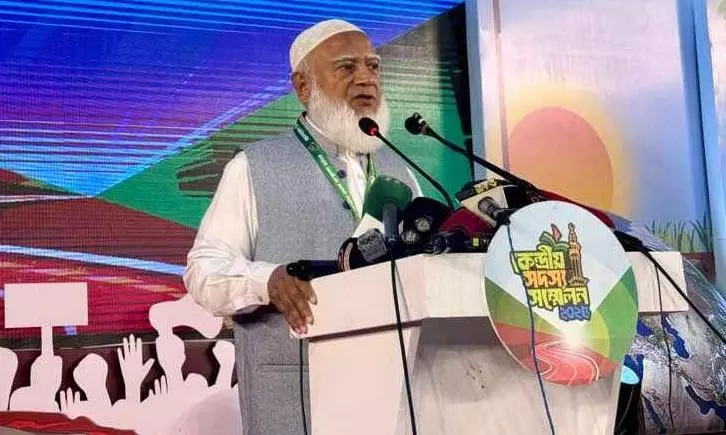
Dr Rahman’s remarks have shaken the Jamaat-NCP alliance, alienated women voters, and revived fears of an Islamist rollback as the BNP eyes electoral gains
A controversial remark on working women by Jamaat-e-Islami chief Dr Shafiqur Rahman has rocked the boat of the Islamist Alliance just when it seemed poised to mount an effective challenge to the frontrunner Bangladesh Nationalist Party (BNP).
With the long-ruling Awami League barred from the February 12 parliamentary polls and its student front sweeping several key university union elections this winter, Jamaat-e-Islami appeared to be at its strongest since Bangladesh’s independence in 1971.
Also read | US seeks ties with Bangladesh Jamaat-e-Islami, but with a tariff warning: Report
Many new-generation voters wanted to give the Jamaat-NCP alliance a chance because they felt let down by the previous Awami League and BNP governments. The NCP is led by student-youth leaders who spearheaded the July-August 2024 agitation that brought down the Hasina government.
Women leaders walk out
But the Islamist alliance received its first shock when a number of powerful young women leaders, including the UK-educated medical practitioner Tasnim Jarra, left the NCP after it stitched together an alliance with the pro-Pakistan Jamaat-e-Islami. These women leaders felt the NCP was compromising the legacy of the July-August agitation, which had promised gender empowerment.
Since the NCP was the brainchild of Muhammad Yunus, the chief adviser of the current interim government, these women leaders and activists became suspicious when the Nobel laureate backed out of implementing the recommendations of the Women’s Commission headed by Shirin Huq, who leads the powerful women’s activist group Naripokkho.
Though Yunus had often stressed the need for reforms, he backed off when Islamist radicals held a massive rally opposing the recommendations of the Women’s Commission, especially the one calling for gender equality in inheritance, property, marriage, and divorce. At the rally, an effigy of a saree-clad woman was disrobed and beaten with slippers, an act that clearly reflected Islamist angst over women’s empowerment.
Jamaat doubles down
Jamaat-e-Islami chief Dr Shafiqur Rahman was clearly not keen to let the issue die. He called for fewer working hours and days for women so that they could focus on the family. Then, in a recent interview with Al Jazeera, Rahman escalated his remarks sharply.
“On the question of women, Jamaat’s position is neither confused nor apologetic, it is principled. We do not think women should come into leadership. In Jamaat, it is impossible. Allah did not permit this,” he reportedly said.
Unsurprisingly, Jamaat did not field a single woman candidate in the 300-member parliament, where it is contesting 179 seats.
Also read | How Jamaat-e-Islami is positioning itself for power in Bangladesh
But Jamaat did not stop there. “We believe that when women are pushed out of the home in the name of modernity, they are exposed to exploitation, moral decay, and insecurity. It is nothing but another form of prostitution. Commodification of women is not a sign of progress, it is a symptom of moral collapse.”
Describing working women as “prostitutes” has sparked huge outrage in Bangladesh, where gender empowerment has progressed steadily in phases and received a major boost during the 15 years of Awami League rule. The Jamaat leader’s opposition to women in leadership runs counter to Bangladesh’s recent history, where two powerful women, the late Khaleda Zia and Sheikh Hasina, have alternated as the prime minister since the end of military dictatorship in 1991.
Voices of resistance
The country has also produced influential women parliamentarians such as Tarana Halim (Awami League) and Rumin Farhana (BNP), lawyers like Barrister Tania Amir, human rights activists such as Sultana Kamal and Shireen Huq, not to mention a cultural sphere dominated by actress-activist Rokeya Prachy.
“The Jamaat is trying to undo gender empowerment in one stroke and destroy the legacy of secular democratic Bengali culture that gave birth to Bangladesh. If it comes to power, it will not only push women back into the domestic space but also undo the 1972 secular democratic Constitution. It will destroy everything we Bengalis hold dear,” said Barrister Tania Amir, who piloted the deregistration of Jamaat-e-Islami as a political party on the grounds that its agenda runs counter to the spirit of Bangladesh’s polity.
Others denounced Western powers, especially the United States, for backing Jamaat-e-Islami by projecting it as a moderate Muslim party. “Now that the Jamaat chief has unambiguously laid bare his position on women, it is time for hypocrites in the West to come clean and debunk Jamaat-e-Islami,” said textile worker Sabina Akhter.
Akhter pointed out that 70 per cent of Bangladesh’s textile workforce are women. “Our garment industry is not just Bangladesh’s main foreign exchange earner but has also played a major role in empowering poor women,” she said. “These clerics live off donations from the faithful and don’t have to work, but women like us must work to sustain poor households. Does that make us prostitutes?” she fumed, calling on all self-respecting women to vote against Jamaat candidates and oppose the July Charter in the referendum.
Islamist takeover fears
“The Jamaat-e-Islami and their chief patron Muhammad Yunus are planning to turn Bangladesh into a Bengali Pakistan. Women and minorities are the most vulnerable,” said actress-activist Rokeya Prachy. “All democratic countries must wake up to this threat. They oppose the Iranian theocracy but support those who plan to turn Bangladesh into a theocracy.”
Also read | ‘Murderous fascist Yunus’: Sheikh Hasina attacks Bangladesh’s interim govt
Since the ouster of Sheikh Hasina’s government, violence against women has risen alarmingly, especially rape cases. Women have been stopped from playing football and beaten for not wearing the hijab or burqa. Now, with the Jamaat chief openly opposing women in leadership and employment, concerns are rising, especially among the poor who supplement household income through women’s work, about an Islamist takeover.
That, many feel, may directly benefit the BNP, whose new chairperson Tarique Rahman has been aggressively projecting his daughter, Barrister Zaima Rahman, as the future leader of the party. Like her grandmother Khaleda Zia, who never compromised on her lipstick or chiffon sarees while holding meetings with Islamist leaders, Zaima could help the BNP swing women voters its way, especially educated young women who resent male domination.
(The Federal seeks to present views and opinions from all sides of the spectrum. The information, ideas or opinions in the articles are of the author and do not necessarily reflect the views of The Federal.)