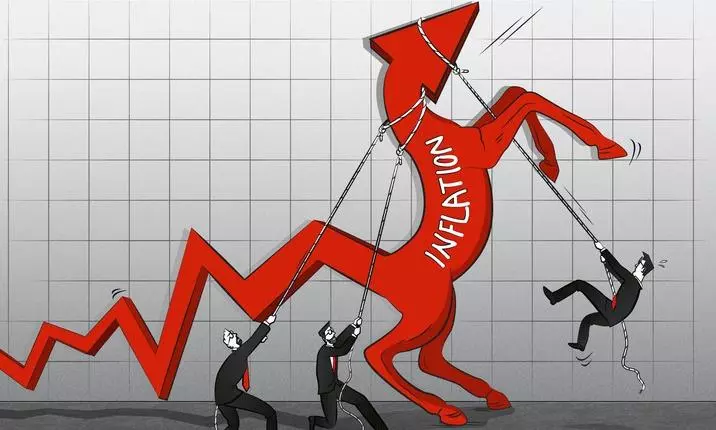
As food prices race ahead, borrowing booms and foreign flows remain fragile, the size of the repo rate hike matters less than the message the MPC sends
It's a no-brainer that the Reserve Bank of India's main job is keeping prices stable. It's equally important for it to look at liquidity— specifically, how the banks are “parking” extra money back with the RBI.
The RBI has been steadily absorbing this liquidity using Standing Deposit Facility (SDF) and frequent Variable Rate Reverse Repo (VRRR) auctions to keep short-term call money interest rates aligned with its main policy rate. With the Consumer Price Index (CPI) crossing the critical limit, the Monetary Policy Committee (MPC) will clearly take a stricter, more hawkish stance at its December 2026 meeting.
The big question is whether the RBI has fallen behind the curve.
Glossary
Policy rate (repo rate): The rate at which the RBI lends short-term money to banks. It is the central bank's main tool for steering interest rates and inflation across the economy.
Basis point (bps): One-hundredth of a percentage point. For eg, a 25 bps hike raises a rate by 0.25 percentage points, from 5.50% to 5.75%.
Standing Deposit Facility (SDF): A window that lets banks park surplus funds with the RBI overnight and earn interest, without having to provide government securities as collateral.
Marginal Standing Facility (MSF): An emergency borrowing window where banks can get overnight funds from the RBI, at a rate above the repo rate, when they run short of cash.
Call money rates: The interest rates at which banks lend to and borrow from each other for very short periods, usually overnight, to manage daily cash needs.
Variable Rate Reverse Repo (VRRR): An auction in which the RBI borrows money from banks for a set number of days, at a rate decided by bidding, to soak up excess cash from the system.
Real policy rate: The repo rate minus inflation. It shows the true cost of borrowing once rising prices are taken into account. A negative real rate means money is effectively cheap.
Inflation breach puts RBI under pressure
The CPI rose to 6.09 per cent in October, up from 5.54 per cent in September 2026. This is the first time inflation has breached the RBI’s upper tolerance band under the new data series.
More concerning is food inflation. It increased to 8.94 per cent due to El Niño and deficient monsoons. Core inflation, excluding food and fuel, reached 4.5 per cent. These numbers will heavily influence the December MPC meeting.
Also Read: More expenses, less savings — what October retail inflation crossing RBI threshold means for consumers
The RBI is already responding to these price shocks. At its October meeting, it raised the policy repo rate by 25 basis points to 5.50 per cent— the first such increase in four years. It shifted its policy stance to “calibrated tightening.”
The monetary policy corridor remains balanced, with the SDF rate at 5.25 per cent and the Marginal Standing Facility (MSF) rate at 5.75 per cent.
The RBI’s message was clear: rate cuts are off the table for now. Future moves will be either rate hikes or a pause, depending on how inflation and growth evolve. With October inflation at 6.09 per cent and the repo rate at 5.50 per cent, the "real" policy rate is negative. Even against the RBI's own forecast of inflation averaging close to 5.8 per cent over the next three quarters, it stays in negative territory. Closing that gap is the main issue for the December meeting.
Credit growth and capital flows add to risks
Financial trends in India show why the RBI must stay alert. Bank credit is growing fast at roughly 19.5 per cent year-on-year, while bank deposits are growing slower at around 16.9 per cent. High credit growth alongside rising inflation risks turning temporary supply shortages into long-term demand-driven price hikes.
Also Read: Public investment powers India’s GDP growth; structural reform must sustain it
Meanwhile, India's external sector has seen both stress and recent relief:
• Earlier in the year: Foreign portfolio investors (FPIs) pulled nearly $30 billion out of Indian stocks. The rupee fell toward 97 against the US dollar, forcing the RBI to sell foreign exchange reserves to slow the drop.
• Recent weeks: Foreign equity inflows bounced back in November, bringing in $9 billion to $12 billion. The rupee recovered to the mid-93 range, and forex reserves stabilised near $720 billion, helped by softer oil prices and global investors moving money out of crowded tech stocks.
However, this recovery is fragile. Global market moods can shift quickly, and the government still hasn't made a clear decision on long-term capital gains taxes.
Global rates could reverse capital inflows
Global monetary conditions continue to influence India’s external accounts. The US Federal Reserve’s policy rate currently stands in the 3.75-4.00 per cent range. Recent communications from US Fed officials have taken a more hawkish tone, reflecting concerns that inflation may prove persistent and that further policy tightening could still be required.
Watch | Food inflation: Modi government's biggest economic challenge in 2027?
US Treasury yields have remained elevated, with the 10-year yield hovering near or above 5 per cent at various points. India’s own 10-year government bond yield has traded around 7.25 per cent. The narrowing of the interest differential reduces the buffer that emerging markets typically rely on to attract and retain portfolio capital.
In this environment, any renewed strengthening of the dollar or rise in global yields could quickly reverse the recent improvement in capital flows and put renewed pressure on the rupee and reserves.
Fiscal policy has a role in containing inflation
These developments highlight the importance of policy coordination. Monetary policy cannot address supply-driven inflation in isolation, particularly when food and energy shocks originate outside the domestic economy.
Fiscal policy has a critical complementary role. The priority should be to avoid measures that add to aggregate demand at a time when the central bank is seeking to keep financial conditions restrictive.
Also Read: One Nation, One Predictable Tax System: What 57th GST Council got right
Untargeted subsidies or large consumption-oriented spending would complicate the inflation fight and could force higher market borrowing just as interest rates are rising. Instead, fiscal efforts should focus on the supply side, by improving the efficiency of food distribution systems, timely release of buffer stocks during price spikes, and prioritising capital expenditure that expands productive capacity.
A clear plan to manage the fiscal deficit will also keep bond yields steady and reassure investors.
December rate decision and the road ahead
Looking ahead to the December meeting, most expect a further 25 basis-point increase in the repo rate to 5.75 per cent. A bigger hike or tougher warning is possible if November inflation stays high.
Ultimately, the exact size of the hike matters less than the message. The RBI must prove it won't let inflation stay well above its 4 per cent target for long, because negative real interest rates are dangerous. With credit booming, core inflation rising, and households expecting higher prices, looking too slow to act is far riskier than raising rates steadily.
India’s economy has shown strong resilience lately—growth is solid, banks are well-funded, and external buffers have held up. Still, this inflation spike shows that these strengths need active protection.
A decisive RBI move in December, backed by clear government fiscal policy, will ensure this inflation breach stays temporary. While it is too early to tell if interest rates will peak at 6.25 or 6.50 per cent, the path forward is clear. Until now, I have believed that inflation is "transitory" (temporary)—but because inflation is constantly changing, we must stay on constant guard.
(The Federal seeks to present views and opinions from all sides of the spectrum. The information, ideas, or opinions in the articles are of the author and do not necessarily reflect the views of The Federal.)