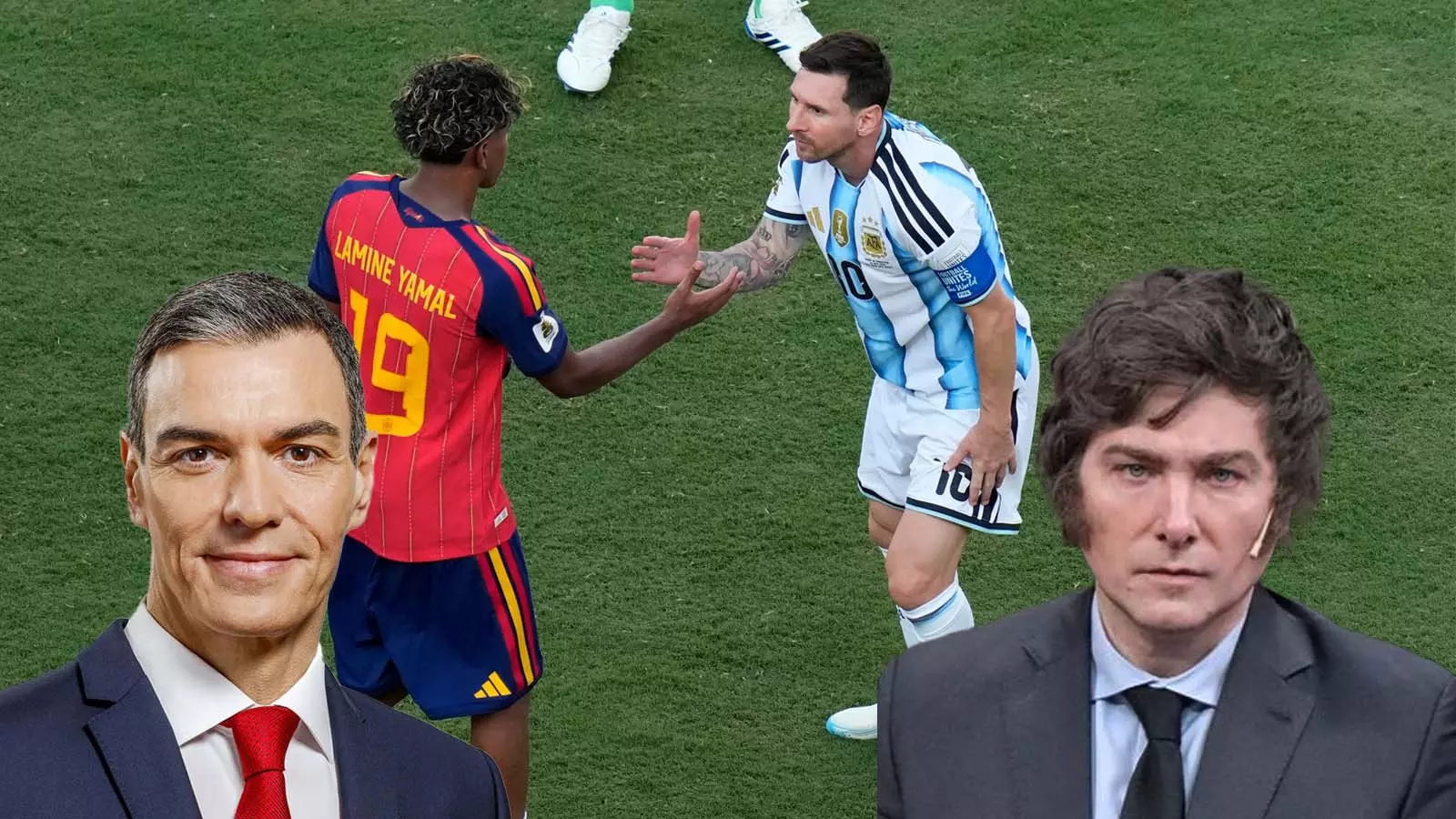
The Spain-Argentina World Cup final of July 19 assumed a different dimension due to the contrasting political stances of the top leaders of the two countries, President Pedro Sanchez of Spain (left) and President Javier Milei of Argentina (right). Photos: AP/PTI, Wikimedia Commons, X
The Spanish PM has opposed Israel’s genocidal assault on Gaza and the US-Israel attack on Iran, which saw La Roja gaining huge backing against Argentina
Beyond the football field, Spain’s victory over Argentina in the 2026 FIFA World Cup final reverberated among its newfound fans in the occupied Palestinian territories and across the world, as the game got entangled with the pro-South, anti-Donald Trump political stand of its Prime Minister Pedro Sanchez.
A Palestinian resident, among the hundreds thronging in front of television sets, was quoted as saying that “Spain was playing for humanity”.
Spain president critical of Israel, attacks on Iran
Following the genocidal Israeli strikes on Gaza after the Hamas attack on Israel on October 7, 2023, among the first voices criticising the Benjamin Netanyahu dispensation was the Spanish prime minister. This, while most other European nations as well as the rest of the world were largely mute spectators to a two-year assault that killed around 72,000 Palestinians. Sporadic attacks still continue, despite a ceasefire.
Also read: Spain win second FIFA World Cup: How La Roja built a gold-digging football system
Sanchez, incidentally, was in New York witnessing his country’s final with Argentina, whose president, Javier Milei, was noticeably absent. The Spanish leader, a socialist and among the few leftist politicians in power in the world, has angered US President Trump and his factotum, Israeli Prime Minister Netanyahu, by opposing Israel’s assault on Gaza and the US-Israel attacks on Iran.
The presidents of Spain and Argentina share a personal animosity borne out of their differing political ideologies — another element that took the Spain-Argentina final to a different level. Two years since Milei came to power, the bitter feud between the two has been played out publicly.
Moving beyond rhetoric, Spain withdrew permission for ships transporting military weapons to Israel from berthing in Spanish ports. It was also among the first European nations to recognise Palestine's statehood.
More recently, Sanchez was quick off the feet to criticise the US-Israeli attacks on Iran that started at the end of February. His government proceeded to expressly prohibit the US from using its military bases in Spain for the military strikes on Iran. That Spain and the US are fellow NATO allies has made no difference to Sanchez who has termed Trump’s attack on Iran as “illegal and against international law”.
At a time when conservative, right-wing governments are coming to power or are already in power across the world, including in India, Sanchez has turned into a near-cult figure for the opposition liberal left governments and their supporters.
The FIFA World Cup final sat squarely in the middle of a narrative that goes beyond the 90 minutes of football on the field, into a much larger polarised political ecosystem, between the left and right.
Argentina president is pro-Israel, Trump
Argentina, on the other hand, though a much-loved team largely due to the iconic Lionel Messi, finds itself on the defensive due to its pro-Israel, pro-Trump President Milei.
As head of a country with South America’s largest Jewish population, the Argentinian president has expressed his wish to even convert to Judaism. Most notably, he has supported Israel’s genocidal assault on Gaza and Trump’s war with Iran.
Also read: Israel, the only factor that can ruin Iran-US deal
Messi, the icon, has a personal track record of trying to keep off politics or making political statements. But, there’s a tug of war among his fans over whether he supports Israel or not.
For instance, the Israeli media claims he is a Jewish supporter. A photograph of him praying at the sacred Western Wall in 2013 in occupied East Jerusalem has been widely circulated to show his proximity to the Jewish community. This was when his team Barcelona was visiting Israel.
Tonight, across Palestine, millions of hearts seem to beat as one — for 11 people wearing a red jersey. Some call it the colour of resistance. Others see the colour of resilience. Perhaps, tonight, it is simply the colour of hope.
On the other hand, his anti-Zionist supporters point out his response to a presidential invite following Argentina’s victory in the previous edition of the World Cup in Qatar. Messi, at the time, in an attempt to distance himself from Argentina’s polarising politics, directed his team not to accept an invitation to the presidential palace (then under President Alberto Fernandez).
Spain, Argentina presidents don't get along
Interestingly, Sanchez and Milei share a personal animosity borne out of their differing political ideologies — another element that took the Spain-Argentina final to a different level. Two years since Milei came to power, the bitter feud between the two has been played out publicly.
While Sanchez dismissively refers to Milei as a “right-wing firebrand”, the latter has accused Sanchez’s family of indulging in corruption.
Gaza's support for Spain in WC final
For Gazans, under attack from Israel, Palestinian residents in the West Bank and groups supporting them around the world, the Spain-Argentina contest willy-nilly turned into a “war by other means” in the process increasing the stakes to a different, bigger level altogether.
A resident in the West Bank was quoted as saying, “Tonight, across Palestine, millions of hearts seem to beat as one — for 11 people wearing a red jersey. Some call it the colour of resistance. Others see the colour of resilience. Perhaps, tonight, it is simply the colour of hope”.
“For 90 minutes, those 11 players carry far more than a nation’s dreams. They carry the silent prayers of people longing to believe that humanity, too can still win.”
Also read: Why did Argentina hold Falklands banner? Messi and Co could face FIFA action
Eventually, when Spain scored the solitary goal of the final, reflecting on the scenes of joy erupting from among the Palestinians, a post from the occupied territories said, “For one beautiful fleeing moment, football erased every distance between us. We were no longer strangers, only human beings celebrating hope together”.
The final, watched by millions, arguably lent itself briefly to a romanticised view of the world. But, irony of ironies, the brawl that followed among a few players minutes after Spain’s win was probably much closer to reality, as we know it.
(The Federal seeks to present views and opinions from all sides of the spectrum. The information, ideas or opinions in the articles are those of the author and do not necessarily reflect the views of The Federal.)