In the aftermath of the US-Israeli attack on Iran, global oil and gas supplies stand curtailed. Their prices are going up, and the US reluctance to risk lives by sending in ground troops leaves the Iranian regime intact, leaving it to decide when to end the war.
It is inevitable that India would face sharp increases in the cost of energy, as the country depends heavily on imported energy: well over 80 per cent for crude, and about half for natural gas and cooking gas.
In the short run, there is little to do but to bear the higher hydrocarbon prices as a nation, shielding the less well-off from the full impact of the increase in prices. But, it is vital to draw the right lessons and prepare the nation against oil and gas shocks by correcting the historical, mistaken choices made with regard to our fuel choices.
Cooking gas, LPG expensive
Cooking gas, known in the trade as liquid petroleum gas (LPG), is a mixture, primarily, of propane and butane. Butane has four carbon molecules, and propane, three. Methane, the primary component of natural gas, is one atom of carbon linked to four atoms of hydrogen, and ethane has two atoms of carbon and six of hydrogen.
Gas, when it emerges from the ground, in association with oil or on its own, is a mixture of all these four gases, and described as ‘wet’. The heavier gases are separated for higher value use, and lean methane alone is sold as natural gas. LPG can be produced, in addition, while fractionally distilling crude oil to extract petrol and other fuels, or through catalytic conversion of other hydrocarbons.
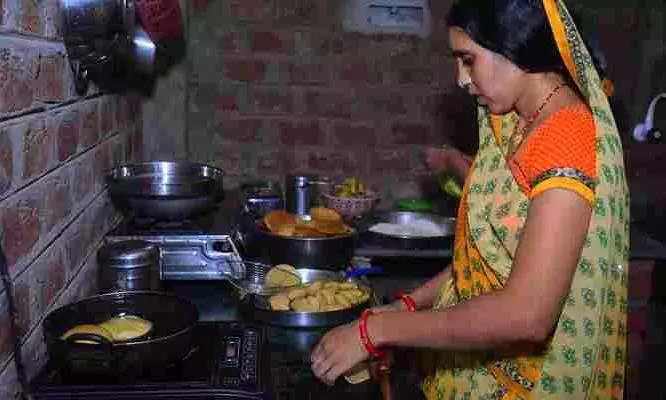
Indians have traditionally used firewood or other biomass for cooking. This produces a lot of smoke, and is injurious to health, particularly of women, who do most of the cooking, and of the very young, who tend to be around their mothers. As incomes and living standards rose, those who could afford to, switched over to cooking with gas. Making gas available for cooking is expensive.
Offer of patronage
LPG is heavier than air, and, if at all it leaks, it would form an incendiary layer over the site of the leak and nearby areas. Therefore, LPG is rarely delivered to homes by citywide pipeline networks, the way natural gas is. Methane is lighter than air, and while leaked methane is a potent climate warming greenhouse gas, pipes carrying methane do not represent a pyromaniac’s delight.
LPG is carried by special, heavy-duty pipelines from import terminals and refineries to bottling plants, from where the gas is filled in bottles/steel cylinders. The cylinders are transported across large distances by trucks that consume considerable amounts of energy to move around.
Cooking with LPG is convenient, but also expensive, offering governments an opportunity to offer patronage by way of subsidy to large sections of LPG users.
Using electricity
The sensible way for Indians to cook is using electricity. Ever since the rural electrification schemes of the UPA and the present NDA governments met with success in wiring up most Indian homes, encouraging people to cook with induction stoves has been the most energy-efficient method of smoke-free cooking.
But that has not happened, for two inter-related reasons. Power supply is still erratic, as regards reliability of availability and voltage. Further, governments have trained Indians to expect power to be free or heavily subsidised, making it difficult to generate and supply power as a sustainable, profitable business. This is a problem to be solved by mustering the needed political will.
Where is the power to come from? It will have to come essentially from coal, either burnt directly or, preferably, converted into gas as fuel for highly efficient combined cycle plants. India has a bountiful supply of coal, storing the world’s fifth or fourth largest reserves of the mineral.
About half the power generation capacity in India is based on non-fossil sources: renewables about 40 per cent, nuclear less than 2 per cent, hydel 9.8 per cent, and thermal 48 per cent. But when it comes to actual generation, thermal plants account for about 75 per cent of the power, renewables contributing 13-14 per cent, nuclear, about 3 per cent and the rest from hydel.
The climate equation
Wouldn’t using electricity generated from burning coal increase India’s contribution to climate change, make India fail to deliver on its Nationally Determined Contribution to climate mitigation and adaptation? This is not obvious.
At the point of cooking, induction stoves are far more energy-efficient, as compared to gas stoves, nearly double. Further, the energy spent on making the cylinders in which LPG is bottled and distributed, and the energy spent on distributing cylinders would be avoided, if cooking switches to electricity.
Certainly, some additional coal would need to be mined, beneficiated and transported. Considering that India would have to switch to electric mobility — whether using hydrogen and fuel cells or battery stored power is another debate — and generate considerably more power to raise India’s per capita electricity consumption somewhere near the global average, the additional coal to be handled for cooking alone would be marginal.
Synthesis gas
Ideally, coal should be gasified underground, the synthesis gas so produced brought up to the surface. This syngas can be burned directly, or converted into natural gas, and piped around the country for generating power, and as feedstock for fertilisers and other chemicals.
Simultaneously, India must undertake significant research in carbon capture technologies, in technology to convert captured carbon into the starting blocks for petrochemicals, and in technology for greater efficiency in converting the heat generated by burning coal into electricity. Simply by adopting existing, proven technologies, India can produce double the electricity it does at present burning the same amount of coal in its suboptimal power plants.
India must encourage mining of coal, minimising social and environmental disruption. Except for some types of virgin forests, which should be left totally untouched, others can be removed, if necessary, with compensatory afforestation carried out systematically.
Tribal populations, if displaced, should be rehabilitated with cultural sensitivity, not left to degrade into drink and prostitution, as has happened in some cases, and the cost of such elaborate rehabilitation fully built into the cost of the coal freed up by such disruption.
Coal untapped
While the present government has removed the legal obstacle to coal mining by private operators — legislated state monopoly in coal mining — it has not succeeded in attracting professional mining companies to undertake merchant mining.
Captive mines were tarred, during the campaign to bring down the UPA government, as sources of massive corruption, ignoring the stark reality that the biggest scam in coal is that it lies underground, untapped, even as Indian power plants are starved of coal and India imports a fifth of its domestic coal requirement.
For want of political courage, India has been persisting with use of LPG as cooking fuel, instead of embracing electricity based on domestically available coal, whose supplies cannot be touched by foreign wars or diktat by global hegemons.
(The Federal seeks to present views and opinions from all sides of the spectrum. The information, ideas or opinions in the articles are of the author and do not necessarily reflect the views of The Federal.)