By ignoring decades of rigorous historical and anthropological research, both political leaders and judicial benches risk trading constitutional rights for majoritarian myths
Of late, many in public life are haemorrhaging over the state of Indian ‘civilisation’. Some of this anxiety is in expected quarters: the Rashtriya Swayamsevak Sangh Chief, Mohan Bhagwat, for instance, feels no obligation to cite decades of research and writing in his interpretation of the Indian past.
Also read: RSS at 100: Hindutva is an ideological camouflage for its Brahminical core
He recently asserted at the Mumbai Karmayogi Awards, that India’s Scheduled Castes and Tribes are the ones who ‘safeguarded’ Bharat’s ‘core identity’ despite the ‘foreign invaders’ who ‘uprooted’ these groups and made them face hardships. So, their degraded social and economic status in India today is not due to any foundational discrimination that continues to be upheld — and has been well documented by archaeologists and historians — but due to the foreigners who imported every evil into this 'punya bhumi' (sacred soil).
He also linked the Vedas, which ''originated in the forests'' of India, to the original Sanatanis, the tribals.
Historical 'corrections'
We have become accustomed to these historical ‘corrections’ which are being undertaken on an industrial scale, particularly by non-historians who already know what they will find before their search for sources. But he went further in that speech: he said that our "Bharat’s civilisational thought was based on oneness, cooperation, duty, and mutual responsibility rather than social contract theories".
He called on the Indian people to magnanimously integrate those whom the ‘foreigners’ had uprooted back into the Hindu fold.
Here, he strikes another blow against the founding document of the Republic, the Indian Constitution, which envisaged another future, different from the hierarchical and unjust society we inherited, through a robust guarantee of equal rights and freedom for all.
The concept of a ‘constant civilisational ethos’ pushes up against constitutional morality, rights and freedoms, and the legal authority of the state buckles under the moral authority of the (majoritarian) nation.
Though we have not yet realised this ideal, to turn against it by citing some ‘civilisational essence’ is to uproot the legal authority of the state and vigorously assert the moral authority of the nation. But the very people whom he portrays as the fount and guardians of India’s ‘civilisational ethos’ have sought refuge in that ‘social contract’ offered by the Constitution, against those who had kept them in bondage for thousands of years. Legal scholarship has taught us this.
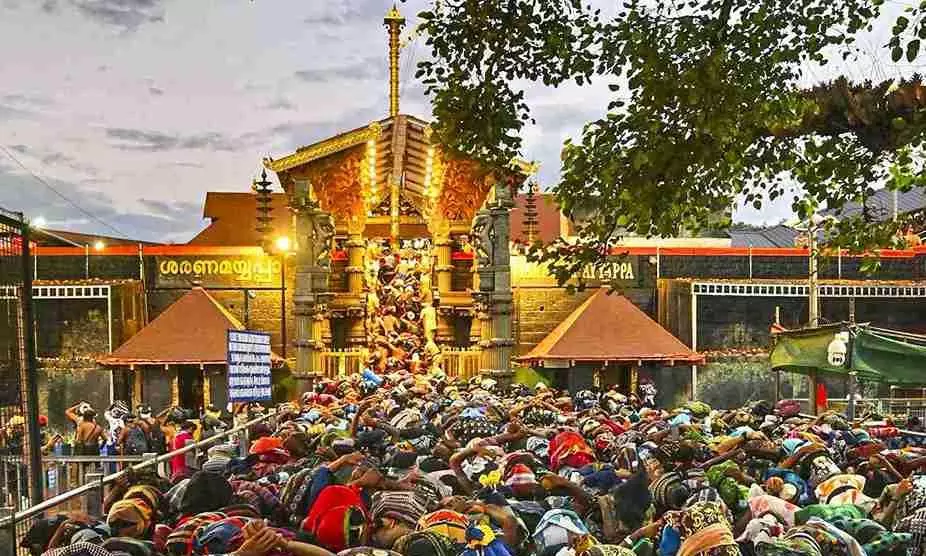
But Bhagwat is only doing his job as the head of the organisation that is committed to resetting the Indian past. What of the ‘protection of civilisation’ argument being used by those whose task is to safeguard the Indian Constitution? Hearing the arguments for the admission of menstruating women to worship at Sabarimala, a right that was accepted once by the same court, and then became subject to ‘review’, Justice Nagarathna said that "If everybody starts questioning certain religious practices or matters of religion before a constitutional court, then what happens to this civilisation where religion is so intimately connected with Indian society? There will be hundreds of petitions questioning this right, that right, opening of temples, closure of temples...".
'We can't break the constant'
She added ‘’despite all its development, economy, everything, there is a constant in us, we can’t break that constant‘’. Indeed, the Constitution Bench can’t ‘upset the civilisation…’.
So, the concept of a ‘constant civilisational ethos’ pushes up against constitutional morality, rights and freedoms, and the legal authority of the state buckles under the moral authority of the (majoritarian) nation. We need a relook at what is being upheld. Bhagwat ignored decades of sophisticated historical research. Likewise, the honourable justices of the Supreme Court have ignored decades of ethnographic fieldwork, anthropological research, and responsible journalism, which have documented important transformations to the Sabarimala pilgrimage over the years.
Also read: Celebrating the centenary of a civilisation, deciphering its discoveries
From a mere 50,000 devotees in the early 1950s, this pilgrimage has exploded to nearly 50 lakh annually. Environmental concerns and governmental responsibility have reshaped the pilgrimage altogether. Practices associated with the pilgrimage have also been voluntarily changed. This has been documented by many scholars such as Rajan Gurukkal, Raju and Radhika Sekhar, the Osellas and R Delage.
The requirements for this pilgrimage — a 41-day vratham during which period the pilgrim must adopt celibate austerity, forsake meat, alcohol, and sex, don the mala and black clothes — have been diluted, citing work pressures and domestic responsibilities. The original pilgrimage has been completely transformed by train and air travel — and new associated practices have sprung up. There are many, research and reports show, who wear the mala just a week before departing for Sabarimala.
When nothing has remained ‘pristine’, the burden of upholding faith at Sabarimala now rests entirely on the prohibited menstruating woman. So, the honourable justices of the Supreme Court need to consider which civilisational continuity they are saving.
Civilisation only a women's thing?
We have had more than two centuries of debates about ‘civilisation’ in crisis and why women should be the bearers of that tradition. Should we go by scriptural sanctions for practices such as widow immolation and lower caste temple entry or by a new standard of morality?
When nothing has remained ‘pristine’, the burden of upholding faith at Sabarimala now rests entirely on the prohibited menstruating woman. The honourable justices of the Supreme Court need to consider which civilisational continuity they are saving.
Should questions of rights enter into Indian families, like a ‘bull in a China Shop’? Or should women ‘put up and shut up’ in violent patriarchal families, where the National Crime Records Bureau shows women are most endangered?
Also read: Sabarimala case: Why every faith has a stake in the nine-judge SC Bench?
When Madan Mohan Malaviya cited from the Hindu sastras to prevent raising the age of marriage beyond 12 years, the All-India Women’s Conference said way back in the 1920s, ‘’We want new sastras‘’.
We now have a new ‘sastra’: the Constitution. We must do everything to enhance its capacity to build new visions and moralities. We must not trot out that nearly 200-year-old argument — and make no mistake, the ‘civilisational anxiety’ only arose due to colonial rule — that our ‘civilisation’ will remain only if women pay the price.
(The Federal seeks to present views and opinions from all sides of the spectrum. The information, ideas or opinions in the articles are of the author and do not necessarily reflect the views of The Federal.)