The reason the RSS succeeds in spreading its toxic ideology is that it works round the clock, relentlessly focused on its mission, unlike most political parties
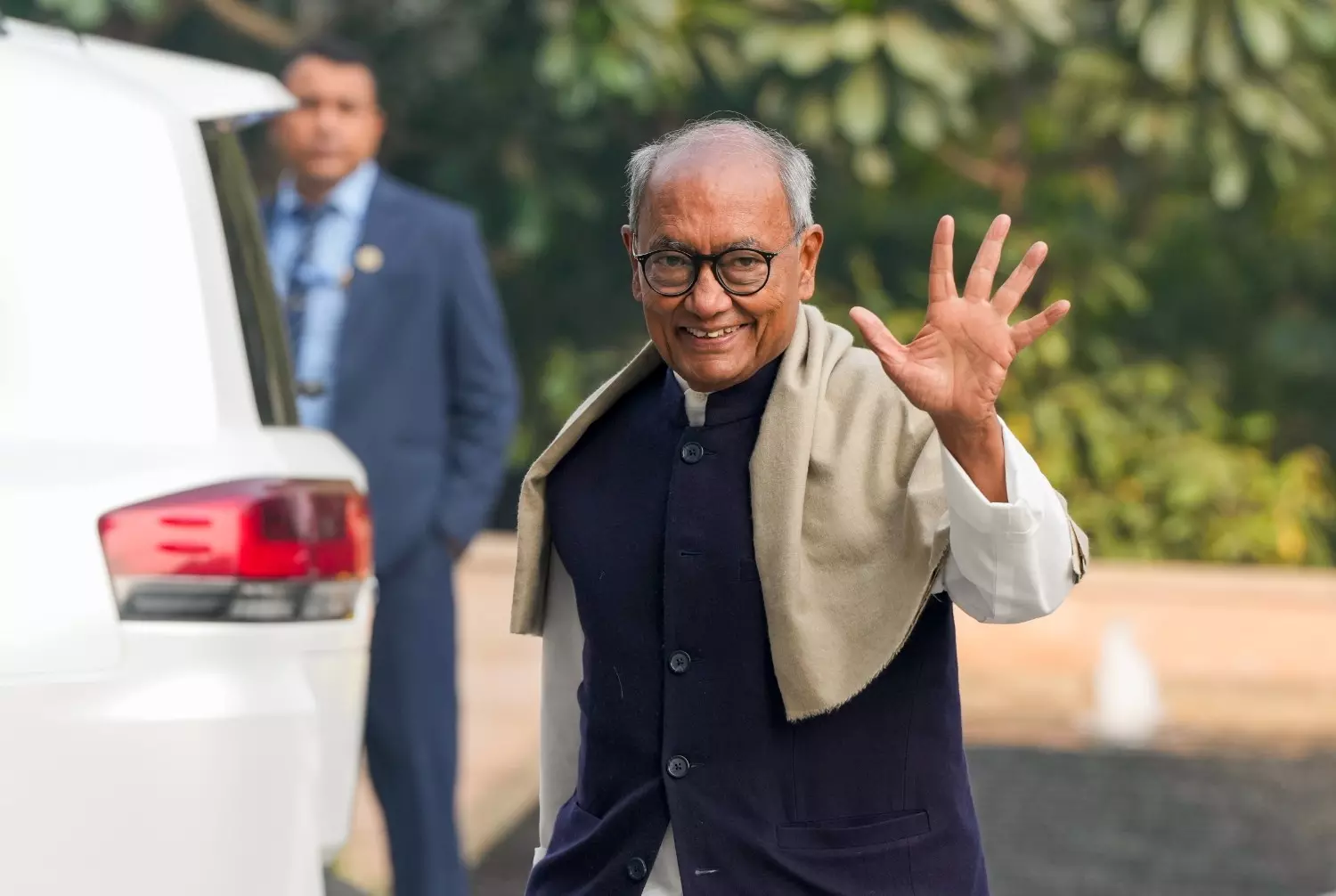
Digvijaya Singh is a rare Congress leader who is not scared of speaking his mind without worrying about how this would affect his standing within the party, particularly in the eyes of its top leadership. His comment in praise of the organisational strength of the Rashtriya Swayamsevak Sangh (RSS) that could propel a grassroots worker such as Narendra Modi to the apex of political power has been widely perceived as criticism of dynastic capture within the Congress.
BJP activists have pounced on the remark to taunt the Congress about the lack of democracy within the party. Very soon, opportunists within the Congress can be counted on to use the statement, in transparent attempts to curry favour with the Gandhi dynasty holding the Congress in thrall, to denounce Singh as an admirer of the Sangh.
Also read: Digvijaya Singh praises RSS-BJP, shares old Modi photo, sparks row
Those who criticise the top leadership of the Congress, even indirectly, must be enemies of the party, of course. And if they actually praise the RSS, even if only its organisational strength, communalism must taint their worldview. Except that such reasoning will not work in the case of Digvijaya Singh.
A vocal critic of Sangh Parivar
Singh is one of the most vocal critics of the Sangh Parivar in the Congress and outside. The BJP itself has accused him of coining the term "saffron terror", and of calling Hindus terrorists. Singh is a devout Hindu and is one of the most articulate proponents of the distinction between Hinduism as a faith and Hindutva as a political ideology built on the othering of Muslims, treating them as second-class citizens, if not actual traitors. The thesis that Singh is a covert admirer of the Sangh, who is now coming out in the open, will not wash.
If secret admiration for the RSS ideology is not what provokes Singh’s admiration for the Sangh’s organisational structure, that would leave the Congress to confront its own organisational lapse highlighted by the contrast with the RSS’s organisational virtue. And that is intimately connected with the culture of the party high command appointing all key organisational functionaries, instead of these worthies being elected by party workers. It is but one more small, additional step to find fault with the high command’s dynastic identity.
The BJP itself has accused Digvijaya Singh of coining the term "saffron terror", and of calling Hindus terrorists. He is a devout Hindu and is one of the most articulate proponents of the distinction between Hinduism as a faith and Hindutva as a political ideology built on the othering of Muslims.
Mallikarjun Kharge might be the president of the Congress but for all effective purposes, it is Rahul Gandhi, great grandson of Jawaharlal Nehru, grandson of Indira Gandhi and son of Rajiv Gandhi and Sonia Gandhi, who calls the shots in the Congress party, with his sister Priyanka Gandhi also trying to play leader.
Decay under epigones
An epigone is the descendant of illustrious forebears, who does not possess the qualities that made the ancestors illustrious. An organisation in thrall to a dynasty founded by capable, charismatic leaders, will decay and disintegrate when led by epigones. The longer the epigones stay at the helm, the more drawn out the inevitable end.
Also read: Shashi Tharoor backs Digvijaya Singh on strengthening Congress organisation
By stressing the rise of Modi within the RSS organisation, Singh draws attention to the organisational dynamic that lets talent rise within the organisation, from the bottom to the very top, without that being blocked by the ringfence around the top leadership reserved for the dynasty and the dynasty’s inclination to reinforce the ringfence through appointment of pliant favourites to key positions across the organisation.
But promotion of capable talent is not the only or even primary benefit of having a functional organisation. A robust organisation makes for round-the-clock and round-the-year work to achieve the goal of the organisation. And such relentless work reflects as well as reinforces conviction about the organisation’s key mission.
What the Congress stands for?
Right now, if you ask the average Congress worker what the party stands for, he or she is unlikely to have a convincing answer. Inclusive politics, welfare of the common man, protection of the Constitution, defence of secularism and such other platitudes can roll off the tongues of Congress workers easily enough.
However much you might disagree with the 'Hindu Rashtra' mission of the RSS, it cannot be gainsaid that the organisation is constantly at work to achieve this goal, through a host of organisations that work among different sections of the populace in different spheres of socio-cultural life.
But if pressed further, they are likely to come clean and accept that their goal is to wrest power from the BJP, with little clarity on what the party would use the power for, different from what the BJP uses state power for.
Wresting power from those who wield it is, of course, a legitimate goal for any political party. That is, indeed, the reason for a political party to exist. A political party is different from organisations such as unions and associations, however political these might be, in that the party’s principal focus is capturing power. But without a vision as to what is to be done with the power that is captured, it is unlikely to succeed in that mission.
A mission pursued relentlessly
The spoils of office are what most politicians seek to achieve by securing the levers of power. For the RSS and its offshoots, changing India into a Hindu state is their main, overarching goal. This, of course, is not presented as such to the people at large. The goal is presented not in its entirety but via the embellishments that carry appeal in themselves: retrieving ancient glory and national self-confidence, making India a developed nation, self-reliance, decolonising the mind.
Converting India into a Hindu state entails negation of democracy, negation of federal devolution of power to the regions, arrogating primacy to one flavour of India’s many-splendoured culture and curtailing opinion that challenges this scheme of things by denouncing such opposition as anti-national, worthy of incarceration without trial and due process.
Creating a Hindu Rashtra entails denying democratic rights to non-Hindus, and that entails ending democracy as we know it. Being democratic has this in common with being pregnant: it is not possible to be either in part. Denying democracy to non-Hindus is to negate democracy for the entire population.
If a section of the majority opposes relegation of the minority to second-class citizenship, those dissidents would have to be brought in line. And that would entail stripping them, in addition to the minority, of democratic rights. The arbitrary right of the state to strip anyone of democratic rights would become the norm. Democracy would stand abrogated, even if the Preamble to the Constitution is preserved.
Also read: Digvijaya Singh on RSS row: 'I oppose Modi, RSS, praised organisation'
However much you might disagree with this mission of the RSS, it cannot be gainsaid that the organisation is constantly at work to achieve it, through a host of organisations that work among different sections of the populace in different spheres of socio-cultural life. This gives the RSS a relentless, unremitting, multifaceted presence in all walks of public life.
An election-time party
Congress leaders become politically active close to elections. Not for them the struggle to democratise Indian society, which is deeply hierarchical, steeped in a culture that valorises the superiority of some groups and the inferiority of others, despises physical work and venerates mental work, and wears modernity as if it were a readymade garment, to be donned or shed at will.
Unless the Congress embraces democratic empowerment of the people of India — as the means to redeem India’s tryst with destiny, very substantially, even if not wholly or in full measure, to borrow the words of an old-time Congressman — as an organisational mission that inspires constant interaction with the people, it will have neither a dynamic organisation that promotes meritorious talent nor electoral salience.
Keep going, Digvijaya Singh. Silence in the face of wrong is collusion.
(The Federal seeks to present views and opinions from all sides of the spectrum. The information, ideas or opinions in the articles are of the author and do not reflect the views of The Federal.)