From meme to mass protest, the CJP has channelled student rage over exams and unemployment, weaponising insult into dissent the BJP cannot easily defuse
In a country where Rabindranath Tagore’s song Ekla Chalo Re (Walk Alone) has motivated generations of Indians to rise for the nation and raised goose pimples for the past 120 years, even if the sands of time have long run out, it is certainly premature for the political class to assign minor numbers to those who attended the first “real-world” show of the platform, birthed and incubated in satire—the Cockroach Janta Party (CJP).
It is not of great importance whether the protest meet was attended by barely a thousand or two, or by numbers far in excess of this. What is more important is that the rally underscored the power of one, and that in India’s politically claustrophobic atmosphere, it is still possible for the not-so-politically-aligned, to make common cause and dare the government to stop the event all by oneself.
The CJP may or may not morph into a political party, enter the electoral arena and trigger exasperation among the ruling party and its principal challengers. It may not reach the heights of events in several neighbouring countries where Gen Z-led movements resulted in regime change.
Also read: Message vs messenger: Can CJP stay issue-focused amid youth rage? | AI With Sanket
But, there is no doubt that historians of the future will not overlook this episode wherein a completely unnecessary slur, cast by a person holding an office that demands extreme caution in action and choice of words, triggered anger and rage.
Extraordinary pivot of street activism
Indeed, in a period where those holding constitutional and other important official positions are always on a lookout for ways to please the powers that be, with the aim of securing a post-retirement office, Chief Justice of India, Surya Kant, is almost certainly ruled out from such an appointment.
The rally on June 6 was an extraordinary modern pivot of Indian street activism. Paradoxically, this began as spontaneous self-lampooning or an internet meme backed by outrageous soundtracks—each varying from others—underscoring its viral character.
Also read: CBSE OSM row: Whistleblower Sarthak shares how he dug up tender flaws | Exclusive
Much before such a transformation could be imagined, the “virtual multitudes” transited into a predominantly apolitical, youth-led street demonstration with a significant number of youngsters joining from towns and cities far away from the Indian capital city.
Importantly, this was no political demonstration wherein the party takes care of the bandobast. Everybody in this case had to literally walk alone, or at best, along with a handful of friends and acquaintances.
The weaponisation of insult
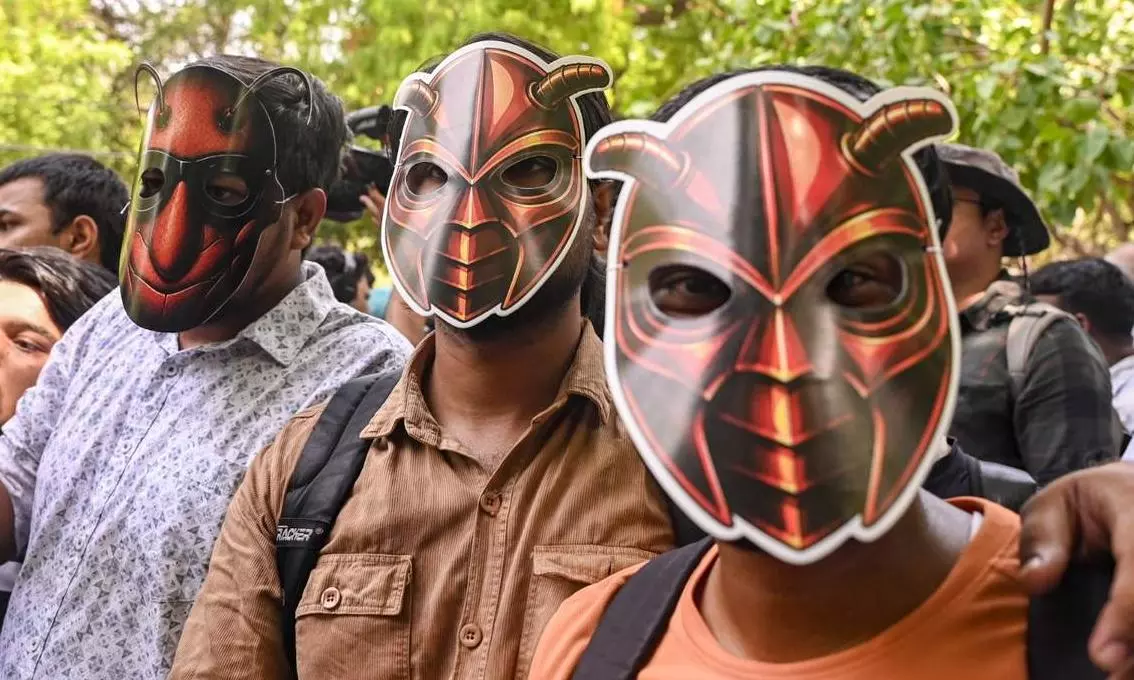
Make no mistake, the name—Cockroach Janata Party—is a parody of the Bharatiya Janata Party and every mask, slogan or song was an instance of insult being weaponised.
Wearing cockroach-masks while holding school and college books, along with the national flag and large portraits of the much-appropriated BR Ambedkar became a symbol of protest and power. Being a cockroach became a matter of pride, because the insect survives the severest of odds, almost being indefatigable or even immortal.
Also read: Cockroach party protest: What are CJP supporters' demands and what Dipke said
Besides converting abuse into a political sledgehammer, the rally on June 6 demonstrated that a political gathering can be staged bypassing conventional political routes which are the domain of political parties.
The challenge, however, will be to convert the 22 million-odd overnight online followers into a political brigade. It is simple to become a digital follower by a click of the mouse, but enlisting supporters for a “real world” turnout is a much more arduous task.
In India, however, where dissent of any form has been choked, especially online, the outpouring of frustration and angst among what was clearly the youth, was extremely worrisome for the government.
A big vote bank lost?
The biggest worry for the ruling party also would be that the entire campaign against the National Eligibility-cum-Entrance Test (NEET), CBSE on-screen marking (OSM) controversies, and the National Testing Agency (NTA) was led by students and the youth.
What was more worrisome was the fact that the lacunae and the alleged scam in the award of the OSM contract were exposed by students of Class XII, some of whom may not yet be 18 years old.
Also read: India’s youth bulge risks turning into a demographic time bomb
Unless the government is able to make amends, the Bharatiya Janata Party has potentially lost significant sections of first-time voters, because many of them would have gone through the agony of imperfect marking in the Class XII Board exam, resulting in an impact on admission.
Likewise, voters below the age of 30 years would have been alienated from the ruling party because of the crisis in education, mismanagement in entrance exams, and high levels of unemployment.
Among voters, this demographic group is technologically empowered and among the most imaginative. There is no knowing when the hyper-connected youth aim and succeed in converting digital dissent campaigns into traditional forms of protests on a scale that is bigger than the one on June 6.
The core demand
Importantly, despite beginning by framing themselves as a joke and openly calling for an assembly of jesters, the protestors managed to unambiguously voice their opposition.
Yet, they were careful to remain non-violent, displayed the Indian tricolour prominently to prevent the BJP from labelling them with their standard political tropes, and did not allow religious identity to become an issue of conversation and display at any point.
Also read: ‘We will not back down until Dharmendra Pradhan resigns’: CJP’s Abhijeet Dipke
It is clear that the demand for Education Minister Dharmendra Pradhan’s resignation is not going to die down easily. Besides the one-day protest, and the promise of more to come across India, students’ organisations attached to political parties, especially the Congress’ students’ wing, the National Students Union of India (NSUI), and the CPI(M)-linked Students Federation of India have also raked up the issues flagged by the CJP.
Voices disparate, issues same
These voices may be disparate but the issues remain the same and the impact on the government can well be cumulative.
The CJP’s biggest success has been that it has directly tapped into the anxieties of India’s unemployed or student youth. This demographic section largely represents an erratic, non-ideological voter base that cannot easily be countered with typical polarization tactics, which has been the BJP’s main strategy to retain its parliamentary majority.
Also read: Teen 'investigator' teases CBSE over deadline extension: 'Was busy exposing you'
The moot point at this stage, however, is whether the CJP, in its present form, or in a new avatar, has a political future in India. The present rage arose over the inadequacies of the NEET, CBSE and NTA and the losses suffered by students on this account.
But, to remain engaged with the youth, the CJP leadership would have to translate temporary student angst into a broader, sustainable framework that addresses youth unemployment, economic stagnation and even wider issues that impact quality of life, such as affordable and quality health facilities.
Modi government’s weakness
The Modi government’s ability to manage public protests has remained among its few weaknesses even though it has managed to keep the past 12 years largely protest free. But the 2015 anger against the plan to liberalise land acquisition and the embarrassing manner in which the farmers’ agitation, the anti-CAA protests, the protests against the Agnipath scheme, and the women wrestlers’ protest ended demonstrated that the government is not adept at tackling mass protests.
Also read: Cockroach Janta Party protest: Experts decode impact; what next? | Capital Beat
Faced with the CJP call, the government, for once, made no effort to prevent the protest and even made concessions by granting permission for the rally by getting the requisite forms signed by Abhijeet Dipke at the airport arrival lounge.
The farmers’ agitation was the first instance when the government had to backtrack from its stated position that policies passed by a democratically elected parliamentary majority should not be dictated or overturned by street blockades.
The dismantling of democratic institutions
India has been termed an electoral autocracy by the V-Dem Institute’s Democracy Reports since 2017. During this period, we have witnessed what the report in 2026 contended as the “slow but systematic dismantling of democratic institutions”.
Importantly, while the report focused on the shrinking of democratic practices, it also stated that the digital-centric generation was aware of the issues at stake.
Also read: How right-wing groups are trying to crush Cockroach Janta Party
In the initial period of the “cockroach movement”, the government continued with its high-handed approach and pulled down the social media handles citing “national security concerns.”
But the replication of several lookalike handles and platforms sent the message that autocratic tactics would backfire. The government’s uncharacteristic non-confrontational stance before and on June 6 indicates that it is of the view that it is best not to use the tactics used previously, most infamously during the farmers’ agitation, the women’s wrestlers protest and of course during the 2020 Delhi riots.
Will the cockroach survive?
Significantly, the rally on June 6 was ignored by almost the entire mainstream TV media. On this score too, the more-than-adequate video coverage demonstrated the power of the digital spread.
Also read: CBSE OSM whistleblower Sarthak Sidhant urges CJP founder to focus on real issues
It is too early to fathom whether CJP will fade away or not from the internet algorithms that place its coverage among the most viewed content.
But, there is no denying that the cockroach shall continue to remain in discussion and analysis in times to come.
(The Federal seeks to present views and opinions from all sides of the spectrum. The information, ideas or opinions in the articles are of the author and do not necessarily reflect the views of The Federal.)