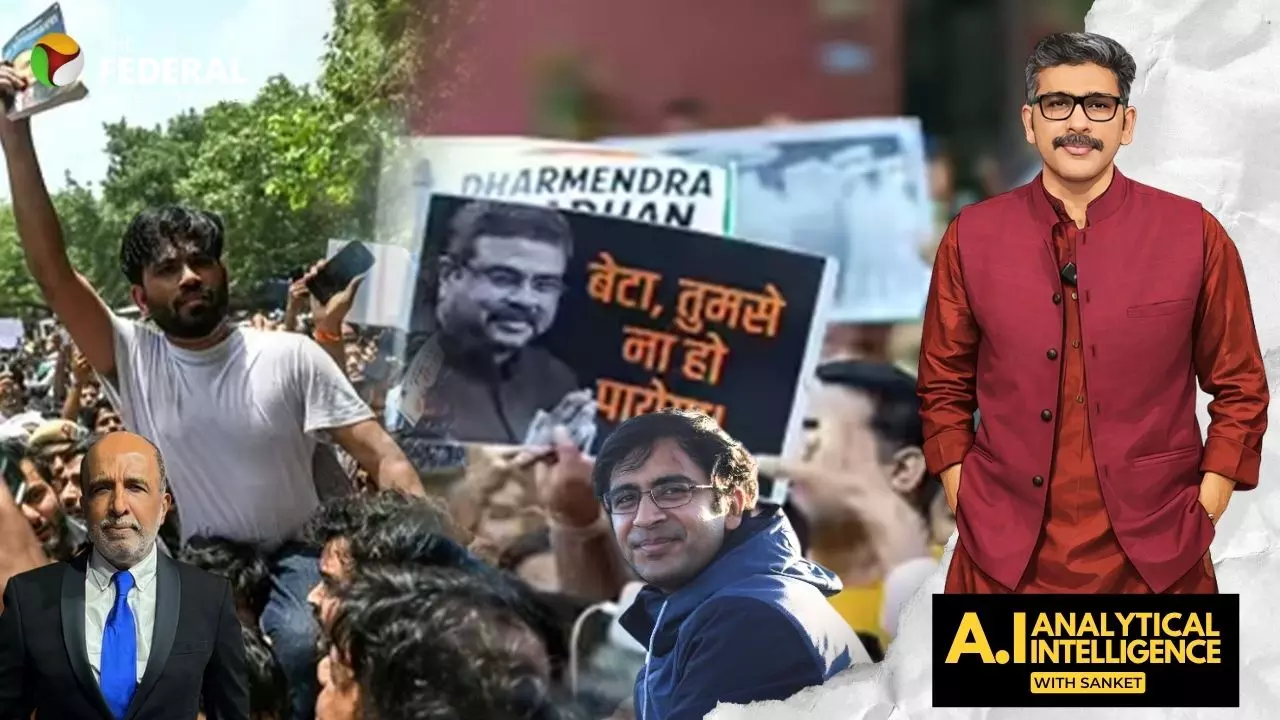
Message vs messenger: Can CJP stay issue-focused amid youth rage? | AI With Sanket
CJP holds its first offline protest at Jantar Mantar over exam failures and paper leaks, as analysts debate Gen Z activism and education accountability

“Every additional day of the education minister’s presence is costing lives,” declared Cockroach Janta Party (CJP) spokesperson Ashutosh Ranka, intensifying calls for Dharmendra Pradhan’s resignation during a heated debate on The Federal.
The movement, which began as an online satire and quickly turned into a mobilised youth protest, is now positioning itself at the centre of a widening political confrontation over India’s education system.
The Federal spoke to political analyst Sanjay Jha and Ranka as they discussed the emergence of the CJP, its rapid digital mobilisation, and its attempt to translate online anger into offline protest. The conversation also examined whether such movements risk becoming personality-driven rather than issue-driven.
Youth anger and legitimacy of issue
Jha opened the discussion by strongly validating the concerns raised by the young protesters, saying the grievances of students are “totally legitimate”. He argued that the education system’s credibility crisis, especially around competitive exams, has created deep anxiety among aspirants and families.
He said the pressure faced by students preparing for exams like engineering, medicine, IITs and IIMs is already intense, and system failures only worsen the psychological and financial burden. According to him, the issue is not limited to Gen Z alone but extends to millennials and even younger cohorts, calling it a “traumatic predicament” for India’s youth.
Also read: Cockroach party protest: What are CJP supporters' demands and what Dipke said
Jha further suggested that systemic mistrust in governance structures is driving resonance for movements like CJP, as young people increasingly question institutional integrity.
System trust crisis
Jha expanded the argument by linking education-related grievances to a broader governance crisis. He said public frustration stems from perceptions of corruption, mismanagement and institutional weakening across sectors.
He referred to what he described as a wider breakdown in trust in systems, including allegations and controversies in financial and regulatory spaces, to underline that youth anger is part of a larger national sentiment.
However, he cautioned that such movements must remain focused on accountability and not drift away from their core agenda. For him, the key test is whether CJP can sustain attention on education reform without becoming another fragmented political voice.
Message vs messenger debate
A major point of debate emerged when the classic “message versus messenger” dilemma in political movements was raised. Does the CJP risk shifting focus from systemic issues to individual leadership and visibility?
Also read: ‘We will not back down until Dharmendra Pradhan resigns’: CJP’s Abhijeet Dipke
Sanjay Jha responded that movements often face this challenge, where leadership personalities begin to overshadow original demands. However, he acknowledged that CJP has successfully tapped into youth dissatisfaction, especially around education and employment.
He also argued that political cynicism in India makes citizens more receptive to non-traditional, volunteer-driven mobilisation, even if it starts online.
Rising mobilisation and symbolism
On the question of CJP’s impact, Jha noted that the movement’s online growth has been “stratospheric,” suggesting it has managed to galvanise youth participation at an unprecedented scale for a digital-first platform.
However, he described the demand for Education Minister Dharmendra Pradhan’s resignation as “symbolic”, arguing that removing a minister alone will not fix structural problems in the education system.
He warned that governance issues in India are deeply embedded and cannot be resolved through leadership change alone, calling them “endemic” and tied to systemic administrative culture.
Ranka’s response: Education crisis and accountability
Responding to the criticism, Ranka rejected the idea that the resignation demand is merely symbolic. He said continued tenure of the education minister is directly linked to ongoing harm in the system.
Also read: Cockroach Janata Party: How a satire became Gen Z’s latest political movement | Capital Beat
Ranka listed multiple issues including exam irregularities, delays, system glitches and alleged data leaks affecting students. He argued that these failures are not isolated incidents but part of a recurring pattern affecting lakhs of aspirants.
He specifically referenced competitive exam disruptions and student distress cases, saying these failures have resulted in severe consequences for young people and their families.
According to him, the movement is not a one-point campaign but a broader push to “reset” the education system.
Youth mobilisation online and offline
Ranka emphasised that the movement’s strength lies in its ability to reflect youth sentiment through digital platforms. He said millions of followers and a large-scale petition demanding ministerial resignation show that the issue has already moved beyond online chatter.
He also defended the transition from online mobilisation to ground protests, saying it demonstrates that young people are willing to act collectively and peacefully.
He rejected criticism that Gen Z lacks political understanding, arguing instead that young participants are capable of organising structured and peaceful demonstrations.
Women participation concerns
During the discussion, questions were raised about the representation of women in the movement’s visible leadership structure. Ranka acknowledged the concern and said it was a valid criticism.
Also read: Cockroach Janta Party linked to AAP? Founder Abhijeet Dipke’s past ties raise questions
He explained that several women involved in the movement had faced harassment, including threats and doxxing, which forced some of them to step back from public-facing roles. However, he said many continue to play key roles behind the scenes, including media coordination and organisational work.
He also noted that women’s participation in the movement’s content consumption and support base is significant, suggesting a broader engagement beyond visible leadership.
Call for broader unity
Both speakers converged on the idea that education reform requires collective political and civil society engagement. Ranka said any party, organisation or individual supporting youth concerns is welcome, regardless of political affiliation.
He emphasised that CJP positions itself as politically neutral and focused solely on education reform, urging a unified voice across parties and civil society groups.
Sanjay Jha, while acknowledging the movement’s potential, reiterated that real impact will depend on whether it can drive tangible policy change rather than remain a symbolic mobilisation.
Conclusion: Movement at a crossroads
The discussion ended on a reflective note, with both panellists agreeing that the CJP represents a new kind of digital-first political mobilisation. While its rapid rise reflects deep youth frustration over education and employment, its long-term relevance will depend on whether it can translate online energy into sustained institutional change.
Also read: Cockroach Janta Party protest: Experts decode impact; what next? | Capital Beat
As the debate highlighted, the central question remains unresolved: Is this a temporary surge of digital anger, or the beginning of a structured pressure movement capable of reshaping India’s education policy discourse?
(The content above has been transcribed from video using a fine-tuned AI model. To ensure accuracy, quality, and editorial integrity, we employ a Human-In-The-Loop (HITL) process. While AI assists in creating the initial draft, our experienced editorial team carefully reviews, edits, and refines the content before publication. At The Federal, we combine the efficiency of AI with the expertise of human editors to deliver reliable and insightful journalism.)