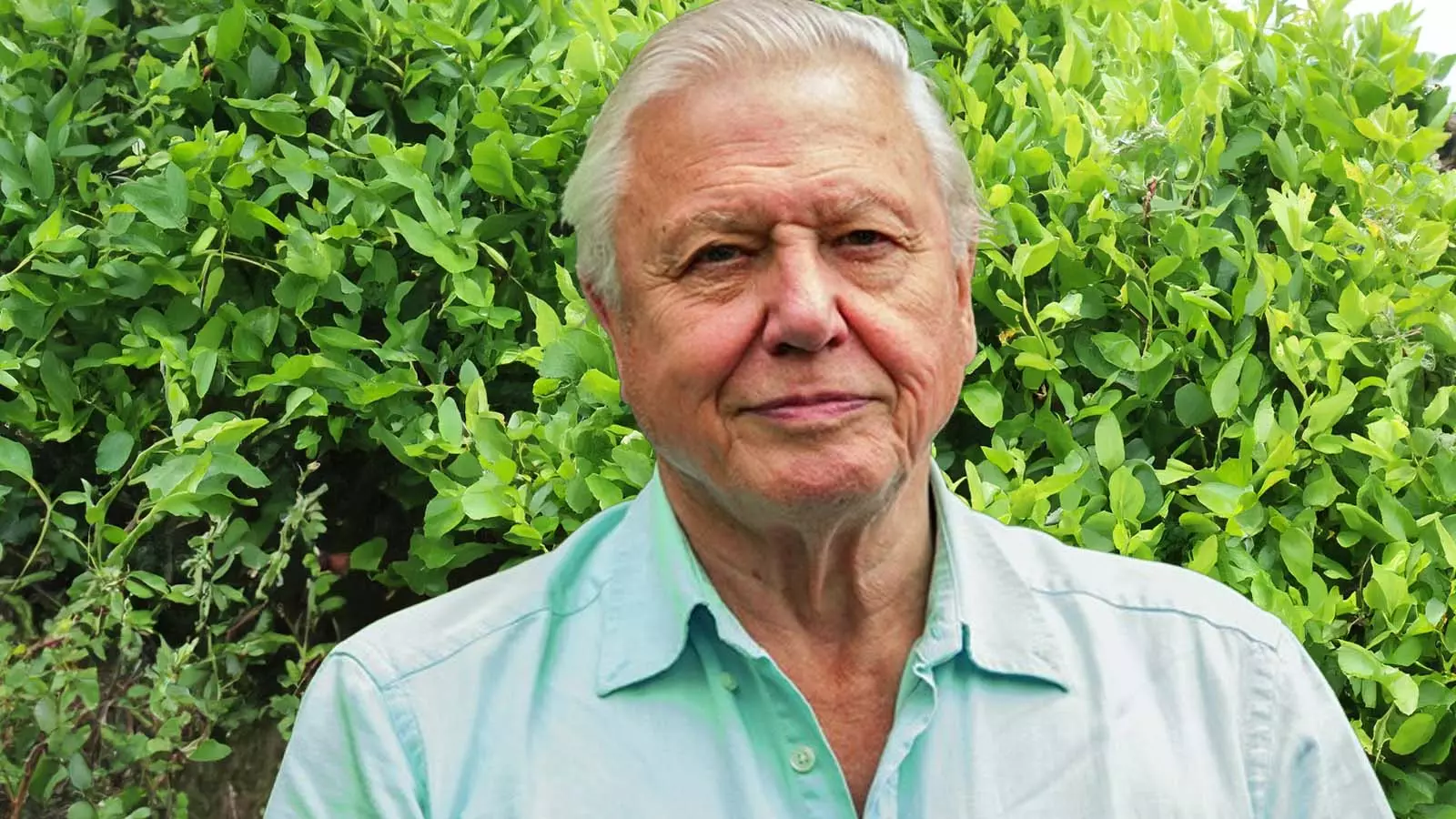
His landmark film 'A Life On Our Planet' moves and inspires, but its vague blame on 'humanity' shields the corporations and systems behind ecological collapse
It was the 1980s. The ozone-hole crisis loomed large, competing with the threat of nuclear war. Acid rains were not just a scientific term. They were part of a newspaper editorial. The Supreme Court was concerned about India's pride in the Taj Mahal and directed steps to protect it from acid rain emanating from the Mathura Refinery.
Out on the streets, you could not escape it. Every corner had some campaign or another. Posters stuck on walls.
Also read: Shun meat, go vegetarian if you want to save the planet: Sir David Attenborough
Students collecting signatures. Someone is always selling a sapling. "Let us grow trees, and ensure rain," people would say. And they meant it.
Rising awareness
Initial awareness of climate change and global warming was just emerging. Not an alarm yet. You could feel it in the air, that quiet unease. But no one knew what to do with it. So, we watched documentaries. We read magazines. We marched in the streets. We hoped.
It was one of those days when I had a chance to watch David Attenborough's Life on Earth (1979). The film told the history of life on our planet. Beautiful visuals captured with painstaking effort. Frame after frame of creatures and landscapes I had never seen before.
During the mid-1980s, Attenborough's films were an indispensable part of the growing global environmental awareness. Far from the BBC's London studios, we felt their influence.
Then came The Living Planet: A Portrait of the Earth (1984). Another nature documentary. Breathtaking visuals of flora and fauna from every corner of the globe. The book versions of these films were eagerly grabbed from shops and libraries. (To confess a truth, it was not uncommon to steal books from friends' places.) Read cover to cover, often multiple times.
The making of environmental imagination
Back then, as a male youth in Chennai, you needed bellbottoms, Rajender's Oru Thalai Ragam, Irani chai, aloo tikki (a recent rage), Hofstadter, and Attenborough. Miss any, and your gang would excommunicate you.
On a serious note, during the mid-1980s, these films were an indispensable part of the growing global environmental awareness. School classrooms showed them on grainy VHS video players. Nature clubs discussed them. Even in India, far from the BBC's London studios, we felt their influence. I was part of this. A young person trying to understand the natural world. Learning about evolution, ecosystems, and the delicate balance of life.
Attenborough's voice became familiar.
That is why I watched his later film, A Life On Our Planet (2020), with much anticipation. Again, beautiful images and breathtaking cinematography. Flawless script.
The same voice. The same face. But now a witness statement. However, I could no longer accept a set of conclusions.
From natural history to witness statement
Sir David Attenborough. The name itself evokes lush green forests, strange deep-sea creatures, and that calm, familiar voice. For over 60 years, he has been Britain's most famous naturalist and broadcaster, whose work has been telecast in many countries, including India.
Also read: OTT: Oh, for the love of dogs; marking Earth Day with Attenborough & dark dramas
Way back in 1952, he produced a film for the BBC on the rediscovery of the coelacanth, a fish once thought extinct. Since then, his documentaries, books, and videos have educated generation after generation worldwide. He brought the wonders of nature right into our living rooms. Many of us grew up watching him.
The refusal to distinguish between the exploitative class and the working class is not harmless. It is disingenuous.
For many decades, Attenborough’s documentaries rarely showed any destruction to the natural world. No acid rains, no destruction of the undersea landscape, no threat to the ozone layer. The camera never pulled back to reveal the urban sprawl. It did not show forests turning into farmland.
You never saw the massive oil sands or open coal mines visible from space. Some say back then, he had little control over editorial decisions.
Did he look away?
Others argue he chose to look away. Whatever the reason, these films were silent about the ecological threat the planet was facing.
Then came A Life On Our Planet, released on Netflix. Running at 83 minutes, it is styled as his "Witness Statement". The documentary charts the timeline of climate change and biodiversity loss. These changes unfolded right during his own lifetime. The film depicts rampant environmental destruction and unsustainable consumption. It also lists positive actions we must take to save our planet.
The impact on viewers was great.
The film opens powerfully. Attenborough stands alone in the ruins of Pripyat, the abandoned town near Chornobyl. He argues that the nuclear disaster resulted from "bad planning" and "human error". Then he makes a leap. Global environmental destruction, he says, has the same cause. Human error.
This is where the trouble begins.
Sticky question, easy answer
At best, this framing is a simple plea. Learn from our mistakes. But think for a moment. If the cause is merely repeated mistakes, why do they happen again and again? Who exactly is making these errors? Is it all of humanity equally? The film does not ask these questions. It prefers a comfortable answer to correct one.
Consider the case of Borneo. Since the 1980s, that island has lost one-third of its rainforest cover. Attenborough explains the consequences well. Rainforests act as carbon sinks. They regulate climate. They harbour incredible biodiversity.
Also read: Speaking with Nature: Ramachandra Guha traces roots of Indian environmental thought
And yet, they are being cleared. Why? He says human beings want timber and land for farming. Specifically, for oil-palm plantations. This is true. But it is not the whole truth.
Avoiding reality
Ask yourself a simple question. Does a poor Adivasi or a landless farmer have the power to cut down a single tree? Can they even collect firewood without fear? The forest department, the police, and the entire state machinery will pounce on them. They cannot touch even a single branch.
So, who is really clearing the forest? At the ground level, you may see poor labourers doing the physical work. But behind them stand profit-seeking, exploitative big businesses. They have clout. They have money.
They push the system to permit destruction. They collude with the state, or the state buckles under their pressure. Attenborough avoids this reality. He points his finger at "humanity"; it is safe — no one can take offence. As if a starving farmer is as much to blame as the privileged who fly in private jets to Epstein's islands.
This refusal to distinguish between the exploitative class and the working class is not harmless. It is disingenuous.
Humanity' as explanation
Then comes the population argument. He states that humans and their livestock account for 96 per cent of Earth's biomass. He argues that the only way to save the planet from famine and extinction is to limit human population growth.
He advocates for plant-based diets and rewilding. He advocates "natural" population control through education, accessible healthcare, and gender equality. He points to Japan as proof. As countries develop, birth rates fall. Voila — be like Japan.
But look closer. Japan is the world's seventh-largest emitter of greenhouse gases. Its emissions have not disappeared. They have been outsourced to poorer countries. Industrialising regions burn coal and cut forests to produce cheap goods for rich nations. This has nothing to do with population size. It has everything to do with who controls the global economy.
Also read: How India’s East Coast and Eastern Ghats are losing their rich biodiversity rapidly
Attenborough’s neo-Malthusian position is a well-worn path. It has plagued the environmental movement for decades. It shifts blame away from the powerful and onto ordinary people, especially poor women in the Global South.
Hollow claims
At one point, he says that our planet is run by humankind for humankind — and that is the root cause. The claim sounds hollow. Set against threats by powerful leaders that an "entire civilisation" could be erased unless that country complies, it rings worse than naive.
Elected leaders are abducted; democracy is "exported" through regime change; elected assemblies are warned whom not to elect. And yet, we are told the planet is run for & by all. Really?
The global economy is steered largely by a small circle of immensely wealthy multinational corporations and their shareholders. Their interests, not humanity's interests as a whole, nor humanity as a whole, had a role in the decision-making.
Solutions or spectacle?
Then comes his ‘solutions’ to the global crisis. The most powerful moment in the film is mute. The camera holds on his face for a long time. You can see his anguish. The visible emptiness of a destroyed Eden. The silence is more eloquent than any speech. The film could have ended right there. We would have felt our stomachs churning at the hell that awaited us. The earlier sequences had already made things plain.
We perhaps realised what needs to be done. Stop carbon emissions. Allow poorer countries and other species more space. Choose leaders capable of acting on evidence.
Take global action, as we did successfully during the ozone hole crisis. But suddenly the mood changes. The music lifts. A remarkable film needs to move us to action, not just to tears, but alas! Attenborough announces that the solutions are "simple".
You can almost hear a crack in his voice. Perhaps he did not want to end on a downer, and was forced to say them.
Yet what follows is not very convincing. A sequence of techno-solutions appears. We see the American plains restored to their grassland state. Vast herds of bison roam among wind turbines. Drones sustainably harvest reforested rainforests.
Also read: How Madhav Gadgil put people at the heart of Western Ghats’ conservation
Oceans, which we were just told are 90 per cent overexploited, now teem with fish and whales. Futuristic "responsibly-sourcing" fishing craft glide through photoshopped waters. It looks nice. It feels hopeful.
But it does not feel real.
Environmentalism and its limits
Environmentalism is a crucial response to capitalism's ecocide. It expresses revulsion at the wanton destruction and barbarism unleashed upon nature. That revulsion is honest and necessary. But too often, environmentalists end up naively advocating capitalist and technocratic solutions. Carbon trading. Nature financialisation. These ideas are consistent with the profit motive and corporate power.
Others go to the opposite extreme. They reject modernity entirely and call for a "return to nature". Very few see through the smoke and screens and reject capitalist norms in favour of alternative, redistributive value systems or democratic controls over corporate and ruling-class actors.
Attenborough remains one of the most influential naturalist filmmakers in the world. His work has inspired millions. That is not a small thing. But he also epitomises a certain limitation. He identifies problems clearly and movingly. Yet he shows no real understanding of why these problems exist. As a result, he reaches conclusions that are incorrect and even harmful.
Also read: How Hyderabad Tiger Conservation Society built the human-leopard coexistence model
Let us go back to first principles. There are ultimately just two sources of all use-value. Everything we need for food, shelter, clothing, and even smartphones. The two sources are human labour and nature. Capitalism, in its endless search for profit, degrades both.
Karl Marx perceptively wrote, "[c]apitalist production, […] develops technology, […] only by sapping the original sources of all wealth, the soil and the labourer." Capitalism depends on exploiting workers. It also depends on exploiting the planet's living and non-living resources. Non-exploitative capitalism is a contradiction in terms. It cannot exist.
Capitalism vs planning
Attenborough says at the beginning that "bad planning" is behind the crisis, and he is not far from the truth. But under capitalism, there is no real plan. Capitalism and planning are opposites. The last few decades have proven that capitalism cannot be curbed or reformed from within.
Not seriously. Not at the scale required. We need a system change. Not simple techno-fixes. Not population control. Not vague pleas to humanity. A Life On Our Planet is a beautiful and sad film. It is worth watching. In fact, a must-watch.
It provides a witness statement from an avid naturalist about how he observed nature being exploited over the years and laid to waste. His passionate call to save the plant comes from this anguish. But he fails to identify the real culprit. That culprit is not our children. Not the poor farmer. Not the Adivasi. The perpetrator is a system.
A system that treats living forests, clean air, and human beings themselves as nothing more than inputs for profit. Until that system is named and dismantled, all the beautiful helicopter shots and heartfelt witness statements will only ever be that. Statements. Not solutions.
(The Federal seeks to present views and opinions from all sides of the spectrum. The information, ideas or opinions in the articles are of the author and do not necessarily reflect the views of The Federal.)