These organisations could take on infrastructure upgrades needed to replace imported hydrocarbons with electricity as the main cooking fuel in India
A new breed of energy service organisations (ESOs) would greatly facilitate the needed switchover from imported hydrocarbons to domestically sourced electricity as the fuel for cooking, at least in urban areas. Rural areas have ready access to biomass as an alternative to cooking gas.
It never made sense for India to cook on imported fuels, whose prices are volatile and availability uncertain for reasons beyond production capacity in the source country. India imports more than 60% of the liquid petroleum gas (LPG) and 50% the natural gas used domestically.
Natural gas should be prioritised for fertiliser production, instead of being diverted for cooking or as vehicle fuel. India should ideally cook on electricity, which can be produced from local sunshine, wind and coal.
Coal can power India's kitchens
India has some of the world’s biggest deposits of coal: an estimated reserve of some 400 billion tonnes, with proven reserves of 220 billion tonnes. The country struggles to mine a billion tonnes a year, and imports an additional 200 million tonnes.
If gasification of coal is taken on an urgent priority, coal-based power generation can become a whole lot cleaner than it is today. In any case, more than 70% of all power generated in India comes from coal, even if half the installed generation capacity is non-fossil fuel based.
Also Read: LPG shortage | Consumers turn to induction stoves as backup
If India were to universalise electric cooking, all that would be required to be done, on the energy front, is to streamline coal mining/gasification, ideally complemented with carbon capture and use. Indian kitchens would stand insulated from geopolitical risk, exchange rate fluctuations, and cartelised production squeezes.
Tentative steps fall short
The government is making tentative steps towards electric cooking. It is reportedly considering tax cuts on induction cooktops to encourage people to buy and use these devices to cook, to alleviate the shortage of cooking gas. This is not a particularly meaningful piece of policy action.
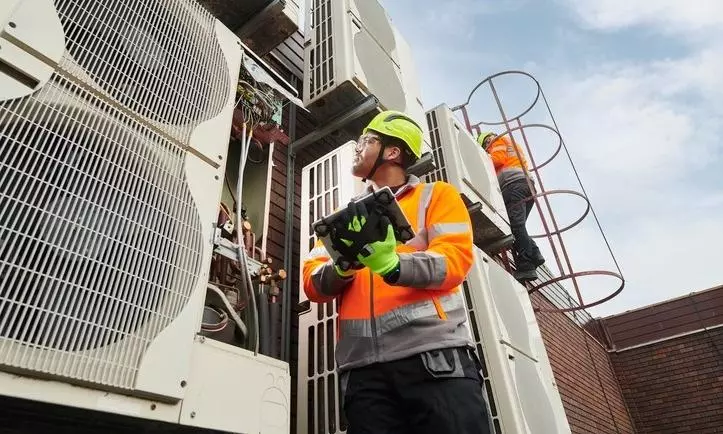
ESOs can provide heating, ventilation, and air conditioning (HVAC) services, including air filtration, cooking services, refrigeration services, and lighting, taking responsibility for rewiring buildings, and replacing old and energy-inefficient equipment with new ones of the desired capacity.
The principal constraint on mass adoption of induction cooking is not the availability or affordability of cooktops and cookware but the capacity of the buildings in which cooking has to be performed to take on the additional load, and the capacity of the local grid to sustain the increased load — cooking would be concentrated in certain times of the day when a sudden surge in the demand for electric power occurs simultaneously.
India is experiencing a cooking gas shortage amid a heatwave. That means the power demand for air-conditioning would also go up.
Power versus energy use
As consumers of electricity, we mostly worry about how many units of electricity we consume and how much that costs. That is to say, we do not bother about the distinction between the electric power we need and the electricity we consume. It is straightforward enough, without grappling with Watts’ Law and Ohm’s Law on the relationships between power, voltage, resistance and current.
Analogies work. Think of power as water pressure, and electricity consumption as the water collected by turning on the tap for a particular period of time. If the only purpose was to collect water, the pressure matters only with regard to the time taken to collect the desired amount. But suppose the water is meant to turn a turbine of a particular size. Then, the pressure of the water matters. You need a minimum level of pressure to turn a turbine.
Also Read: Coal India plans to e-auction 25.62 MT coal in April amid energy crisis
You need a minimum level of power for certain kinds of equipment to work. An air conditioner might require 1,500 Watts, an electrical iron, 2,000 W and a geyser, 1,000 W. If you want to switch all these on at the same time, your sanctioned load must be in excess of 4,500 W. Depending on how long you run these, you will consume different amounts of electrical energy, measured as Watthours (Wh), or thousands of Watthours, kWh, each unit of what is billed being one kWh.
Infra upgrade challenge
Consider an apartment block with 28 flats, each flat with a sanctioned load of 7.5 kilowatts or 7.5 kW, this accounting for their normal usage of heating, cooling, lighting, use of water pumps, etc. If 20 of these flats start using induction stoves with an average power rating of 2,000 W, the building’s wiring will have to accommodate an additional load of 40 kW, an increase of 19%.
Even if the building’s wiring and circuit-breaker infrastructure has 20% redundancy built in, that cushion would disappear if induction cookers are introduced, and the risk of electrical fires, which are hard to put out, would go up.
In other words, the introduction of induction cooking on a scale large enough to counter the shortage of cooking gas cannot be a matter of individual choice and action. It calls for additional investment in infrastructure to be undertaken by whoever looks after facilities at the building complex, and by distribution utilities to strengthen the grid.
If heatwave conditions persuade more people to invest in multiple air conditioners, the load per household and for the building would also go up, again calling for collective infrastructure upgrades. Who would carry that out, and who would pay for it?
Where ESOs can step in
This is where energy service organisations make sense. They could spare apartment owners and their management committees of the need for upfront capital investment.
These companies can offer to provide heating, ventilation, and air conditioning (HVAC) services, including air filtration, cooking services, refrigeration services, and lighting, taking responsibility for rewiring buildings, and replacing old and energy-inefficient equipment with new ones of the desired capacity, giving the households the option of ownership of equipment or of assured service of the equipment without having to own, maintain, and periodically replace the equipment.
Also Read: India's cooking gas crisis has a homegrown solution — induction stoves
Such companies would have economies of scale in purchase of different types of equipment, in maintenance and repair, in bulk purchase of electricity from renewable providers and from the distribution utility, and, crucially, in obtaining financing for the needed equipment purchase and infrastructure upgrades. These economies of scale could be shared with end-consumers.
For the slums, too
The poor are often deprived of intended benefits of concessional electricity tariffs, because they do not have meters for their individual units in a large building, and the cumulative power consumption by the landlord would be in excess of the threshold for concessional power tariffs.
These energy service companies can be mandated to install individual meters in every rented unit, so that their electricity consumption can be accurately billed at the concessional rate, even if the company buys the power in bulk from the utility.
Urban slums can form their own cooperatives to perform the functions of an energy service organization, with mentoring by voluntary groups, and possible financial assistance from the local government. This alternative might be needed to overcome the trust deficit that occupants of informal dwellings could face from formal energy service companies.
Competition, regulation
Multiple such companies could operate in a neighbourhood, so that consumers have a chance to see which ones work better, and competition would keep the companies on their toes. Such companies should be registered with the electricity regulatory body, and accountable for standards of service to consumer courts. The companies could be asked to obtain certificates of meeting process standards, as well.
(The Federal seeks to present views and opinions from all sides of the spectrum. The information, ideas or opinions in the article are of the author and do not necessarily reflect the views of The Federal.)