MP Parameswaran obit: The nuclear scientist who became Left's conscience-keeper
The scientist who left BARC to popularise science, embraced Marxism on his own terms, and spent his final decades arguing for power to be devolved to the grassroots

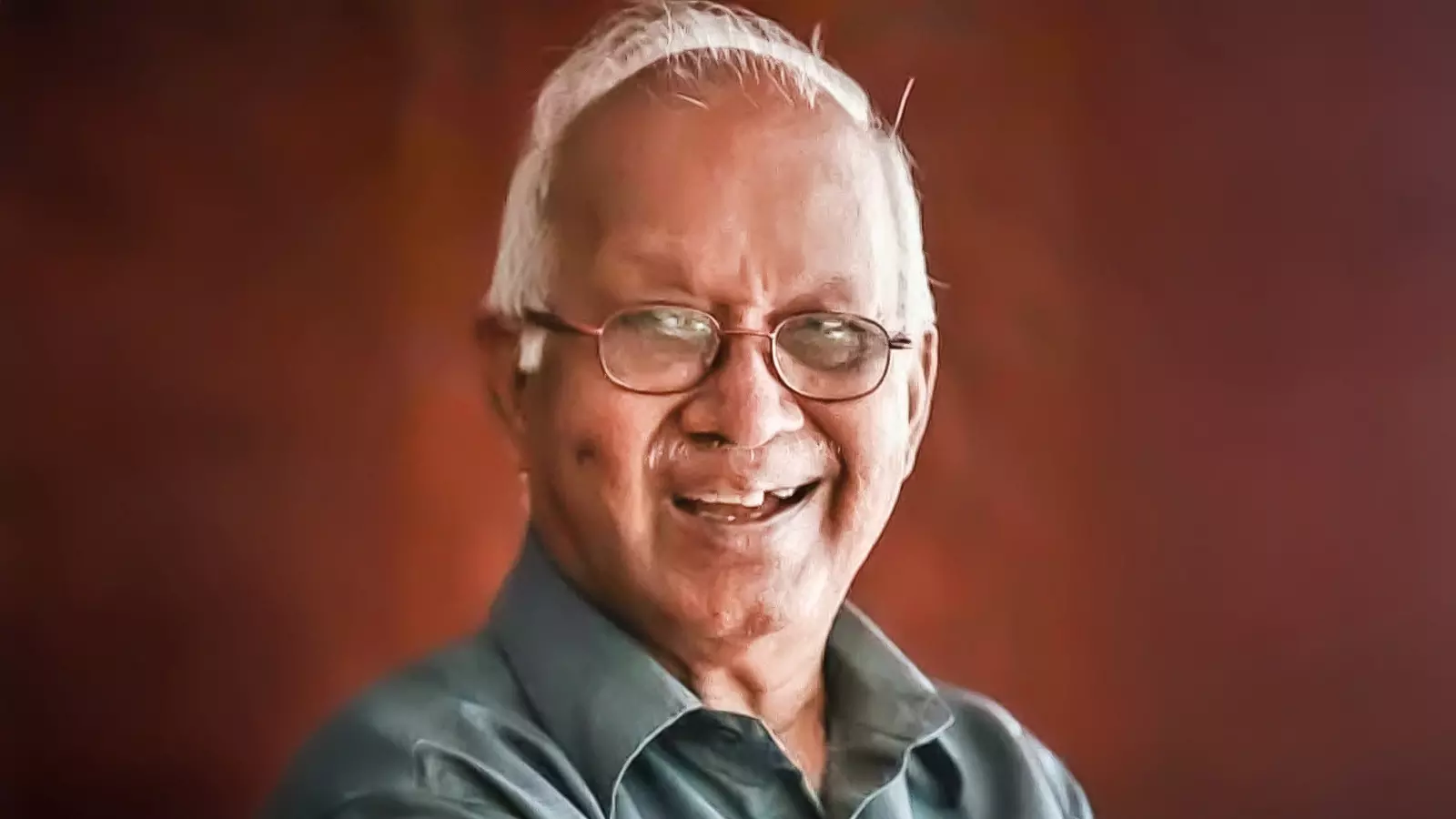
MP Parameswaran: January 18, 1935 to August 11, 2026
Marxist theoretician, nuclear scientist and popular science activist MP Parameswaran passed away on Tuesday (August 11). He was 92.
He was born on January 18, 1935, in the village of Kiralur, Thrissur district, Kerala. He earned a degree in Electrical Engineering from the College of Engineering, Thiruvananthapuram, and a PhD in Nuclear Engineering from the Moscow Power Engineering Institute.
Multifaceted personality
He worked as a scientist at the Bhabha Atomic Research Centre (BARC) from 1957 to 1975, before leaving his job to devote himself to popularising science.
Also read: S Janaki obit: The singer whose voice transcended languages and generations
A multifaceted personality, Parameswaran was a scientist, science communicator, writer, theoretician and literacy activist. He was also one of the founders of the Kerala Sasthra Sahithya Parishad, a popular science movement.
Parameswaran began his working life with the atom and spent much of the rest of it trying to understand the human being.
A nuclear engineer who worked at BARC and later spent time in the erstwhile Soviet Union, Parameswaran could have remained within the world of laboratories, reactors and high science. Instead, he returned to Kerala with a different question. What good was science if it remained locked inside laboratories and textbooks, away from ordinary people?
That question took him in an unexpected direction.
Drawn to Marxism
By 1975, Parameswaran had left the nuclear establishment and immersed himself in the Kerala Sasthra Sahitya Parishad. Science, for him, was no longer merely a professional discipline. It became a way of reaching people, encouraging them to question authority and making them participants in the production of knowledge. The popular science movement became his political classroom.
Also read: Vijaya Mehta obit: How the stage veteran reshaped modern Indian theatre, mentored generations of act
His Marxism grew in much the same way. It was not simply a matter of accepting a prescribed ideological line. He was drawn to Marxism because of its concern with inequality, exploitation and the possibility of a more just society. But Parameswaran was never entirely comfortable with a Marxism that became an article of faith.
That distinction would eventually put him at odds with the party he had been associated with.
Parameswaran's Left was curious, argumentative and open to influences outside the traditional communist canon. Gandhi, environmentalism, feminism, human rights and advances in science could all enter his political imagination. He did not see Marxism as a closed room. He saw it as a way of asking questions about society, and therefore something that had to respond to changing realities.
This was also what drew him towards decentralisation.
The People's Plan Campaign
For Parameswaran, democracy could not be reduced to voting once every five years or to the transfer of power from one political establishment to another. If people were to have a meaningful say in their lives, power had to move closer to them. Local governments could not remain implementing agencies waiting for instructions from the state capital. They had to become places where people could deliberate, plan and decide.
His engagement with Kerala's decentralisation experiment gave these ideas a practical setting. The People's Plan Campaign of the 1990s offered a rare opportunity to test whether the language of participatory democracy could be converted into institutions. Planning was taken closer to the people. Local bodies were given resources and responsibilities. Ordinary citizens were invited into processes that had traditionally belonged to bureaucrats and politicians.
‘Fourth World’ idea
Parameswaran saw something larger in this than administrative reform.
He saw the possibility of another way of organising society.
That possibility found its most provocative expression in his idea of the "Fourth World". The idea emerged after the collapse of the Soviet Union and the disillusionment that followed the failures of actually existing socialism. Parameswaran was unwilling to respond by simply accepting capitalism as the only remaining model.
But neither was he prepared to defend the old socialist model merely because it carried the Marxist label.
The Fourth World was his attempt to think beyond that binary. It imagined a society made up of a network of self-reliant local communities, with production and decision-making decentralised as far as possible. It drew from Marx's concern for equality, Gandhi's emphasis on self-sufficient communities and the environmental movement's warning against limitless consumption. Technology was not to be rejected. It was to be used to make smaller communities more capable and less dependent.
Expulsion from CPI(M)
The idea was controversial precisely because it challenged the certainties of orthodox Marxism.
His expulsion from the CPI(M) in the early 2000s, following the controversy over the Fourth World, exposed a fundamental difference between Parameswaran's Left and a more dogmatic Marxist tradition.
Parameswaran never really left the party. The party expelled him, but the relationship was never marked by bitterness or hostility. The party too did not go harsh on him, even if it could no longer accommodate his ideas within its organisational framework. Parameswaran understood that the party had its own logic, rooted in its reading of dialectical materialism, and he respected that even when he disagreed with its conclusions. The party, in turn, seemed to recognise that his disagreements came from within the Left and not from a rejection of it. The expulsion was therefore less a dramatic break than an acknowledgement that Parameswaran's intellectual journey had taken him somewhere the party could not follow.
Populariser of science
There is something almost fitting about the journey. The nuclear engineer who once worked with the most concentrated form of technological power eventually became an advocate of dispersing power.
He moved from the reactor to the village meeting, from high science to popular science, from Marxist theory to the messy experiments of local democracy. His politics became less about capturing the state and more about asking how much power ordinary people could exercise without waiting for the state to give it to them.
The Fourth World was never a finished political blueprint. It was an invitation to imagine differently. Its importance perhaps lies less in whether every part of the idea can be implemented than in the question it leaves behind: can a democratic and egalitarian society be built by concentrating power, or does it have to begin by giving people greater control over the places where they live?
Parameswaran spent his life moving towards that question. The nuclear scientist became a populariser of science. The Marxist became a critic of Marxist orthodoxy. And the political ideologue eventually became one of Kerala's most persistent advocates of taking power closer to the people.