Vijaya Mehta obit: How the stage veteran reshaped modern Indian theatre, mentored generations of actors
The legendary actor-director died on Tuesday after prolonged age-related illness. She was 91. From founding the theatre group Rangayan to introducing audiences to new dramatic idioms inspired by Bertolt Brecht and Anton Chekhov while remaining deeply rooted in Indian traditions, Mehta helped redefine modern theatre in India.

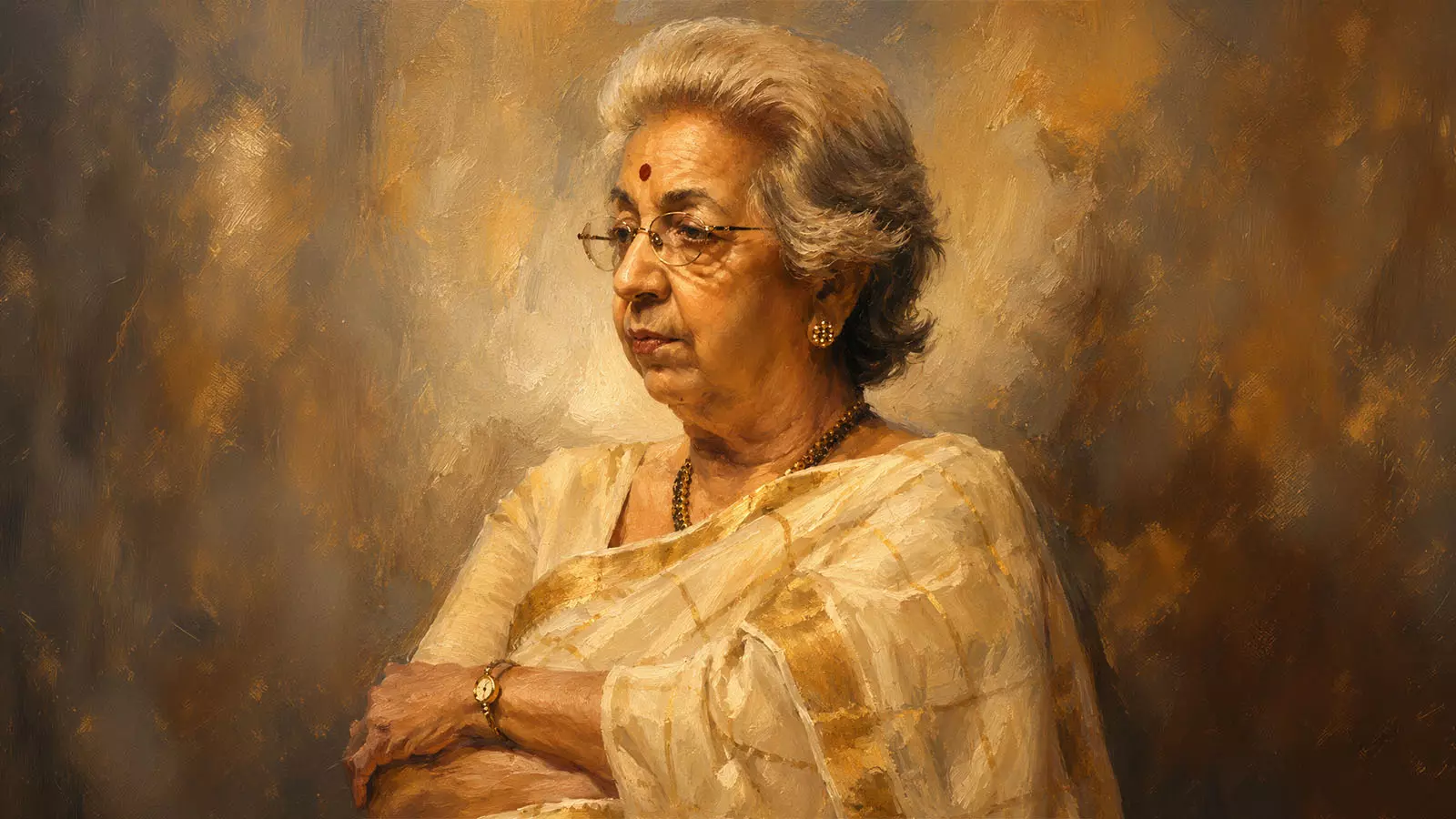
For nearly seven decades, Vijaya Mehta remained one of the rare directors equally respected by actors, scholars and audiences. Photo: By special arrangement
One of the principal architects of post-Independence Indian theatre, director, actor and theatre visionary Vijaya Mehta died late on Tuesday after prolonged age-related illness. She was 91.
For over a year, the veteran theatre-maker had remained confined to her Mumbai home owing to deteriorating health. Her death marks the end of an era that fundamentally altered the language of Marathi and Indian theatre, influencing generations of actors, playwrights and directors.
From founding Rangayan (whose experimental productions challenged the conventions of Marathi commercial theatre) to introducing audiences to new dramatic idioms inspired by Bertolt Brecht and Anton Chekhov while remaining deeply rooted in Indian traditions, Mehta helped redefine what modern theatre in India could look like.
Her influence extended far beyond her own productions. Among those she mentored were Nana Patekar, Reema Lagoo, Vikram Gokhale, Neena Kulkarni, Suhas Joshi and Anahita Uberoi, besides countless theatre practitioners who passed through her rehearsals, workshops and productions.
Remembering 'Vijaya Bai'
“This is like losing my mother. I am beyond shock. With Bai’s [madam in English] passing, it feels as though everything has come to an end,” said Patekar, struggling to come to terms with the news of her passing. Underlining how mainstream roles today are rarely written down to their finest nuances, he added: “One simply finds the character’s groove and plays it. Since there is little beyond what’s on the page, the challenge is to take something banal that’s been done a thousand times and make it look unique, serene and beautiful. Whatever ability I have to do that, I owe entirely to Vijaya Bai.”
Also read: Funeral paparazzi: With Bhagyaraj's funeral, Tamil cinema's grief was turned into circus again
His fellow-actor Neena Kulkarni, who also began her theatre innings under Mehta, recalled meeting her at a workshop meant for student awardees who had got recognised on stage in college. "When she called me for Hamidabai Ki Kothi, I remember being a bundle of nerves. There was Ashok Saraf and Bhakti Barve in the cast who were both senior to me and so well-known. And then there was Nana, who, despite it being his first professional play, was already the cool cat. She had identified that nervousness as my character's signature trait and let me stew in my juices as we began practice."
She recalls how Mehta never got up to demonstrate something. "She would cue you so perfectly that there was no chance you would take any other direction than the one intended."
During travels for shows, they drew closer, says Kulkarni, as she began realising the layers of her extraordinariness. "She could fuss over me and pat my forehead in a motherly way and also teach me to detach and become the character to an extent that nothing would get in the way - even if a fight broke out in the audience."
That ability to nurture rather than merely instruct emerged repeatedly in tributes from colleagues. Actor-director Vijay Kenkre called her “my guru in every sense of the word”, adding that every production reflected “a restless mind and a compassionate heart.”
Born in Baroda on November 4th, 1934, Mehta came from one of Indian cinema’s best-known families. Actor Nalini Jaywant and actor-director-producer Shobhna Samarth were her aunts, while actors Nutan and Tanuja were her cousins. Through her first marriage to Harin Khote, she was also related to the legend Durga Khote (Khote was her former mother-in-law).
Despite those connections, she chose theatre over mainstream cinema after training under Ebrahim Alkazi, building a career that would leave an indelible imprint on Indian performance. Among her landmark productions were Hamidabai Ki Kothi, Hayavadana, Ajab Nyay Vartulacha, Barrister and Ghashiram Kotwal. She also directed acclaimed films such as Pestonjee and Rao Saheb, demonstrating the same precision and psychological depth that marked her work on stage.
A lasting legacy
Shabana Azmi, who worked with Mehta in Pestonjee, recalled how the director replaced instruction with collaboration. Initially anxious about portraying the Parsi character Jeru, Azmi expected detailed directions. Instead, Mehta invited her to spend time observing Parsi families before sitting with her to build the character's emotional history. “She wanted actors to collaborate with her, not simply obey her. That gave me enormous confidence,” said Azmi, who is confident Mehta’s influence will outlive her. “Her legacy will inhabit every rehearsal room, every stage and the heart of every artist who dares to dream.”
To filmmaker Jabbar Patel, Mehta was “a colossus”. He credits Rangayan with ushering in a new movement in Indian theatre. “It was more a movement than a theatre group and credit for bringing a new grammar with it belongs to Vijaya Mehta,” he said.
Also read: Four films, four genres: How K Bhagyaraj created cinema history in 1981
Actor Anupam Kher remembered her as a director who invested deeply in performers. “She never imposed knowledge. She guided depending on need. She raised standards, not her voice.”
As chairperson of the National Centre for the Performing Arts (1993-2010), Mehta opened Indian theatre to some of the world’s most influential practitioners, including Peter Brook, Ariane Mnouchkine, Eugenio Barba, Jerzy Grotowski and Richard Schechner through productions, workshops and exchanges, recalled veteran actor Sarita Joshi. “That is what made her everyone’s ‘Vijaya Bai’,” she remarked.
For nearly seven decades, Vijaya Mehta remained one of the rare directors equally respected by actors, scholars and audiences. Her greatest achievement perhaps lay not in the productions she mounted, but in the generations of performers she inspired to think more deeply about theatre, and about life itself.