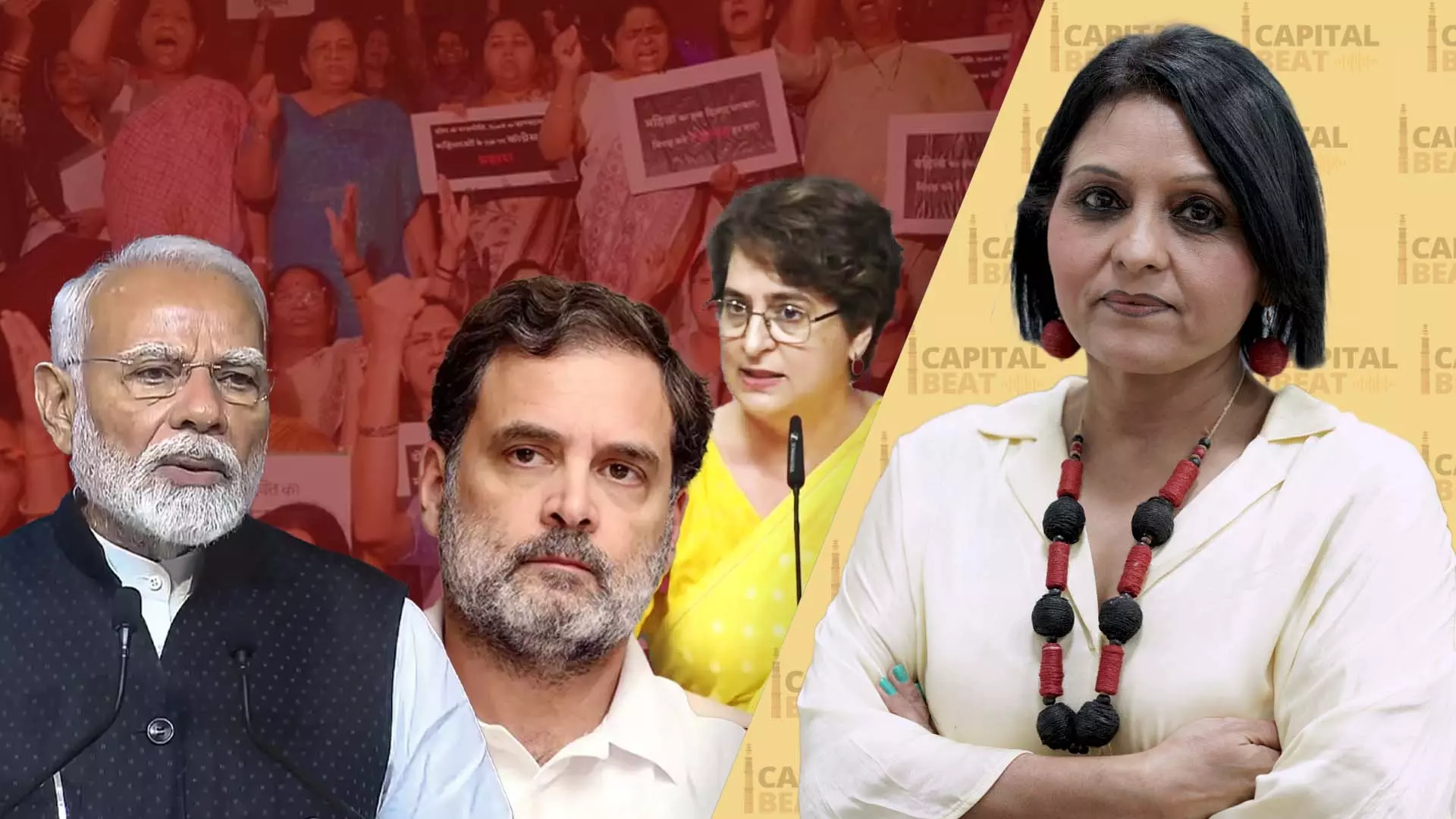
Speculation over Modi address after women’s quota hits Lok Sabha hurdle | Capital Beat
Experts tell The Federal that the government anticipated the legislative loss to build 'anti-women' campaign against the opposition

India’s political battle over women’s representation intensified after the Constitution amendment bill failed in the Lok Sabha on Friday (April 17), with experts alleging it was a “pre-planned political move” rather than a genuine legislative push.
Also read: Women's quota: Opposition has not averted delimitation danger, only deferred it
As Prime Minister Narendra Modi prepared to address the nation on Saturday (April 18) evening, questions swirled over whether the move was aimed at shaping electoral narratives rather than policy reform.
In this episode of Capital Beat, The Federal spoke with policy expert Radha Kumar, activist Shabnam Hashmi, and senior journalist TK Rajalakshmi on whether the Opposition can counter the BJP’s messaging.
Bill defeat
The Constitution (135th Amendment) Bill, which proposed 33 per reservation for women in Parliament and state assemblies, failed to secure the required two-thirds majority in the Lok Sabha. While 298 MPs voted in favour, 230 opposed it.
The bill also sought to increase the strength of the Lok Sabha from 543 to 850 and link implementation to delimitation based on the 2011 Census—conditions that became the core of opposition resistance.
The panellists argued that the BJP’s narrative quickly shifted from legislative defeat to political messaging. Within minutes of the vote, BJP women MPs staged protests with pre-printed placards, raising questions about whether the outcome had been anticipated.
Also read: Women's Quota Amendment Bill fails: Here are the key takeaways
Hashmi called the sequence “meticulously planned,” alleging that the government knew the bill would fail and intended to use it to portray the opposition as anti-women.
Narrative battle
A full-page advertisement published across national dailies further amplified the BJP’s position. It highlighted Modi’s “commitment” to women’s reservation while accusing the Congress of having an “anti-women mindset”.
Rajalakshmi noted that such messaging indicates a broader strategy. “This is essentially an election pitch,” she said, arguing that Modi’s address to the nation would likely reinforce the same narrative without explicitly naming opposition parties.
She added that the BJP may frame the defeat as a missed opportunity caused by opposition resistance, appealing directly to women voters ahead of upcoming state elections.
Meanwhile, Congress MP Priyanka Gandhi countered the narrative, stating that the opposition supports women’s reservation but opposes linking it to delimitation and census exercises.
Opposition strategy
Kumar emphasised that the opposition’s strongest response lies in legislative action rather than rhetoric. She pointed to the DMK’s proposal for a private member’s bill that seeks to implement 33 per cent reservation immediately, without linking it to delimitation.
“The opposition should support such initiatives and introduce more legislation to ensure speedy implementation,” she said. “Narrative depends on action.”
The DMK's proposal, introduced by MP P Wilson, aims to implement reservation from the next election using the existing 543 seats—offering a direct counter to the BJP’s approach.
Kumar also suggested that opposition parties field more women candidates in the upcoming elections to demonstrate commitment beyond policy debates.
Election lens
The panellists widely agreed that the timing of Modi’s national address is politically significant. With assembly elections approaching in states such as Tamil Nadu and West Bengal, Rajalakshmi described the speech as a “last-ditch attempt” to mobilise women voters.
“All his speeches are election speeches,” she said, arguing that the address would likely highlight government achievements while blaming the opposition for blocking reform.
Also read: Three grounds on which delimitation laws may be challenged in court
Hashmi went further, claiming that welfare schemes such as LPG subsidies and cash transfers are part of a broader narrative-building exercise aimed at consolidating women voters.
However, she argued that such narratives may not reflect ground realities, stating that “women continue to struggle with rising costs and lack of support”.
Delimitation debate
A key sticking point remains delimitation, which critics say could alter political representation significantly. Kumar warned that linking women’s reservation to delimitation risks delaying its implementation indefinitely.
She also raised concerns about “gerrymandering” in past exercises, citing examples from Jammu and Kashmir and Assam.
“The principles of fair representation and equal voter weight must be preserved,” she said, adding that experts are working on criteria to ensure transparency in future delimitation processes.
Hashmi echoed these concerns, arguing that the BJP’s approach avoids redistributing existing seats and instead proposes expansion—effectively creating “second-class representation” for women.
What next?
As the political battle intensifies, the Opposition faces the challenge of countering a well-coordinated narrative backed by media campaigns and grassroots mobilisation.
Also read: What is gerrymandering, and why is everyone suddenly talking about it?
The panellists agreed that while the BJP has seized the messaging advantage, the opposition can regain ground through consistent communication, legislative initiatives, and visible commitment to women’s representation.
With Modi’s address expected to set the tone, the debate over women’s reservation is likely to remain central to India’s political discourse in the coming months.
(The content above has been transcribed from video using a fine-tuned AI model. To ensure accuracy, quality, and editorial integrity, we employ a Human-In-The-Loop (HITL) process. While AI assists in creating the initial draft, our experienced editorial team carefully reviews, edits, and refines the content before publication. At The Federal, we combine the efficiency of AI with the expertise of human editors to deliver reliable and insightful journalism.)