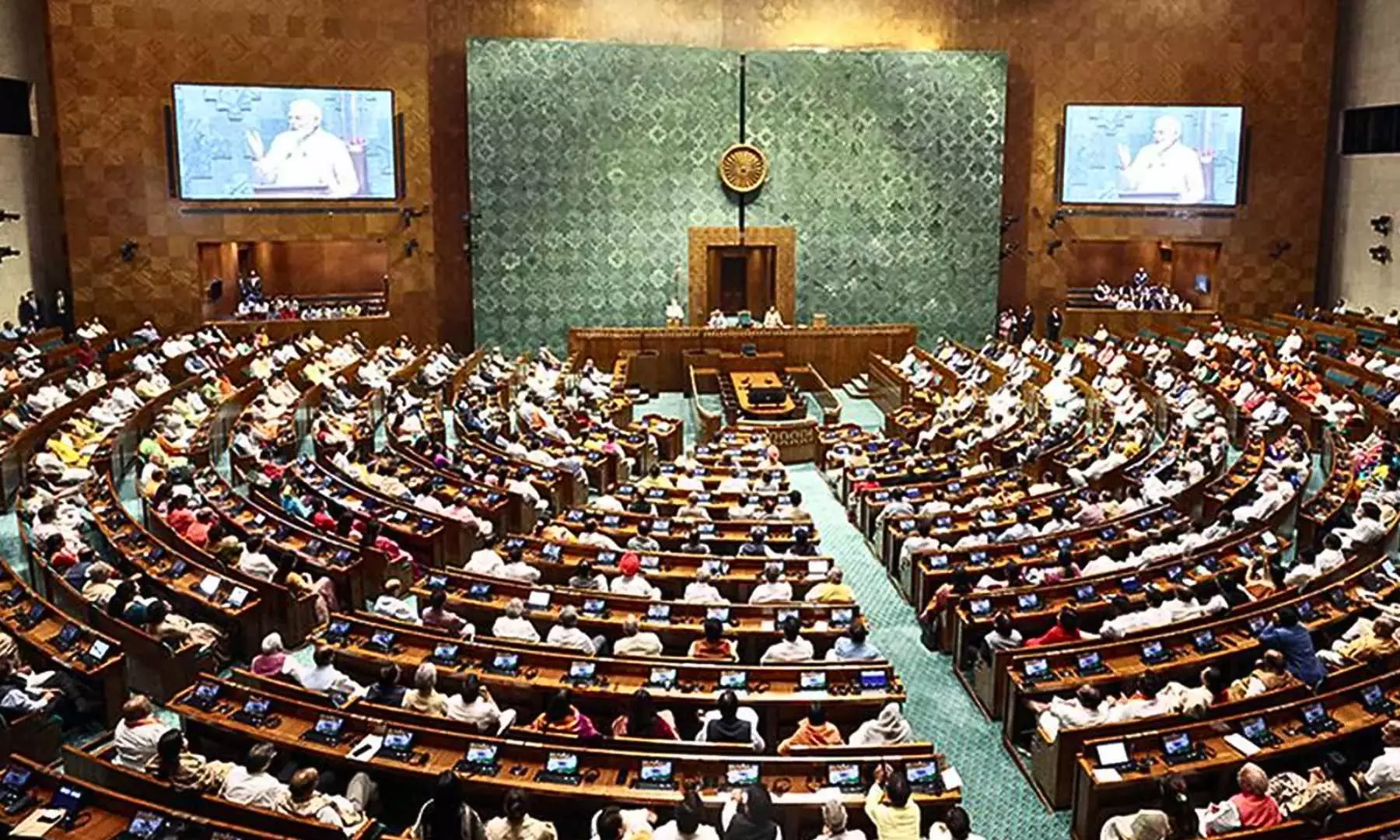
Why the Congress, SP and other INDIA allies are seeing red over delimitation
The proposed 50% seat increase raises questions about delimitation independence and the constitutional principle of “one person, one vote, one value”

In April this year, when the Centre first moved the Constitution (131st Amendment) Bill in Lok Sabha but failed to have it passed for lack of a two-thirds majority, Prime Minister Narendra Modi cried foul, blaming the Opposition for defeating a Bill guaranteeing women’s reservation. Seven months later, as the Centre prepares a fresh ploy to have that Bill passed by Parliament, the pretence of women’s reservation has disappeared.
Revised Bills put delimitation at the centre
The buzz now, as the now swollen bench-strength of the ruling NDA and the Opposition’s shrunk and fractured INDIA bloc prepare for a face-off, is firmly about delimitation; the exercise that the Opposition had always claimed was being stealthily introduced through the Constitution (131st Amendment) Bill under the garb of operationalising a women’s reservation that the Centre had kept in abeyance since 2023.
Late Friday (November 27), the Centre finally released drafts of the legislative agenda it hopes to transact when Parliament reconvenes on November 30 for an extended sitting of the monsoon session, which was adjourned sine die on August 13 but has not been prorogued for an unprecedented 105 days. The drafts of the Constitution (132nd Amendment) Bill and the Delimitation (Second) Bill make it abundantly clear that the Centre has shed its reticence to admit that the Bills are, first and foremost, about delimitation. Operationalising women’s reservation, enacted unanimously by Parliament back in 2023 but with the Centre’s insistence then for an indeterminate timeline of the rollout, is only incidental to these Bills.
Also Read: Delimitation: Can NDA reach 360? Here is the breakup
Barring a few additions to the April version of the proposed constitutional amendment, introduced no doubt as the BJP’s outreach to the DMK and the NCP-SP, the revised version of the Bill has exactly the same provisions – increasing the strength of Lok Sabha to 850 MPs, reserving one-third of these for women with the provision for a quota within the SC and ST quota for Dalit and tribal women and a uniform 50 per cent increase in seats across all states. The additions are an assurance that the inter-state ratio will be frozen till 2051 and so, by inference, the current share of all States in Lok Sabha will remain unchanged despite the change in composition of the House – both key demands put forth by the DMK.
INDIA bloc constituents such as the Congress party, the Samajwadi Party, the CPI(M), the Jharkhand Mukti Morcha and Mamata Banerjee’s Trinamool Congress (reduced to eight MPs in Lok Sabha following the defection of 20 MPs in May), are predictably seeing red over what they see not as a mere exercise of delimitation but as gerrymandering constituencies across the country to the BJP’s electoral advantage.
Assam and J&K raise concerns over electoral impact
The apprehension isn’t unfounded, especially since the only templates of delimitation before the Opposition from the Modi-era inspire little confidence of fair and bipartisan redrawing of the geographic boundaries of Lok Sabha and assembly constituencies.
While the last major pan-India delimitation happened back in 2008, the Modi years have seen redrawing of constituencies in Assam and Jammu and Kashmir. The electoral impact of those two exercises isn’t lost on the Opposition.
In Assam, the exercise has practically created a clear divide on the political map – that of a large chunk of Hindu-dominated seats suited to the BJP’s politics, anchored in communal polarisation and militant Hindu identity assertion, and a massively shrunk segment of seats where Muslims hold sway, giving the BJP’s secular rivals some advantage.
Also Read: Delimitation | The 34-vote gap: Who BJP is counting on, and who could still say no
The Assam Assembly polls held earlier this year demonstrated this theory with remarkable clarity. In the 126-member Assam Assembly, the BJP bagged 102 seats without a single MLA from the Muslim community, while the Opposition’s Congress party, Raijor Dal, Trinamool Congress and the AIUDF were reduced to a bloc of 24 MLAs – 22 of them Muslims, two Hindus; and all elected from constituencies with a sizeable population of the religious minority.
In J&K, India’s lone Muslim-majority province, the delimitation exercise deepened previously existing religious (and political) fault lines. After the delimitation exercise, the number of seats in the Hindu-dominated Jammu region, which accounts for 44 per cent of the UT’s population as per the 2011 Census, went up from 37 to 43; a 48 per cent share of the Union Territory’s 90 Assembly seats. In contrast, the Muslim-majority Kashmir division, which accounts for 56 per cent of the UT’s population, got an addition of a lone seat; its total representation in the Assembly hiked to 47 seats.
Opposition questions fairness of delimitation process
When J&K went to polls in October 2024, the political advantage delimitation provided the BJP. Given the marginally larger share of seats in Muslim-majority Kashmir division and the fact that the community also has concentrated pockets across the Jammu region, the National Conference bagged 42 seats and came to power. However, the BJP managed to widen its electoral footprint thanks to both the increase in seats in Hindu-dominated Jammu and the manner in which this region’s seats were redrawn.
The BJP swept the Hindu belt, securing its best-ever tally in J&K of 29 seats. In the districts of Udhampur, Kathua, Samba, Kishtwar, Reasi, Doda and Jammu, where a bulk of the region’s Hindu population is concentrated, the BJP’s hold was near absolute – of the 33 seats across these districts, the BJP won 28.
This is not to suggest that mere concentration of Hindus in a region puts the BJP at a clear advantage or even that the same template can be uniformly applied in every state. What must evoke interest, though, is whether pockets of Muslim concentration were being expunged by design from constituencies that previously had more religious diversity and the impact this has in electoral terms when a party weaponises communal polarisation.
Also Read: Delimitation in Telangana: Will Hyderabad LS constiuency be split?
In states or regions within a state where the Muslim population is sparse or holds little electoral sway, can delimitation be used to selectively remove constituencies from areas where the BJP’s rivals perform better and, in turn, reduce the number of seats where those rivals have a better chance of winning?
“This is exactly the concern we have – that the entire exercise of delimitation will be conducted for further ghettoising Muslims; in states without a big religious minority population the template will be tweaked to alter the caste arithmetic on seats where the Opposition is stronger and traditional constituencies of prominent Opposition leaders will also be altered in a way that will either force them to look for a new seat or to face a tougher contest in the existing seat because areas more prone to vote for the BJP will be added to their constituency,” Congress MP Mohammed Jawed told The Federal.
The BJP, predictably, rubbishes such concerns. During the discussion on the Constitution (131st Amendment) Bill in Lok Sabha in April, BJP leaders repeatedly asserted that the Delimitation Commission is an independent and autonomous body with no involvement of the Centre. They pointed out that associate members of the commission are not drawn exclusively from the BJP but are to be appointed from a cross-section of parties by the Lok Sabha Speaker and the Speaker of the State Assembly concerned.
Critics question commission’s independence
Samajwadi Party MP Rajeev Rai says while what BJP leaders claimed is “true in theory, there are enough reasons for the Opposition to suspect that in practice, this would be a completely political exercise aimed at giving the BJP an advantage”.
“Appointing associate members will be the prerogative of the Speaker of Lok Sabha and Speaker of the State Assembly. Whether the associate members represent different parties or are drawn only from BJP and its allies will be decided by these two Speakers because the Bill doesn’t say associate members (five MLAs from the State Assembly concerned and five Lok Sabha MPs from the state concerned) have to be from all parties. Even if an Opposition MP or MLA is appointed, we have seen how the BJP intimidates and poaches MLAs from the Opposition; that MP or MLA may be with the Opposition party while acting as an associate member and still do what the BJP dictates and once the exercise is over, the person may defect,” Rai added.
Also Read: Delimitation push: Centre clears 50 pc increase in Lok Sabha seats, 25-year freeze
Arguing on similar lines, the RJD’s Manoj Jha said, “the associate member has no voting rights under the Bill; he can only recommend to the commission and the final opinion will be of the Commission’s chairperson, who will be a Supreme Court judge appointed by the Centre, and of the Chief Election Commissioner, who throughout this exercise is going to be the same Gyanesh Kumar against whom the Opposition has moved an impeachment motion for acting as a BJP agent. The third member who will have voting rights will be the election commissioner of the state, but then the Commission’s report has to be adopted by majority, not unanimity.”
“The Centre will appoint a judge of its choice to head the commission and Gyanesh Kumar will be the second member, so the Centre already has a majority in the Commission and will get adopted whatever proposals suit BJP; where is the fairness in this system,” Jha asked.
As per the Delimitation Bill, the proposals once adopted by the commission and published in the Gazette of India will not be open to challenge before “any court”. As such, while the Opposition may have drawn some solace from the legal remedies available to it against the Gyanesh Kumar-enabled and manifestly problematic SIR, the delimitation proposals, once approved by the commission comprising the same Gyanesh Kumar and a Supreme Court judge enjoying the Modi government’s confidence, will be beyond any legal challenge.
Flat seat increase faces constitutional questions
Lastly, there is also the question of whether the Centre’s move to weave into the text of Bills its assurance of a flat 50 per cent hike in seats across all states will stand legal and constitutional scrutiny.
The bedrock of Article 81 of the Constitution is the principle of “one person, one vote, one value”. Clause 2 (a) of the Article states, “there shall be allotted to each State a number of seats in the House of the People in such manner that the ratio between that number and the population of the State is, so far as practicable, the same for all States”. The only exceptions to this clause, as outlined in a proviso, are states with a population of less than 6 million.
Also Read: Inside the delimitation battle: What Centre wants and why Opposition is resisting
The proposal to offer a flat 50 per cent hike in seats across all states, effectively delinking delimitation from population figures, is in direct conflict with the constitutional principle of “one person, one vote, one value”.
The Modi government may have woven the 50 per cent hike formula into the Constitution (132nd Amendment) Bill to appease the DMK – the party had stridently opposed any delimitation based on population as southern states had achieved better family planning and population control than their Hindi belt counterparts – but it seems to have forgotten to, by design or sheer oversight, suitably change the text of Article 81(2)(a) to do away with the “one vote, one value” principle.