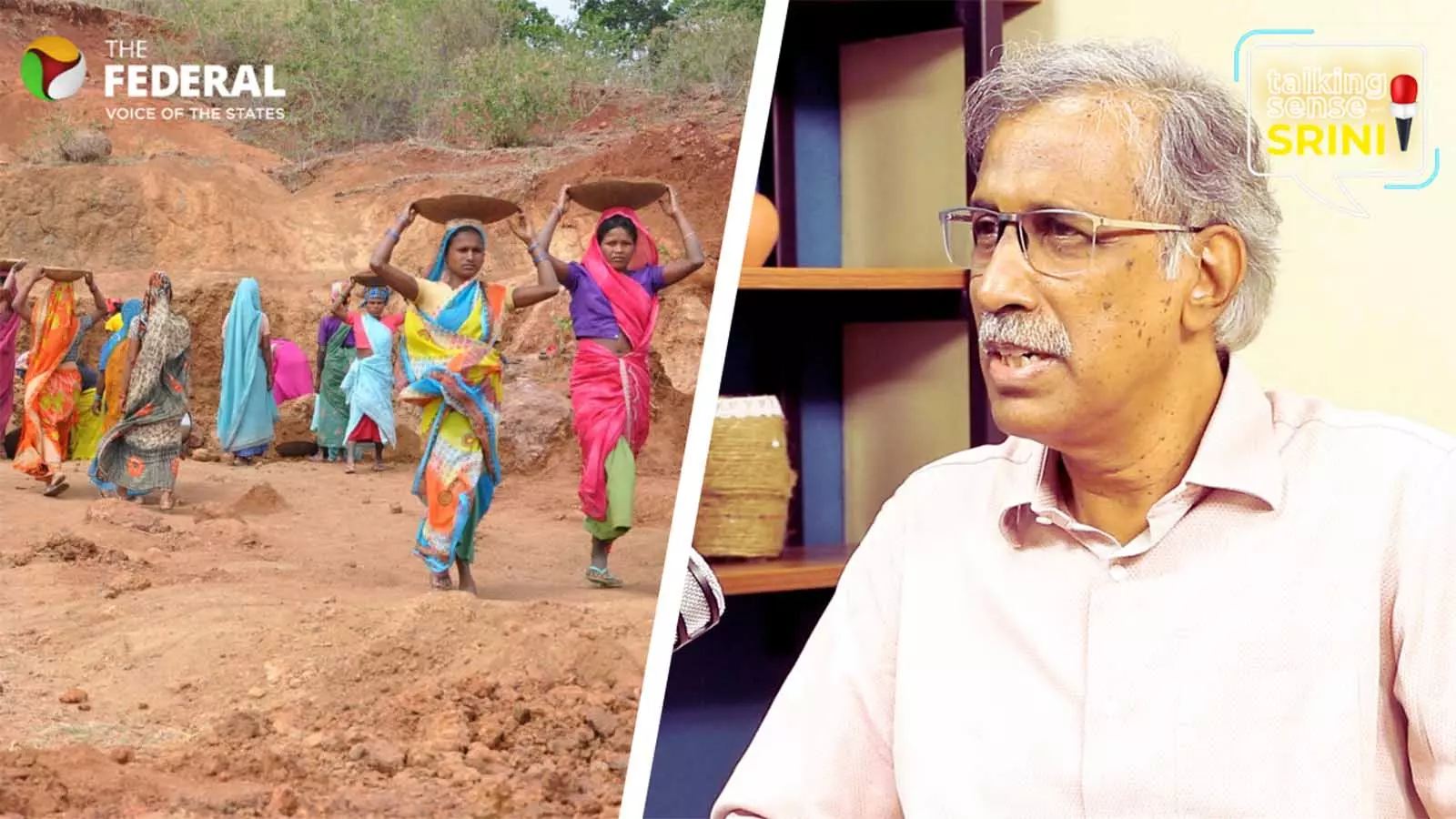
Why Centre's G RAM G spells trouble for states | Talking Sense With Srini
The recasting of MGNREGA, the nation's largest rural employment programme raises deeper questions about the gap between macroeconomic claims and ground-level realities

India’s flagship rural employment programme is facing its most consequential restructuring in two decades. The Mahatma Gandhi National Rural Employment Guarantee Act (MGNREGA) has been rechristened as G RAM G under a new Bill introduced by the Modi government, sparking political controversy and fresh concerns over funding, federal balance and employment policy.
Speaking on Talking Sense with Srini, The Federal’s Editor-in-Chief S Srinivasan said the most significant shift lies in the proposed funding structure. Under the new framework, the Centre plans to fund only 60 per cent of the wage bill, with states expected to bear the remaining 40 per cent, in addition to existing administrative and material costs. Until now, MGNREGA has functioned largely as a centrally funded, rights-based employment guarantee.
States losing ground
“This is a major change,” Srinivasan noted, warning that states are already under severe fiscal stress. Citing estimates by economists and state-level assessments, he said the additional burden on states could run into tens of thousands of crores annually. The pressure is compounded by the fact that MGNREGA’s budget allocation for 2024–25 has been cut by more than 20 per cent compared to the previous year, even as unpaid dues to workers continue to accumulate.
Also Read: MGNREGA vs VB-G RAM G: What changes for states and workers | Interview
Srinivasan also highlighted changes in how work is planned and allocated. The earlier demand-driven model, where states designed projects based on local employment needs, will be replaced by "normative allocations" determined by the Centre. Any expenditure beyond these norms will have to be met by state governments.
According to Srinivasan, this shift dilutes the scheme’s rights-based character and raises concerns about increasing centralisation in a programme implemented primarily by states.
Cosmetic changes
The Bill raises the guaranteed number of workdays from 100 to 125, but Srinivasan questioned the practical impact of this expansion. Citing official data, he pointed out that average employment under MGNREGA has remained below 55 days per worker in recent years, with only a small percentage completing even the existing 100-day guarantee. “Without addressing funding adequacy and delays, increasing the number of guaranteed days risks being merely cosmetic,” he said.
Also Read: Why MGNREGA, in G Ram G avatar, could be new pain point in Centre-state ties
Another provision mandates a 60-day suspension of work during peak agricultural seasons. While intended to prevent labour shortages in farming, Srinivasan cautioned that the pause could affect non-agricultural rural workers and restrict employment choices, particularly in migration-prone regions.
Political backlash
Beyond policy design, the renaming of the scheme has triggered a political backlash, with Opposition parties accusing the government of undermining Mahatma Gandhi’s legacy. The government maintains that the changes align with its long-term development vision.
Also Read: Why Centre’s plan to remove Mahatma Gandhi from MGNREGA has triggered a political storm
Srinivasan argued that the broader contradiction remains unresolved: if India’s economy is growing rapidly and unemployment is falling, the recasting of its largest rural employment programme raises deeper questions about the gap between macroeconomic claims and ground-level realities.