



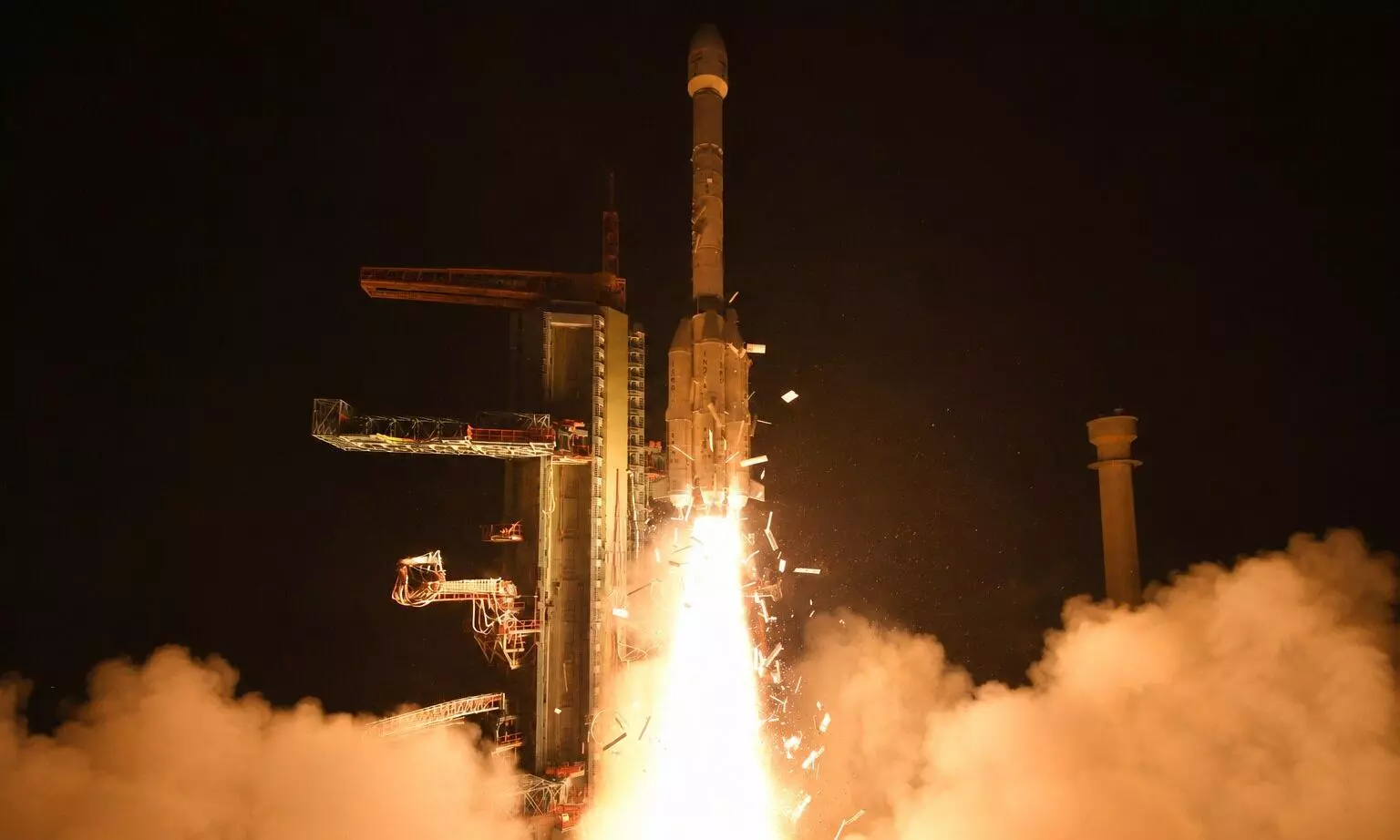
EOS-05 is India’s first dedicated imaging satellite for the geosynchronous platform. Photo: @isro
What Is EOS-05? Why ISRO’s new Earth observation satellite matters
EOS-05’s high-altitude imaging capability could enable near-continuous monitoring of weather, disasters, agriculture and environmental changes

The successful launch of EOS-05 comes as a major success for ISRO after a difficult period for India’s launch programme. At 2:55 AM on September 4, the GSLV-F17 lifted off from Satish Dhawan Space Centre carrying the 2,367 kg Earth observation satellite. Around 18 minutes later, EOS-05 reached its intended sub-geosynchronous transfer orbit.
EOS-05 reaches intended orbit
The satellite’s destination is what makes this mission different. EOS-05 is India’s first dedicated imaging satellite for the geosynchronous platform. At roughly 36,000 km above Earth, a satellite can move at the same rate as the planet’s rotation. It can therefore remain over the same broad region for repeated observation.
Most Indian Earth observation satellites operate much closer to Earth. The Cartosat and RISAT series, for example, use low Earth orbits and pass over locations at intervals. EOS-05 is designed to provide near-continuous imagery instead.
Satellite to track weather, fires
That capability has practical uses. The satellite can monitor severe weather, lightning, fires, floods, agriculture and environmental changes. Its repeated coverage also has applications for border surveillance and other strategic requirements.
Also Read: IN-SPACe overreach threatens ISRO's strategic future: G Madhavan Nair
According to a Times of India report, the EOS-05 carries two multispectral imagers. One has a spatial resolution of 42 metres per pixel, which is reportedly the highest-resolution camera in a geostationary orbit. The satellite is intended for civilian as well as strategic applications.
Success after setbacks
ISRO suffered a setback on January 12, when the PSLV-C62 carrying 16 satellites failed to place them into the intended orbit after an "anomaly" in its third stage. The PSLV fleet remains grounded while engineers conduct tests and corrective work.
Also Read: ISRO's strategic satellite delays expose cracks in India's space readiness
The GSLV has also had a difficult record. Its 19 missions include six failures, earning the rocket the nickname "naughty boy." Its development, though, is closely connected with one of India’s longest efforts to acquire advanced rocket propulsion capability.
GSLV's long cryogenic engine effort
During the 1990s, India sought cryogenic engine technology from Russia. Technology restrictions limited the transfer, leaving ISRO to pursue domestic development. The agency spent about 20 years working on the technology.
The latest mission also brings back memories of August 2021, when GSLV-F10 failed while carrying GISAT-1. An anomaly in the Cryogenic Upper Stage led to the loss of that mission. GISAT-1 had been intended to provide continuous monitoring from a high orbit.
Heavier payload marks GSLV progress
The payload itself marks a step forward for the GSLV. The first GSLV D1 mission carried a 1,536 kg payload. Friday’s launch placed 2,367 kg into orbit.
"I am very happy to announce that the GSLV F-17 vehicle has successfully and precisely injected the advanced EOS-05 geo imaging satellite in the intended and required orbit,” said ISRO chief V Narayanan.
Also Read: Modi govt emasculating ISRO through aggressive privatisation agenda: Congress
The flight was the 107th launch from Sriharikota and the 19th GSLV mission. ISRO said the satellite was healthy and that its solar panel had been deployed. Orbit-raising operations will move EOS-05 toward its final geostationary position.
The matter of launch costs
An economic question also surrounds India’s launch programme.
A 2026 paper by University of Cambridge economist Alessio Terzi and Francesco Nicoli of Politecnico di Torino examined more than 6,740 rocket launches between 1960 and 2025. Published in Economics Letters, it estimated India’s average 2025 launch cost to low Earth orbit at about USD 13,302 per kilogram, compared with USD 3,225 per kilogram for the US.
That finding provides useful context. The EOS-05 mission shows what India’s existing launch system can accomplish. The Cambridge study points to the cost challenge that remains as the country seeks to expand its space activities.
Six more launches are reportedly planned during the current financial year, while the first uncrewed Gaganyaan mission is targeted before the end of 2026.