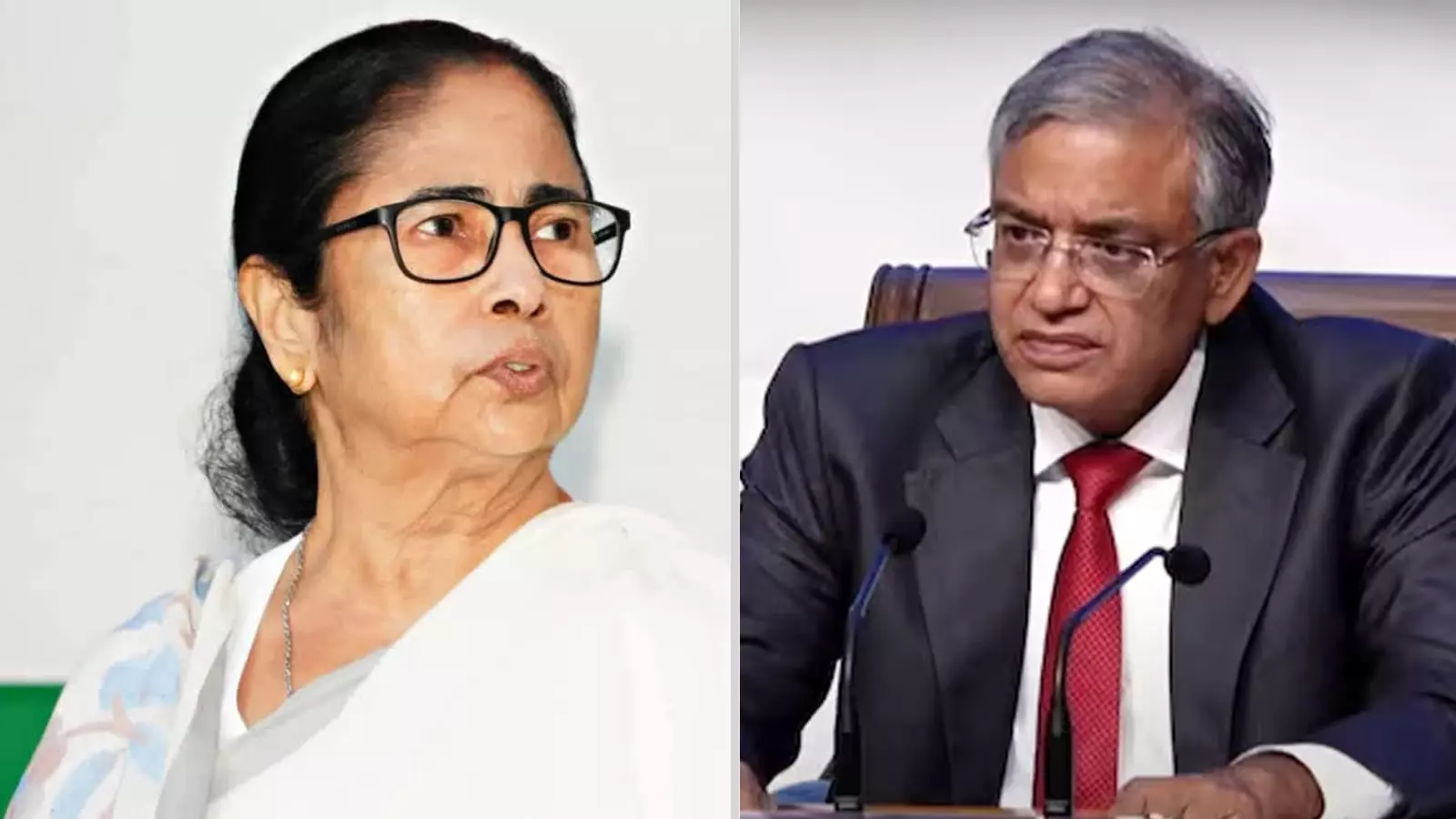
West Bengal SIR row escalates as EC summons Chief Secretary to New Delhi
The poll body pulls up several state officials, including Chief Secretary Nandini Chakraborty for alleged noncooperation

Despite repeated Supreme Court interventions aimed at streamlining West Bengal’s Special Intensive Revision (SIR) of electoral rolls, the confrontation between the Mamata Banerjee government and the Election Commission (EC) shows no sign of abating.
Tensions took a new turn after Bengal's Chief Secretary Nandini Chakraborty was summoned to the EC's office in New Delhi on Friday (February 13).
Top officer asked about 'non-compliance'
During an hour-long meeting, the top state official was reportedly asked to explain alleged non-compliance with several of the poll body’s directives.
Also read: Mamata tears into EC in Supreme Court over Bengal SIR: 'Justice is crying'
The discussions reportedly focused on the implementation of earlier orders relating to alleged irregularities in the electoral rolls.
In August last year, over the alleged enrolment of “ghost” voters, the EC had ordered the suspension of two electoral registration officers (EROs) and two assistant electoral registration officers (AEROs) in Baruipur in South 24 Parganas district and Moyna in Purba Medinipur district and directed that first information reports (FIRs) be lodged at the respective police stations.
The commission’s full bench had earlier also summoned the state's then chief secretary Manoj Pant over the state’s alleged reluctance to implement those orders.
The EC had also written to the state government directing that departmental proceedings be initiated against the four government officials and that FIRs be filed against them.
EC, state lock horns over SIR officials
Amid allegations of illegal inclusion of names and other irregularities in the Bengal voter list, the EC had directed the district election officer (DEO) to file FIRs against four officials and one staff member.
In response, the state government had informed the EC that the four officers were being suspended pending departmental inquiry and sought additional time before filing FIRs, if required.
Also read: Mamata scores brownie points before polls by taking on EC over SIR in apex court
Several months later, however, no FIR has been lodged, leading to Friday’s in-person meeting for clarification.
The EC on Friday also issued several stern administrative directives at a video conference with the chief electoral officer (CEO), district magistrates (DMs), special roll observers and roll observers.
According to officials who attended the meeting, several district heads were specifically admonished during the review.
The DMs of Cooch Behar, Jalpaiguri, Malda, South and North 24 Parganas, and Purba Medinipur were pulled up over alleged procedural shortcomings.
The DM of Purba Bardhaman was advised to refrain from making “political comments” while the Cooch Behar DM was questioned over delays in document uploads.
EC raises concerns
The EC flagged multiple instances in which documents uploaded in support of voter inclusion claims included newspaper clippings, blank pages or illegible images.
These examples were presented to district authorities and central observers through a PowerPoint presentation.
Also read: Amid SIR row, Kolkata civic body sees massive surge in domicile certificate pleas
Officials were asked who had uploaded such documents, how they had been verified and on what basis they were accepted into the system.
In written directions circulated later, the EC said the EROs and AEROs may consider only those documents specifically prescribed either by the commission or by court directives.
“Fabricated” or unauthorised documents would not be acceptable, it said, adding that DMs must take personal responsibility to ensure compliance.
It set a deadline of 5 pm on Monday (February 16) for all DEOs to personally verify and certify that every uploaded document conforms to the approved list.
If even a single impermissible document remains in the system after the deadline, the concerned DM would be held personally accountable, officials said.
Also read: Muslim voters in flux ahead of 2026 Bengal polls as SIR fuels fear
The EC’s IT team has also been instructed to monitor uploads and flag discrepancies.
During the meeting, officials were told that all documents and decisions would remain digitally stored for years and could be examined later.
If, even one, two or five years down the line, it is found that the name of a “foreign” national remains on the electoral rolls because of negligence, legal action could follow against the responsible officers.
The administrative tightening adds to an already strained relationship between the EC and the state government.
Exclusion of state-picked officers
Another point of friction has been the exclusion of a substantial number of the 8,505 “Group-B” officers nominated by the state government to serve as micro-observers for SIR hearings.
The EC claimed that many of the nominees are lower-grade clerical staff who may not meet the supervisory threshold required for quasi-judicial scrutiny of voter claims and objections.
Also read: Amartya Sen flags SIR issues: Undue haste, possible ‘class bias’, ‘faulty arrangement’
The state government maintained that the officers fall within recognised Group-B service criteria and that delays in deployment stem from differing interpretations.
The Supreme Court had earlier directed the state government to provide officers to serve as observers for SIR-related duties. It also made it clear that final decisions on voter inclusion or deletion rest solely with designated EROs.
However, disagreements over classification standards have delayed the appointment of state government-nominated officials as micro-observers in several districts.
EC choosing residential societies as polling stations
A separate dispute has emerged over the commission’s identification of 78 multi-storied residential complexes as potential polling stations ahead of the 2026 elections.
Also read: Bengal misses SC deadline on voter discrepancy list due to software delay
The state government has formally opposed the proposal, arguing that polling booths should remain in public buildings such as schools and government facilities to ensure transparency and equal access.
The EC officials have described the move as an administrative step aimed at improving voter convenience in densely populated urban areas.