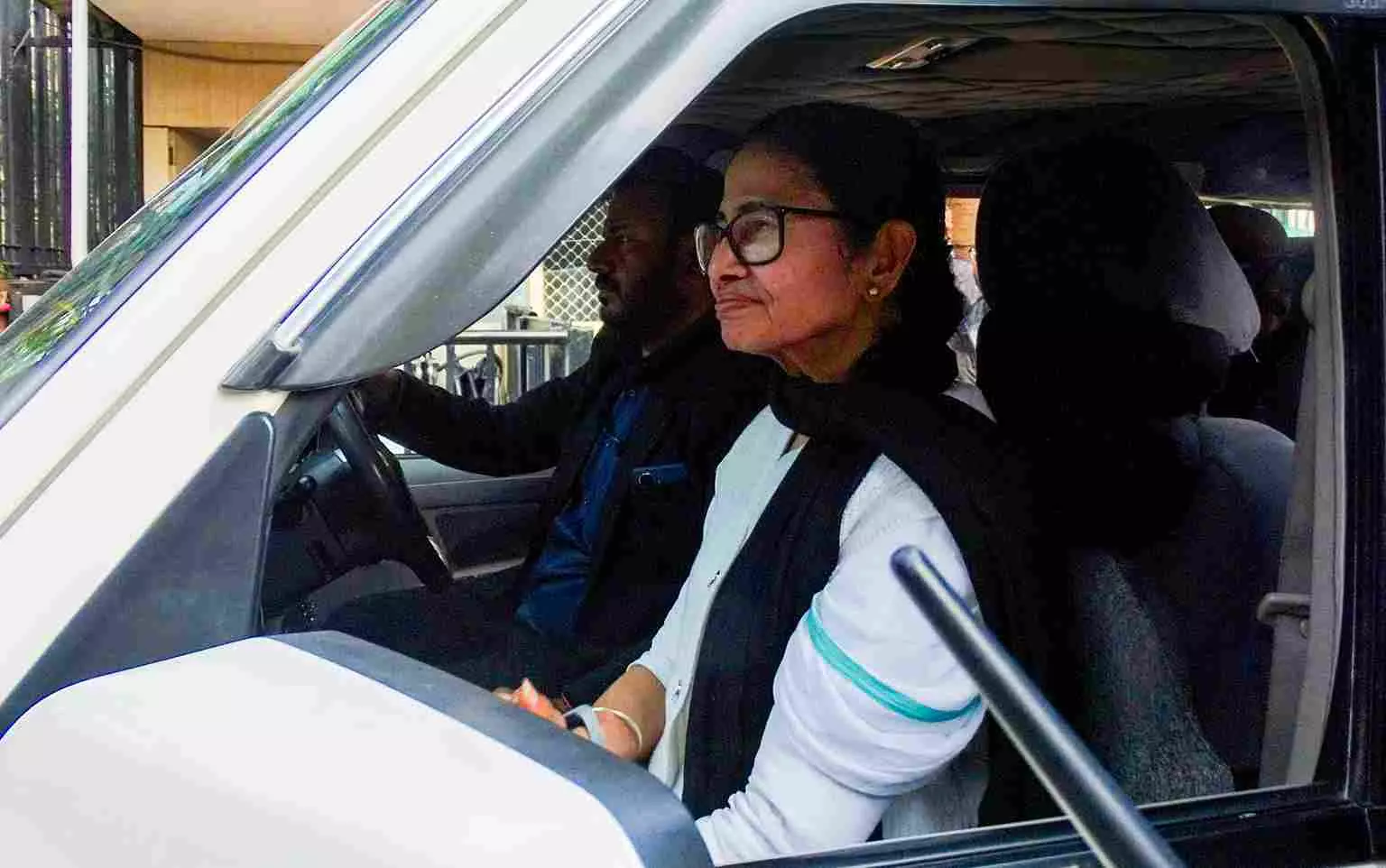
West Bengal Chief Minister and Trinamool Congress chief Mamata Banerjee on Wednesday (February 4) scored a brownie point by taking her concerns over the Special Intensive Revision (SIR) of electoral rolls in her state directly to the Supreme Court, in a move that her party believes strengthened its position.
In an unprecedented moment in the country’s judicial history, for the first time a sitting chief minister “appeared party in person” before the apex court and addressed the bench during the hearing on the SIR.
Political messaging
Standing in the front row of the Chief Justice’s courtroom, she sought and received permission to speak briefly, an act that was as much symbolic as it was strategic.
The political messaging in her brief submission was unmistakable.
“I am not getting justice anywhere. Please allow me to speak. People are suffering. I have come from West Bengal and can explain the entire situation,” she pleaded to the bench, underlining that her intervention was rooted in concerns about ordinary voters. “I am a very insignificant person. I am not here fighting for my party,” she added.
She further pointed out that names were being removed even for reasons such as a change of surname or residence, and informed the court that she had written multiple letters to the Election Commission (EC) regarding the issue but had received no response.
Through her submission, the chief minister portrayed herself and the state as victims of a targeted exercise focussed on deleting, rather than including, voters’ names.
Senior West Bengal minister and TMC’s national spokesperson Shashi Panja said, “What India witnessed today, and what people of Bengal saw was the constitutional battle spearheaded by West Bengal chief minister and TMC chairperson Mamata Banerjee. She fought for the voters of Bengal… She is rescuing voters in Bengal."
SC's safeguards
The Supreme Court’s decision to issue a notice to the EC after the hearing is being seen as a political gain for the TMC supremo, as the court formally acknowledged and acted upon the concerns she raised.
After Banerjee highlighted what she described as widespread hardship caused by the SIR process, the apex court directed the EC to respond and explain the steps it was taking.
The court also laid down specific safeguards, making it clear that no voter’s name should be deleted from the electoral rolls due to minor spelling errors or technical discrepancies.
The bench further directed the EC officials to exercise greater sensitivity while issuing hearing notices to voters, an observation that directly echoed the chief minister’s complaint that the process was being conducted in a manner that was intimidating and disruptive for ordinary citizens.
Issue of micro-observers
During the hearing, it emerged that a large number of voters had been summoned for hearings because of data inconsistencies, often arising from spelling mistakes in names, changes of surname, or changes in address.
To address these issues, the court asked the state government to submit a list of officers who are proficient in the Bengali language.
The court observed that appointing officers who understand Bengali would help resolve such discrepancies more effectively and reduce unnecessary harassment.
Significantly, the court also pointed out that if Bengali-speaking officers are engaged for SIR-related work, it may not be necessary to appoint micro-observers, a remark that TMC views as lending weight to its criticism of the current structure of the entire exercise.
The chief minister’s counsel alleged that 8,300 micro-observers had been appointed from BJP-ruled states and that they were vested with powers to remove names from the voter list, while the authority of Electoral Registration Officers (EROs) had been curtailed.
Responding to this, the commission’s lawyer argued that the state government had failed to provide an adequate number of Group-B officers for the SIR process, forcing the commission to appoint micro-observers from outside the state.
The court directed that by Monday, the West Bengal government must inform how many Group-B officers fluent in Bengali it can make available for the exercise.
Additionally, the apex court clarified that no document would be treated as valid unless it carried the signature of the Booth Level Officer (BLO), reinforcing procedural safeguards.
Notably, the BJP has expressed scepticism about the involvement of the state machinery in the SIR process, to the extent that it has been sharply critical of booth-level officers (BLOs), accusing them of partisanship.
Even BJP leaders, in private, acknowledged that if micro-level observers are replaced by state government officials and booth-level officers are further empowered, the SIR process could be unduly influenced by the TMC.
TMC reaction
For the TMC, the Supreme Court’s directions collectively amount to more than procedural instructions.
TMC leader Kalyan Banerjee claimed that by issuing a notice to the commission, questioning the role of micro-observers, and emphasising voter protection and linguistic familiarity, the court has implicitly recognised the substance of the state’s concerns.