



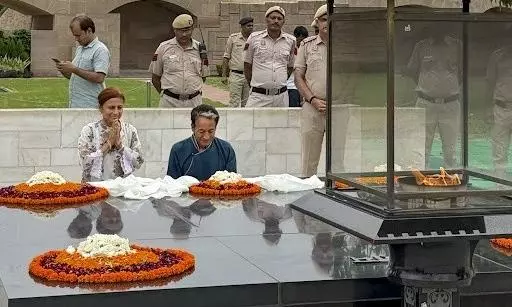
Activist Sonam Wangchuk, accompanied by his wife Gitanjali Angmo, pays tribute to Mahatma Gandhi at Rajghat after being discharged from Medanta Hospital, marking a peaceful conclusion to his 26-day hunger strike in New Delhi on Monday (July 27). Photo: X/@Wangchuk66
Wangchuk says Gandhian path vindicated as student protests force Centre's hand
Activist defends ending his 26-day fast in the presence of union ministers, says it symbolised the govt's acceptance of protesters' demands and marks only the beginning of education reforms

Climate activist Sonam Wangchuk on Monday (July 27) said the success of the recently-concluded students’ protests reaffirmed that Mahatma Gandhi's methods remain relevant, and clarified that union ministers helping him break his hunger strike signified the Centre's acceptance of their demands rather than any political endorsement.
Speaking to PTI after paying tributes to Mahatma Gandhi at Rajghat, Wangchuk said criticism over him ending his 26-day fast in the presence Union ministers Jitendra Singh and JP Nadda stemmed from a misunderstanding of the Ladakhi traditions.
"I wanted to pay my tribute to Bapu (Mahatma Gandhi). His path is as relevant today as it was 100 years ago. This experiment is successful today," he told PTI.
Explaining the controversy, Wangchuk said in Ladakh, when a government representative or senior leader helps breaks a protester's fast, it is regarded as a sign that the government has yielded to their demands.
"In Ladakh, when protests happen, it is believed that if a government representative or some big leader breaks your fast, it is considered a victory. They are bowing to you while feeding you. When that does not work out, we break our fast by the hands of a child or an elderly person," he said.
Recalling earlier protests in Ladakh, Wangchuk said a government secretary had ended his fast during an agitation at the Ladakh Bhavan, while a child had broken his 21-day fast in Leh because no government representative had turned up.
"In Ladakh, this is considered victory, maybe it is different in Delhi," he said.
‘Enduring relevance of Gandhi’s philosophy of non-violence’
Addressing reporters after paying tribute to Mahatma Gandhi, Wangchuk said the movement had once again demonstrated the enduring relevance of Gandhi's philosophy of non-violent resistance.
"People kept saying such tactics would not work on this government. I believe it is more about taking the message to the people, and every government ultimately listens to the people," he said.
Also Read: Wangchuk: No deal with Centre, ended fast fearing crackdown like Ladakh
Referring to his earlier campaigns in Ladakh, Wangchuk said Gandhi's methods had worked there too, but the latest movement had proved their relevance at the national level.
"It may be slow, but it succeeds. You may not succeed initially, but torturing yourself instead of others can melt the toughest hearts. It has been proved again," he said.
Praises peaceful movement
Congratulating the organisers and participants of the agitation, Wangchuk said the movement had succeeded because it remained peaceful despite police action.
"It did not succeed because of batons and stones, but because of peaceful protest. The baton charge would have made the situation worse," he said, urging people in India and across the world to continue following Gandhi's path.
Also Read: ‘Sonam Wangchuk’s removal was more like abduction; no legal basis at all’
Asked whether the resignation of former Union education minister Dharmendra Pradhan was sufficient, Wangchuk said it was only the beginning.
"The resignation is a start. Reforms would make the country better. I am certain we will be able to adopt them," he said, adding that any proposed legislation should be debated thoroughly in Parliament.
‘Peaceful protest our constitutional right’
He also expressed hope that the assurances given by the government would be honoured and that no action would be taken against peaceful protesters.
"Peaceful protest is our constitutional right," he said.
Also Read: How CJP protest spread to UK, USA, Europe, got Indian diaspora's support
On allegations of excessive police force during the agitation, Wangchuk said "in a democracy every minister should be accountable." Stressing that he bore no personal animosity towards anyone in government, Wangchuk said Gandhi had taught people to oppose actions, not individuals.
"I do not have hatred against anyone. If the government is wrong, it does not mean I hate them. Bapu said hate the action, not the person," he said.
‘I want India free of fear, injustice, corruption’
Expressing hope that the political developments following the agitation would usher in better governance, Wangchuk said, "I hope after this change, there is a change in the country as well and we get good governance... we can love our government again and government should love the people as well. So far there has been an atmosphere of fear, corruption has increased. I want India free of fear, injustice, and corruption. We want to look ahead with new hope," he added.
The activist was on Monday discharged from Gurugram's Medanta Hospital, after being shifted from Delhi’s Safdarjung Hospital on court orders. He was forcefully admitted to Safdarjung on July 18 by the police.
Also Read: After Centre, CJP confronts BJP-ruled states, warns Bihar, Bengal over protesters' arrests
The 36-day student-led agitation spearheaded by the Cockroach Janta Party (CJP) ended on Saturday (July 25) after the Centre accepted its key demands, including the resignation of Pradhan, the constitution of a committee to recommend reforms to the National Testing Agency, withdrawal of cases against peaceful protesters, and an assurance that no punitive action would be taken against students who participated in the movement.
Wangchuk, who joined the protest on June 28 and observed a 26-day fast before being hospitalised, formally ended his fast late on Thursday night (July 23) after the government's announcement.
(With agency inputs)