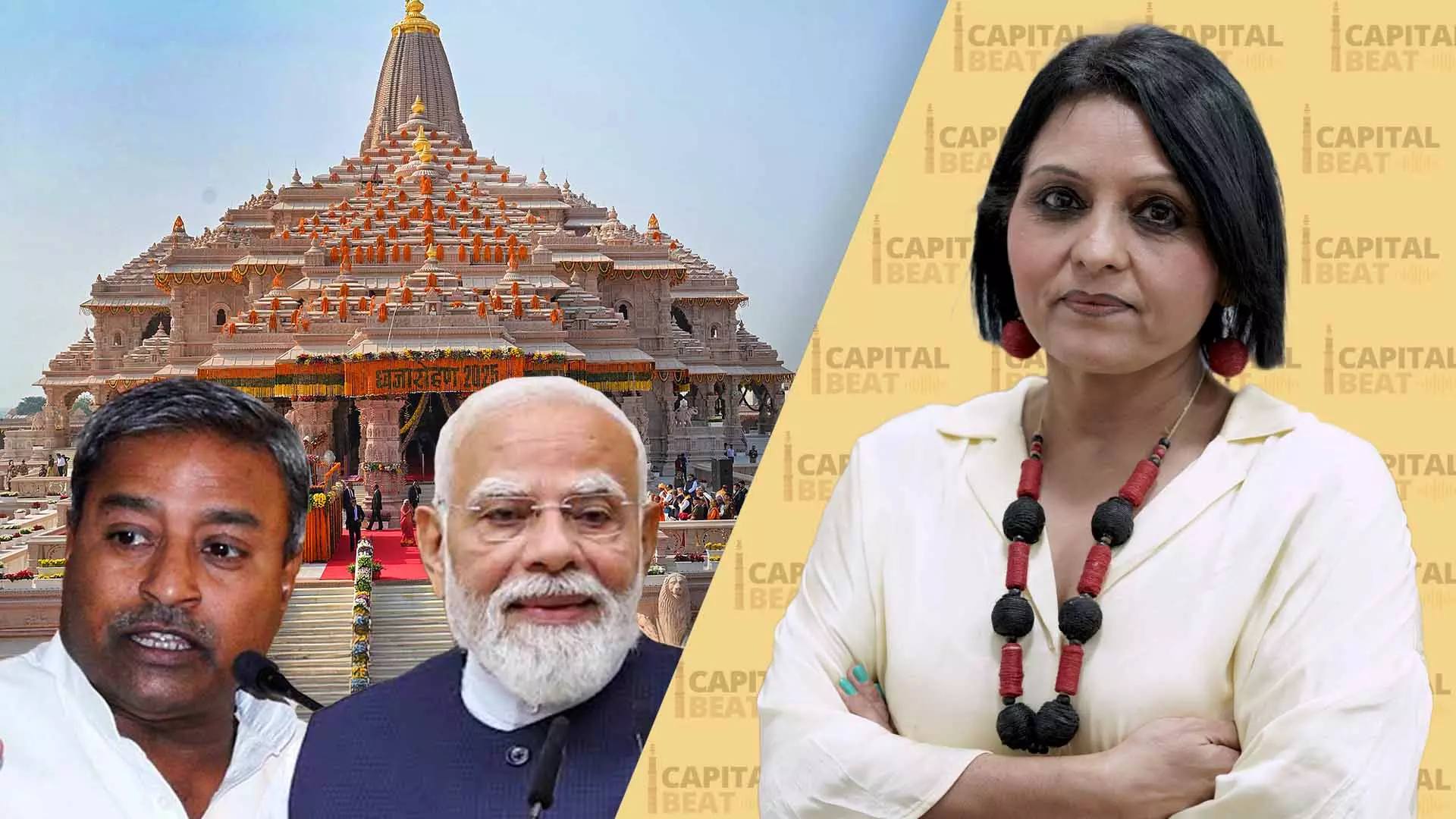
Why has Vinay Katiyar’s Modi claim in Ram temple row sparked debate?
Experts debate the timing, credibility and political implications of Vinay Katiyar's claim that he discussed the Ram Temple donation row with the PM

BJP leader and Bajrang Dal founder Vinay Katiyar's claim that he discussed the alleged Ram Temple donation fund irregularities with Prime Minister Narendra Modi has triggered a political debate.
As speculation grows ahead of the July 6 Ram Temple Trust meeting and the extended SIT probe, The Federal spoke to senior journalist Shaira Naim, political commentator Sharad Pradhan, and Samajwadi Party leader Sarvesh Tripathi about the political significance of Katiyar's remarks. They questioned not only the timing of the purported conversation but also the way it has been projected in sections of the media.
The discussion centred on Katiyar's remarks that former Shri Ram Janmabhoomi Teerth Kshetra Trust general secretary Champat Rai, administrator Gopal Rao and former trustee Anil Mishra could face jail over the alleged siphoning of donation funds. He also claimed that he had spoken to Prime Minister Modi on the issue.
Also read | RSS' Hosabale breaks silence on Ram Temple scam, wants guilty to be punished
The panel agreed that while the statement has generated considerable political interest, several aspects remain unclear, especially when the alleged conversation with the prime minister actually took place.
Timing questioned
Shaira Naim argued that Katiyar's statement lacks clarity and leaves crucial questions unanswered.
She said it is impossible to determine from the remarks whether Katiyar spoke to the prime minister before the names of Champat Rai, Gopal Rao and Anil Mishra surfaced in connection with the controversy or after those developments. She said the timing would significantly alter the political interpretation of the conversation.
She also questioned why several news organisations prominently reported that Katiyar had spoken to Modi despite a lack of clarity on whether it was a recent phone call, an earlier meeting or a conversation held in another context.
Naim noted that public curiosity surrounding the controversy has resulted in every development receiving heightened attention. However, she maintained that the remarks do not conclusively establish when the exchange took place or what exactly was discussed.
Ambiguous remarks
Sharad Pradhan echoed similar concerns, saying Katiyar's comments remain open to multiple interpretations.
He said he tried to contact Katiyar for clarification but received no response. He said that the ambiguity surrounding the statement leaves room for speculation about whether Katiyar was referring to an earlier interaction with the prime minister rather than a recent conversation.
Pradhan also questioned whether Katiyar currently enjoys the kind of direct access to the prime minister that would make such a conversation plausible. Recalling Katiyar's own disappointment over not receiving an invitation to the Ram Temple consecration ceremony, he suggested the political equation between the BJP veteran and the party leadership had changed over the years.
At the same time, Pradhan observed that the names mentioned by Katiyar in his statement are linked to the ongoing controversy, making it unlikely that the conversation, if it occurred, belonged to a distant past.
Political messaging
The discussion then shifted to whether the statement served a larger political objective.
Pradhan suggested there could be an attempt to convey that Prime Minister Modi is monitoring developments surrounding the controversy even if he has not commented publicly. In his view, projecting Katiyar's claim could create the impression that the prime minister is closely tracking events on the ground.
Also read | Why Yogi's Ram temple theft crackdown has Sangh, BJP shaken | Capital Beat
He also argued that the alleged conversation appears unusual because Katiyar claimed Modi asked him what might happen next. Pradhan said such an exchange seemed unexpected, although he acknowledged it could also reflect an attempt by the prime minister to gauge public sentiment in Ayodhya.
Naim said that if any communication had indeed taken place, both Katiyar and the prime minister could derive political value from it. While Katiyar could reinforce his own relevance by suggesting he has direct access to the country's highest political office, she said the prime minister could simultaneously distance himself from the controversy.
Relevance debate
Sarvesh Tripathi argued that Katiyar's intervention should be viewed as part of a broader political process rather than as an isolated statement.
According to him, Katiyar remains one of the few surviving faces closely associated with the Ram Temple movement and therefore continues to possess symbolic credibility on issues relating to Ayodhya. He contended that this credibility makes Katiyar useful in shaping public perception around the controversy.
Tripathi described the statement as the beginning of what he called a "damage control" exercise. In his view, the message being conveyed is that the prime minister is aware of the allegations and will ensure accountability if wrongdoing is established.
He further argued that Katiyar's public remarks could also help restore his own political visibility after remaining largely absent from national political discussions in recent years.
Media narrative
Another issue discussed by the panel was the role of media coverage in amplifying Katiyar's remarks.
Pradhan noted that Katiyar had chosen to speak to ANI and suggested that this itself could fuel speculation about the significance of the statement. He said the extensive reporting by multiple news outlets created the impression that the prime minister's alleged conversation with Katiyar represented a major political development.
However, Naim cautioned against drawing definitive conclusions solely on the basis of media reports. She pointed out that Katiyar's original remarks differed in tone and detail from the way some television channels and websites paraphrased them.
She said the statement remains too ambiguous to support firm conclusions regarding either political strategy or future legal developments.
Trust meeting ahead
The panel also discussed the significance of the upcoming July 6 Ram Temple Trust meeting and the recent decision to extend the SIT investigation by another 15 days.Also read | Ram temple donation scam: Real crackdown or bid to shield real kingpins?
Pradhan suggested that if important decisions emerge from the Trust meeting, Katiyar's statement may later be viewed as an early indication of political developments behind the scenes. He also argued that any action against individuals associated with the Trust could be projected as evidence of accountability.
Tripathi, meanwhile, maintained that the controversy has now reached the level where questions are increasingly being directed at the prime minister rather than lower-ranking functionaries. He said Katiyar's statement may have been intended to prepare public opinion for future political developments.
Despite the extensive discussion, the panel acknowledged that several questions remain unanswered. Whether Katiyar's claimed conversation with the prime minister actually occurred in the context he suggested, when it took place, and whether it signals a larger political strategy remain open questions until further developments emerge from the ongoing investigation and the Trust meeting.