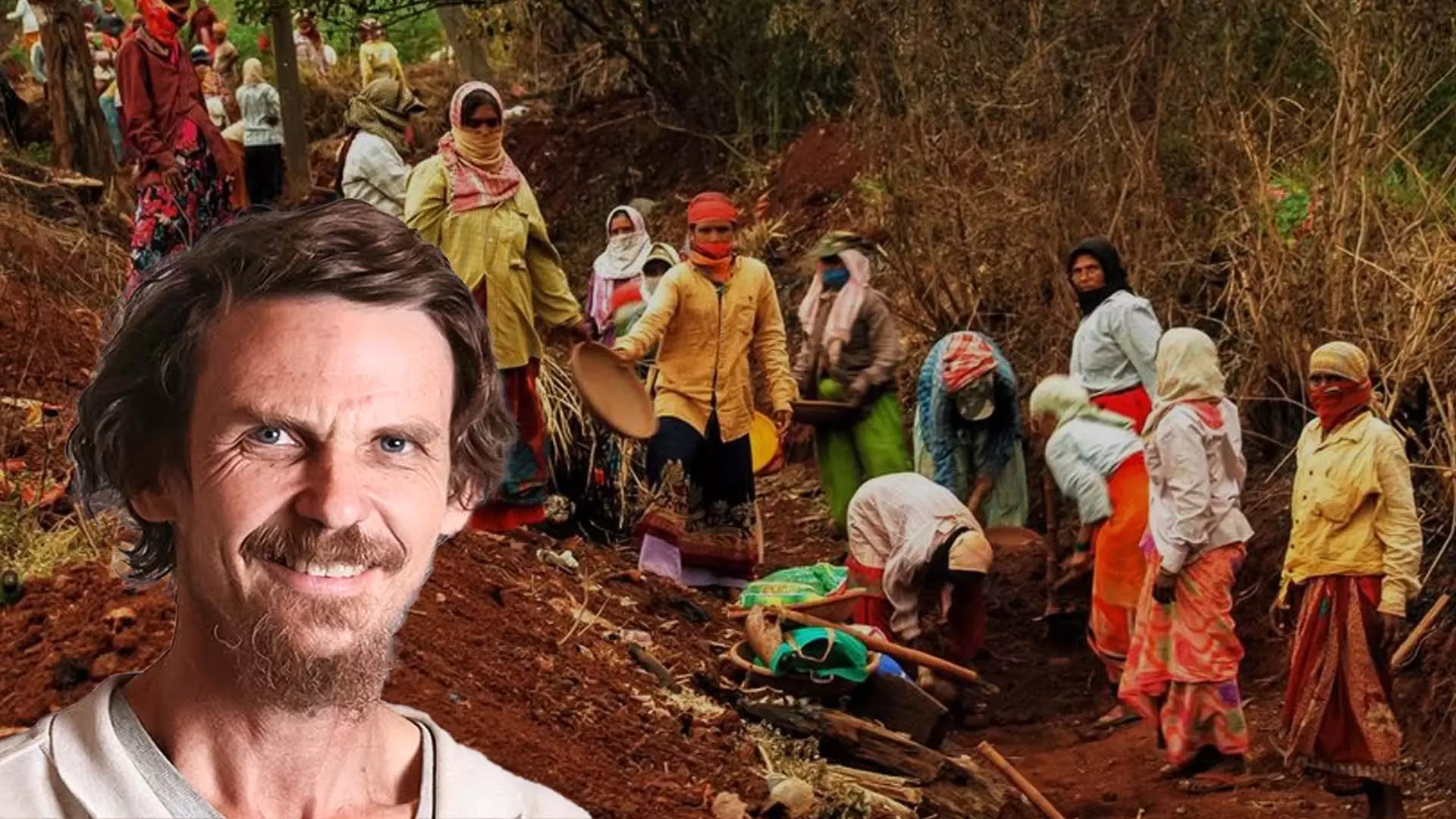
VB-G RAM G Bill repeals job guarantee, warns economist Jean Dreze
MGNREGA faces a major overhaul as a new bill shifts power to Centre. Economist Jean Dreze explains why states and workers should worry about what changes now

The Federal spoke to economist Jean Dreze on the controversy surrounding the proposed VB-G RAM G Bill, which seeks to replace the National Rural Employment Guarantee Act.
Dreze explained why he believes the bill weakens the legal job guarantee, shifts financial burdens to states, and undermines the federal structure. Excerpts from the interview:
There is major opposition to the VB-G RAM G Bill, especially over removing Mahatma Gandhi’s name. How do you see this change?
The change of name is a red herring. It is not the main issue. The change is unnecessary and detracts from the non-partisan nature of the Employment Guarantee Act. I am not in favour of it, but it is not what really matters here.
The real issue is the content of the bill and the way it repeals the Employment Guarantee Act. This is not a renaming and certainly not a revamping. It repeals the National Rural Employment Guarantee Act under Section 37.
Also read: VB-G-RAM-G Bill will end MGNREGA in months, says Priyanka Gandhi
It replaces the Act with a centrally sponsored scheme that operates at the discretion of the central government. The Centre retains all powers, including deciding where and when the scheme will apply. That defeats the purpose of an employment guarantee. It is like saying, “I give you a work guarantee, but I don’t guarantee that the guarantee will actually operate.”
How does this new structure affect states financially?
The bill gives the Centre discretionary powers, including deciding financial allocations to states. Beyond those allocations, states will have to pay 100 per cent of the cost.
For instance, if the Centre decides Kerala does not need support, it can stop funding employment guarantee there. Kerala would then have to run the programme entirely on its own.
Kerala may manage, but poorer states will struggle. The financial burden will be very heavy, and employment levels will fall.
Does this bill change basic idea of MGNREGA as a legal guarantee?
Yes, because there is no real guarantee left. Even when the original Act was drafted 20 years ago, the Centre tried to include a clause allowing it to decide where and when the scheme would apply.
We opposed that clause at the time, and it was removed. That is precisely why the Employment Guarantee Act had teeth.
Also read: G RAM G Bill passed in Lok Sabha as Centre and Opposition trade jibes
Now those teeth have been pulled out again. This is not reform or revamping. It repeals the Act and replaces it with a scheme that is neither a real guarantee nor a legal one.
If not this bill, what kind of changes should have been made?
We are not against amending the Act. My position is simple: junk this bill and then talk about constructive reforms.
This bill contains no constructive provisions. It is full of restrictions — discretionary powers, arbitrary funding, stopping employment during peak seasons, and forcing workers to renew job cards every three years.
Everything here is about restricting access.
The government says workdays have been increased from 100 to 125. Is that meaningful?
That too is a red herring, for two reasons.
First, most households do not even get 100 days today. Only about 2 per cent of rural households actually reach 100 days of work because of systemic hurdles. So, it is only a tiny fraction will benefit from the higher ceiling.
Second, while the government claims to raise the ceiling, it cuts financial support. So the promise is misleading.
Will this bill increase the financial burden on states?
Absolutely. Especially for poorer states, even contributing 40 per cent will be very difficult.
The bill’s own financial memorandum says it imposes a burden of ₹55,000 crore on states. That is the government’s figure.
Beyond the Centre’s state-wise allocations, if states want to spend more, they must fund it entirely themselves.
You were part of the advisory council during the UPA years. Was MGNREGA effective then?
There was a phase when it worked quite well.
Data from 2011–12, from the National Sample Survey and the India Human Development Survey, show that employment generated under the Act matched independent survey findings. That means the work was real and reached real people.
MGNREGA today is not what it used to be. I strongly support improvements, but this bill does not improve anything
Around half the workers were women, and nearly half were from Scheduled Caste and Scheduled Tribe communities. Market wages also rose because of increased employment.
After 2013–14, things deteriorated due to excessive complications, overuse of technology, underfunding, and failure to punish corruption.
Also read: 'VB-G RAM G Bill undermines MGNREGA spirit', says Shashi Tharoor
MGNREGA today is not what it used to be. I strongly support improvements, but this bill does not improve anything.
Is this bill a concern only for Opposition-ruled states?
Not at all. Even states governed by parties allied to the Centre should oppose it.
The bill shifts all obligations to states while freeing the Centre of responsibility. The Centre keeps all powers and sheds all accountability.
The content above has been transcribed from video using a fine-tuned AI model. To ensure accuracy, quality, and editorial integrity, we employ a Human-In-The-Loop (HITL) process. While AI assists in creating the initial draft, our experienced editorial team carefully reviews, edits, and refines the content before publication. At The Federal, we combine the efficiency of AI with the expertise of human editors to deliver reliable and insightful journalism.