Immigration consultant and author Rajkamal Rao says the US is still the best place to study and American higher education system is world class
Trump trouble: Is American dream over for Indian students, techies?
The easy route from Indian campus to career in the US is over, says immigration expert Rajkamal Rao

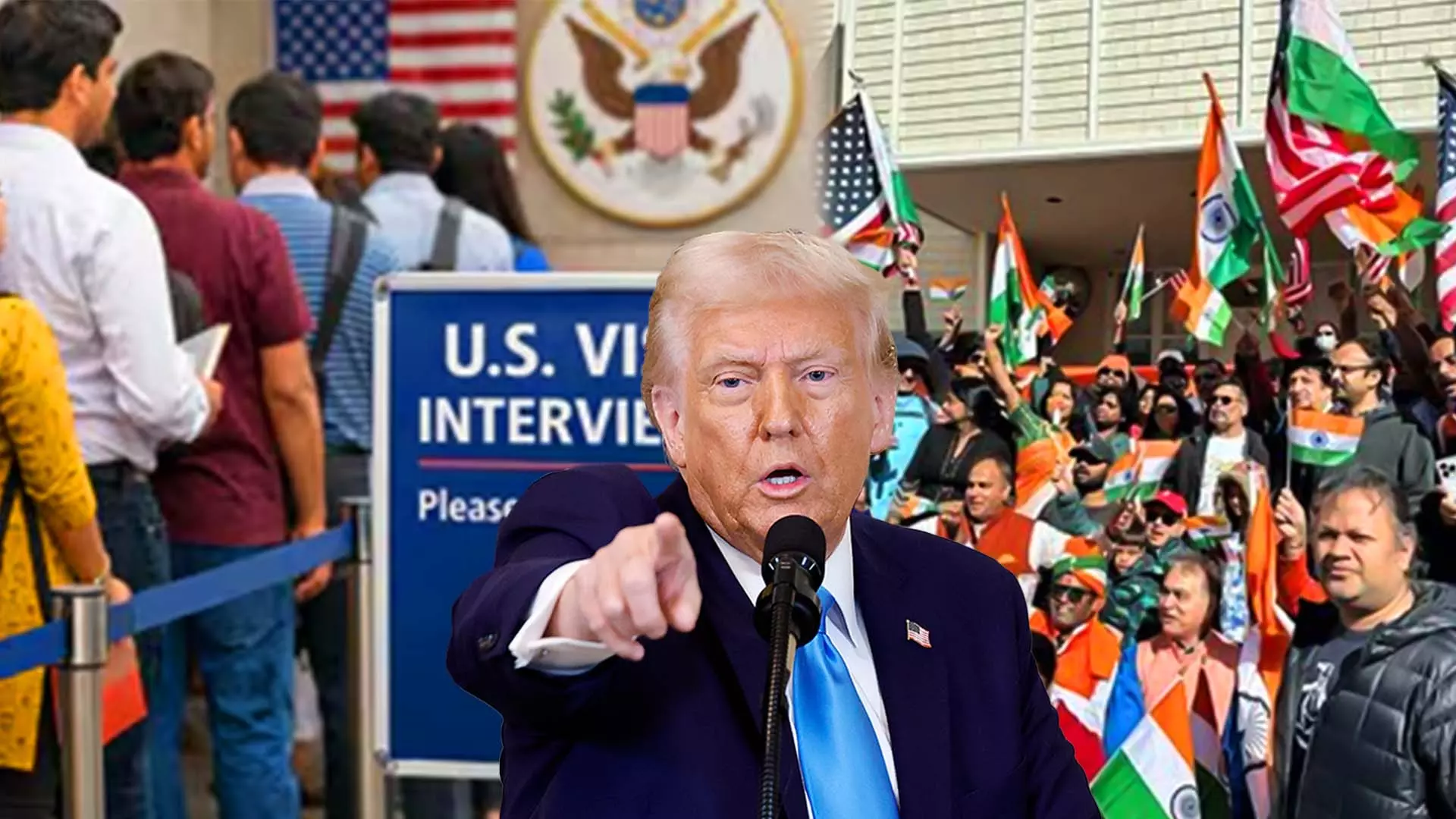
The US immigration route that once seemed predictable for Indian students and skilled workers is becoming increasingly uncertain. With the US President Donald Trump administration halting visa appointments globally and tightening immigration rules, Indian students and professionals may have to rethink the long-standing path of studying in the US, finding a job and eventually settling there.
Immigration consultant and author Rajkamal Rao says the equation is changing even as the US continues to need highly skilled professionals. He believes the days when Indian students could routinely graduate from US universities, secure employment and build a long-term future in the country may be coming to an end.
Also read: End of American dream? 40% of Indian Americans consider leaving US: Study
Rao, who has authored a book on the H-1B visa, discussed the impact of the Trump administration’s immigration measures on Indian students, H-1B workers and the broader Indian-American community in The Federal’s Worldly Wise.
Are the current concerns over US visa restrictions genuine, or is there an element of fearmongering? Should Indians reconsider the American dream?
I think there is a lot of truth to both statements that you made. You alluded to it very well.
India, being the most populous nation on the planet, has a disproportionate impact because of the number of applications that America processes. Even the slightest change in any visa regulation or any regulation has a disproportionate impact simply because we are the largest cohort of contributors to the American economy and we are the beneficiaries of that.
For example, for as long as the Open Doors report has been coming out, I think India has been either first or second in terms of sending foreign students to the US.
We send 130,000 to 140,000 students every year. On the H-1B front, 71 per cent or 72 per cent of all H-1B visas are picked up by Indians alone — people with an Indian passport. That is extraordinary.
If you think about it, there are 190 countries in the UN and two countries dominate the immigration pool coming in. Even in family-based immigration categories, India ranks alongside China, the Philippines and Mexico.
India definitely is a major player in the American immigration ecosystem, and therefore the slightest change will impact Indians disproportionately.
What does an Indian student need to know right now if they are planning to go to the US for further studies?
Starting September, America will look very different for a foreign student.
There is a transition period for students who are currently in the US or who may have gone there a month ago or something like that. Things are different for them and the J visas, so I don't think we should get into that because that is just the transitory cohort of students.
Also read: US deported over 4,800 Indians since 2025: MEA
But if today somebody leaves India on September 16 or 17 to go to the US on an F-1 visa for a master's degree, undergraduate degree or PhD, the major change is that the feature we had before called duration of status, or D/S, is gone.
There is no more D/S, beginning September 16.
What does the end of duration of status actually mean for students?
Typically, a master's degree is intended by the school to be 21 months long. Somebody who goes now in 2026 would graduate in May 2028 and would technically have completed the master's degree.
What happens if you are in that last leg, three, four or five months before you are about to graduate, and, as a foreign student, you are actively looking for a job or some kind of sponsor who is willing to give you a job, and that job is not forthcoming?
The safest thing that you could have done all these years was to apply for a quasi-extension of your stay by simply saying to your professor that you are not done with your master's thesis or that you still have some coursework pending and you want to stay back and finish that project, research or whatever it may be.
That entry would be made by the local school official into a US government form called SEVIS, and the authorisation would be automatic. So the student, instead of graduating in 21 months, could take his or her own sweet time and go to 27 or 28 months.
That meant spending time within the protected walls of the campus while continuing to look for a job. When that job was forthcoming, after going through multiple interviews and when an offer letter was imminent, you could tell the professor, "I am done with my work. I am going to graduate."
This way, you could seamlessly move from graduation to the 60-day grace period, applying for what is called Optional Practical Training, or OPT, and go work for the company.
It used to be such a seamless way, and the D/S was often abused because if you didn't get a job, you could say, "Well, I still haven't completed the project. Can I stay back for another six months?" That thing had a life of its own.
Also read: US student visas for Indians drop 62 per cent in 2025 admissions season, CIS data shows
That is gone now.
So what happens if a student cannot find a job after graduating?
If your degree ends on May 20, 2028, you have 30 days to find an employer sponsor.
If you don't find an employer sponsor in those 30 days, you are going to have to either apply to the US government for an extension of stay, which will require biometrics and will require you to come back to Chennai. It's not very pleasant.
What used to be very easy has been made quite difficult.
How are H-1B visa holders being affected by these changes?
The thing we discussed about F-1 students trying to get onto OPT has been severely restricted.
The next proposal, which I don't think will pass, is that there is some talk, though nothing has come out; there have been some trial balloons floated, where some in the administration are saying that for you to convert from this student visa to the Optional Practical Training visa, you have to pay a $100,000 fee to get the OPT visa.
If the new H-1B visa rules go through, this person, when he goes from OPT to H-1B, will have to pay another $100,000 for the H-1B visa.
These fees are not currently in place. So all of this would severely restrict international students.
What is the status of the proposed $100,000 H-1B fee?
The H-1B rule was just announced but hasn't been finalised because it is waiting for the 30-day rule.
Also read: US set for mass visa revocation targeting up to 2 lakh foreigners: Officials
Last September, Trump announced that the new H-1B rules would take effect. That would mean anyone who applies for an H-1B from India — say, an Infosys, Google or Microsoft applicant — would have to pay a $100,000 one-time fee to the US government.
That fee was supposed to go into effect on April 1.
Initially, he said that the fee would be for every year. Later, they said, "No, no, it's not every year. It's only once," and that it would be collected for H-1B beneficiaries outside the US, such as in India or China, who are coming into the US.
But that foreign student we were talking about — the Indian student who is trying to get onto the H-1B and is already in the US — is exempt. This was purely a $100,000 fee on the Infosys of the world.
Obviously, it attracted a lawsuit because it was an executive action. It went to court, and the chief judge of the Washington, DC, federal court ruled in Trump's favour, saying Trump can indeed extract the $100,000 fee because those powers are embedded in Article II powers for the US presidency.
He has the right to restrict immigration the way he sees it. So this judge was very deferential to Trump.
Technically, the fee was going to be in place. As April 1 came around, the fee was live. The courts approved and blessed it.
Then there was the major Supreme Court ruling on the tariffs — the roughly $100 billion or so in tariffs — and that went against Trump.
The Supreme Court said that Trump does not have the authority under the International Emergency Economic Powers Act (IEEPA) to willingly go and extract tariffs from whichever country he wants at whatever level. That 1976 law never gave Trump that authority.
These guys were waiting to pounce, so they filed another case with a more friendly district judge in the Massachusetts circuit. That judge said that based on what the Supreme Court said, you need congressional approval to collect a tariff.
The H-1B $100,000 fee is like a tariff. It has never been tested in court because a tariff is on goods, while H-1B is on labour. But the judge took some liberties and issued his ruling.
That said, the $100,000 fee is unconstitutional. So Trump cannot collect that $100,000.
In the Indian media, because Indians are obviously very friendly to the idea of their birthright to get an H-1B visa, the Indian media heavily slanted the reporting on this latter federal judge because the judge defeated Trump.
Also read: Trump administration puts US visa appointments on hold globally: Report
But left unsaid was that a more senior judge in DC had actually approved the $100,000 fee.
In the US court system, what happens is that when a judge from one district rules one way — that the sun rises in the east — and another judge in a different court says the sun rises in the west, the United States Supreme Court has to rule on the matter because there is a conflict.
For that to happen, the Trump administration has to appeal this second judge's ruling. They have not done that, but even yesterday they said they plan to appeal.
If they plan to appeal, the Supreme Court is obligated to take up the case because there is a clash between two circuits.
Until that happens, the $100,000 fee — the fee that is currently in limbo — can still come back into force.
So that is the first H-1B, which has two tracks. I hope I didn't confuse your audience.
What is the second H-1B proposal currently going through the process?
The second part of the answer is what is right now going through the official process.
It has been tabled for receiving comments under the Administrative Procedure Act. The administration has said that from now on, 30 days from then, it wants to collect a $103,000 fee for all H-1B beneficiaries, including foreign students who are applying for an H-1B in the US.
So this is a blanket proposal.
There are 85,000 H-1B visas that are given out. Eighty-five thousand times $100,000 is about $8.5 billion.
The administration wants to collect this for everybody.
And yesterday the administration said that the original $100,000 Infosys fee, as we call it, still stays.
If that goes to the Supreme Court and the Supreme Court were to bless it, that $100,000 would be on top of the $103,000 for an H-1B. It is almost making it impossible to get the visa.
Would such restrictions be hugely disruptive to the US economy? Could this become a case of cutting off your nose to spite your face?
For the low levels of employees, I would say that is not really the case.
America definitely has a shortage of skilled and qualified people in tech or otherwise. There is no question about that. It will take several years for America to become self-reliant.
But there is one thing I want to say. This is actually very amusing for me, and it is not an angle that is often covered in the Indian media. I try to make it a point every time I speak with the Indian media.
Guess who is kind of happy behind the scenes with all these Trumpian restrictions on H-1B?
It is the Indian-American family — the H-1B guy from Infosys who went there in 2001 for Y2K, who took his wife, got a green card, became a citizen, and whose children are citizens.
Those children went to school, got an undergraduate degree in computer science and are looking for a job.
Their children have US citizenship. They have to compete with their brothers and sisters from India who are willing to work at whatever cost, at whatever price, and endure whatever difficulties.
So it is amusing to me because this is actually a clash not between the Trump administration and the Indian community.
Also read: US mulls new H-1B, OPT fees, likely to raise costs for foreign students, professionals
The underlying clash is between the established Indian-American families who have raised their children there and are losing out. Their children have to go to graduate school.
Because I am in the college counselling business, I have seen this.
I had a top-notch tutor who came to me when he was very young. He came to me when he was in high school and then went to college. He got a very good degree from UT Austin, with a double major.
He couldn't find a job.
Today, he is pursuing a master's degree in electrical engineering at the University of Illinois Urbana-Champaign.
The same thing happened with another person who really couldn't find a job, although he had a job but wasn't very happy. He is now doing a master's degree at Carnegie Mellon.
This was never the case before.
An Indian-American student would graduate from an undergraduate degree, get a job and settle down.
Now, these people are being pushed out of the job market. That is something I find amusing because there is that clash between two generations.
The US is a nation built by immigrants. Why isn't the distinction between illegal and legal immigration clearer in the current approach?
On the second part, I would say that Trump has been extraordinarily effective in limiting illegal immigration.
There was a report that came out, I think, last June where cross-border immigration across the Rio Grande River and across the Mexican desert into the US had trickled down to zero.
There were no people flowing through the borders.
During the Biden administration, over four years, there were 11 million people who crossed the border in just four years.
These were all illegal, and they were not just from Central American countries. People from India, Bangladesh and Pakistan also went into Mexico. They took the train, went into these coyote areas, paid these people — the smugglers — and crossed the border. Now they are all settled in the US illegally.
Trump has taken a machete — not one, but several machetes — and killed illegal immigration. Those people who are already in the US, he is deporting them. So on illegal immigration, he clearly has been much more aggressive.
He has been aggressive against illegal immigration as well as against legal immigration such as students and H-1Bs.
Regarding your earlier comment about America being a land of immigrants, it is.
But JD Vance, the US Vice President, put it very well. He said, "Yes, we were a land of immigrants, and there were areas during America's development when we needed those immigrants."
The Chinese built the railroad, and the Italians and Germans built the industry. There was room and a place for immigrants from different countries to come in and settle down.
But he said that doesn't mean that today, in 2026, we need to have an uber-tolerant immigration policy that doesn't first take care of the American domestic population.
That is his view, and I think Trump is still implementing that.
Given all these developments, should Indians still consider the US a primary destination for jobs and education?
I still think America is the best place to study. I am a college counsellor, so I believe that the American higher education system is world class.
The only exceptions are the IITs here, the IIMs, BITS Pilani and others, but I still think students should come to the US to study.
But they have to be completely open to the idea that they can come back to India and build India, because India needs those smart people.
If you look at what China has done in the last 10 years, China stopped exporting students to the US and built its own world-class universities.
A lot of Chinese today don't stay back for a green card. They actually go back to China, and they are the people who are powering the Chinese economy today.
I am really hoping that there will always be a small percentage of people who will stay back in the US.
But currently, the idea of an average student here at an engineering college or elsewhere is, "I want to go to the US, study there."
But studying is not really my interest. I want to get that job. I want to go and settle down there.
So I think that train has left the station.