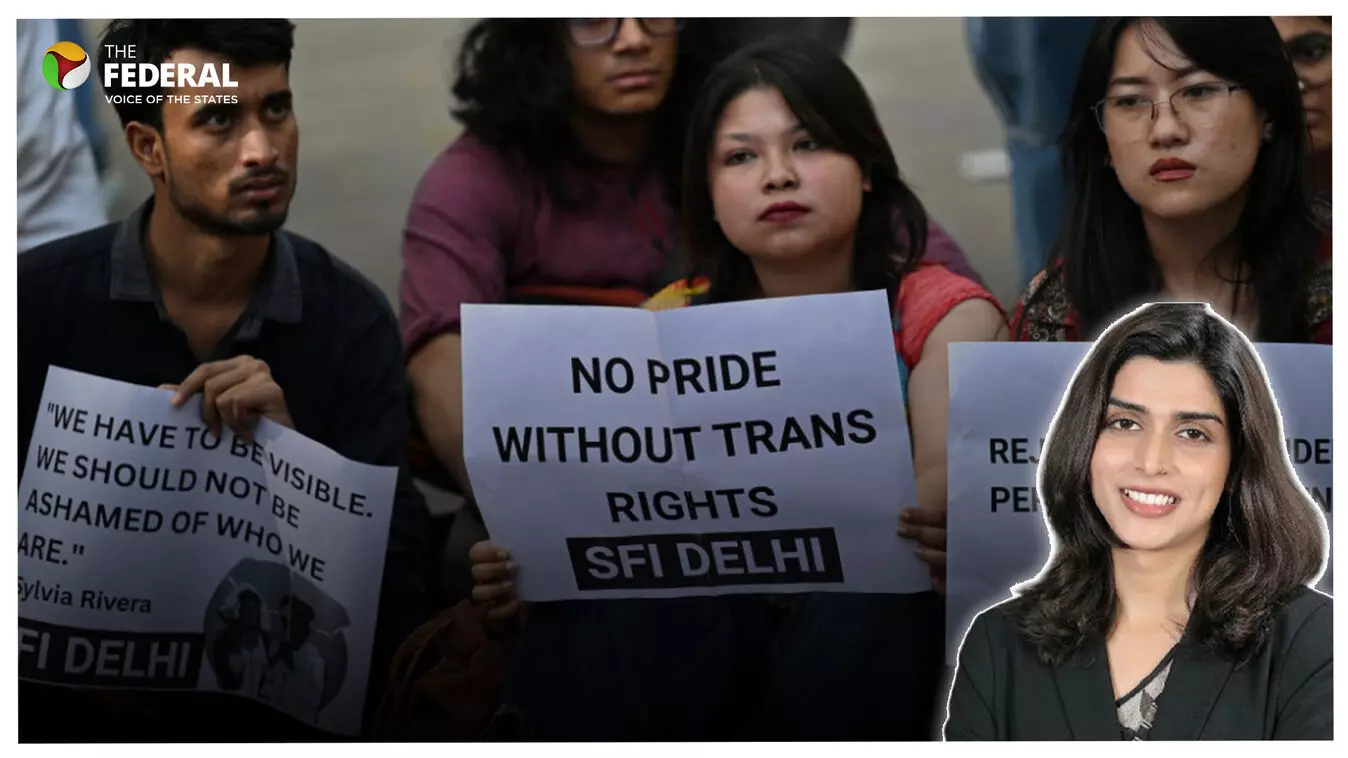
Trans identities will be erased: Lawyer Raghavi Shukla on amendment Bill
Trans lawyer says Transgender Persons Amendment Bill narrows identities to four categories, introduces 5-layer medical gatekeeping, violates SC's NALSA judgment

Amid mounting criticism of the Transgender Persons (Amendment) Bill 2026, concerns are growing within the community over its constitutional validity and impact on rights.
The Federal spoke to Raghavi Shukla, trans woman and lawyer at the Delhi High Court, to understand why the proposed changes are being viewed as regressive and what they could mean for transgender persons in India.
What are your main objections to the Bill, and how does it compare with the 2014 NALSA judgment and the 2019 Act?
The problem is not just with one or two provisions that are being proposed. The Bill, in its entirety, has a whole lot of issues. It poses an existential threat to trans people in India, and we want it to go back. We want it to be withdrawn.
We want that because the provisions being introduced are against the spirit of the Constitution. It goes against the NALSA judgment of 2014, where it was categorically held that a person’s right to self-determination is a fundamental right under Article 21.
Also read | Why has Transgender Persons Amendment Bill drawn widespread flak?
Now we have a Bill that proposes to take that very right away. If this happens, it will be a very regressive step in the queer rights movement. We are going to go back to a place we don’t even know.
The definition is being narrowed down, bureaucratic and medical gatekeeping is being introduced, and identity is being criminalised. In its entirety, the bill is unconstitutional.
What changes are being proposed to the definition of transgender persons? What do you mean by medical gatekeeping?
When I say the definition is being narrowed down, the current definition covers a wide range of identities. It is aligned with the NALSA judgment and international standards, while also including socio-cultural identities in India.
Right now, transgender is an umbrella term. It includes trans men, non-binary people, gender queer individuals, and those linked or not linked to socio-cultural identities. People like me—lawyers, doctors, professionals.
The new definition restricts it to three categories. First, socio-cultural identities—but only four: Hijra, Kinner, Jogta, and Aravani. There are many more that are not recognised, and we don’t know the basis for excluding them.
Second, it confuses transgender with intersex persons and proposes to remove the separate definition of intersex, merging it into transgender.
Also read | Why LGBTQIA+ community is battling India’s blanket ban on blood donation
Third, it refers to people ‘forced’ into being transgender. I don’t know who these people are. There is no credible evidence for this. As a member of the community, I have never come across such cases.
Beyond these, everyone else—trans men, gender queer people—are erased. This will leave many people without clarity on their identity and future.
What happens to people who already have transgender certificates under the current law?
We don’t know yet what will happen. Whether the rules under the existing Act will also be amended is unclear.
There is a lot of uncertainty and vagueness. It could create a situation where many people in the community lose their recognised identity altogether. Their identities and bodies could effectively be erased. This will lead to serious issues—procedural, logistical, and in accessibility—whether in healthcare, employment, or education.
At this point, we can only guess, and I’m avoiding speculation because it may create panic.
Can you explain medical gatekeeping and concerns around data and surveillance?
The proposed changes to Sections 6 and 7 introduce multiple layers. Currently, you can file an affidavit and apply through a portal or a district magistrate to get your ID card.
Now, they want you to undergo a medical procedure, go before a medical board, which then sends recommendations to the district magistrate. The magistrate may then approve it.
But if ‘necessary’ or ‘desirable’, additional medical opinions can be sought. This creates a five-layer process. Even now, getting an ID card is difficult and can take years. That’s why only around 32,000 trans persons have ID cards.
The government says it wants only ‘real’ people who have faced deprivation to access welfare schemes, but it doesn’t specify what these schemes are or how they are being misused.
With these additional bureaucratic and medical layers, it will become almost impossible to obtain identity certificates.
Are you concerned about data sharing and privacy?
Yes. The Bill proposes Section 71A, which mandates that medical institutions share data on gender-affirming surgeries with district authorities.
This means my medical and healthcare records will be shared with the state, and we don’t know how far that data will go. This directly infringes my right to privacy.
In the Justice KS Puttaswamy judgment, the Supreme Court clearly recognised privacy as essential to human existence. This bill attacks that right. If you read the proposed changes in their entirety, nothing in this bill is good.
Does the Bill make medical procedures mandatory for legal recognition?
Yes. That is why the medical board exists—to screen individuals. But we don’t even know who will be on this board. It is not defined. I will have to appear before them, and they will decide.
The proposed changes to Sections 6 and 7 clearly indicate that surgery is a necessary part of recognition.
What are your primary demands regarding the Bill?
Our primary demand is clear—the Bill should be withdrawn entirely. If that does not happen, then it should at least be referred to a parliamentary standing committee. But our main demand remains withdrawal.
Have you been mobilising political support?
That is part of our strategy, and I would rather not share specifics. However, some political parties and parliamentarians have extended support and sympathy. They have said they will raise the issue in Parliament.
We have been meeting MPs almost every day and reaching out through them to others.
Are there plans for protests or public mobilisation?
For now, we are focusing on engaging with parliamentarians since the bill is in Parliament. It has been tabled in the Lok Sabha and will go to the Rajya Sabha.
We are also raising awareness through media and public dialogue. At this stage, we don’t see the need for protests because engagement has been effective.
This Bill goes against what the government itself has claimed to stand for. The NALSA judgment, the Act, and the rules all came during this government’s tenure. We have heard the Prime Minister say that India has been leading on trans rights, especially when other parts of the world are regressing.
But the language of this Bill is colonial and regressive. It uses terms and frameworks that the government itself has opposed. People must understand the consequences this will have on trans lives. I hope more people engage with this issue, support the cause, and spread awareness.
The content above has been transcribed from video using a fine-tuned AI model. To ensure accuracy, quality, and editorial integrity, we employ a Human-In-The-Loop (HITL) process. While AI assists in creating the initial draft, our experienced editorial team carefully reviews, edits, and refines the content before publication. At The Federal, we combine the efficiency of AI with the expertise of human editors to deliver reliable and insightful journalism.