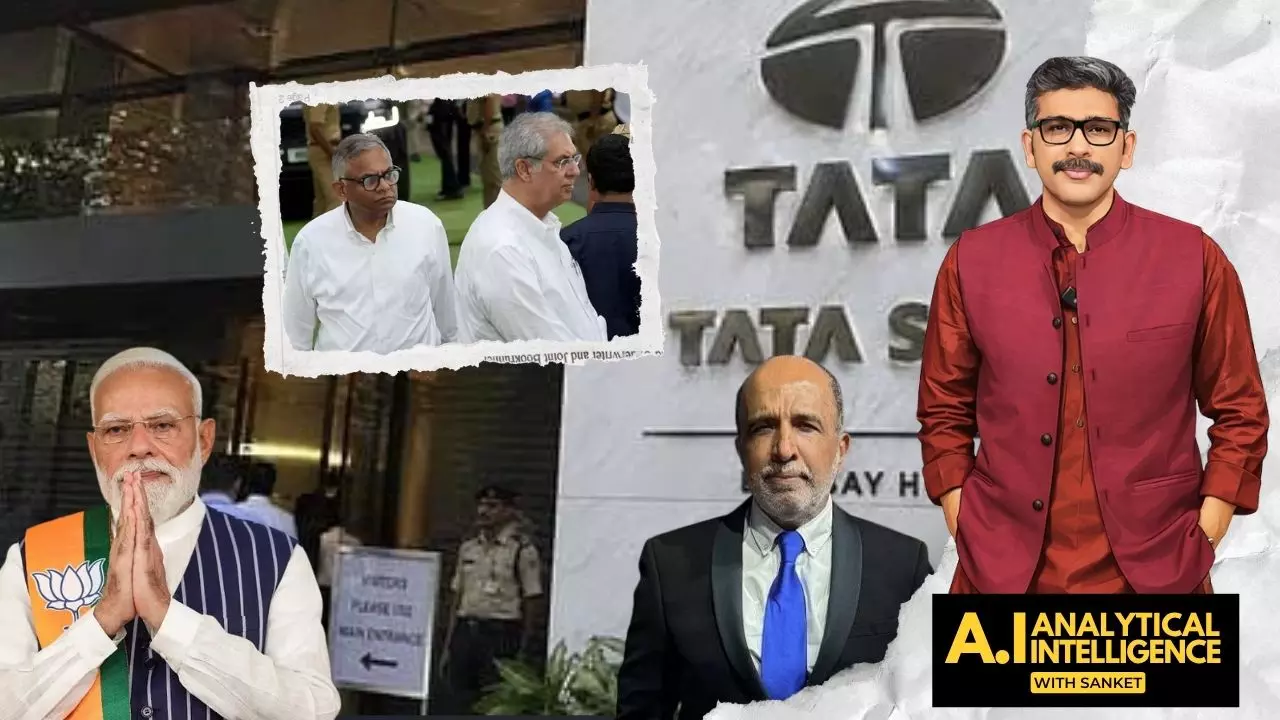
Tata Group power struggle: Is government pressure behind the boardroom battle?
Political analyst Sanjay Jha alleges government pressure behind the Tata Group's leadership tussle, citing regulatory decisions, electoral bonds and questions over corporate governance

The boardroom battle at Tata Sons is not merely an internal corporate feud but, according to political analyst Sanjay Jha, a consequence of political pressure and government intervention. As tensions escalate within one of India’s most respected corporate groups, questions are being raised about regulatory decisions, electoral funding and corporate governance. The Federal spoke to Jha about the government’s alleged influence in the Tata Group’s leadership conflict and its implications for India Inc.
What makes you believe the ongoing boardroom conflict at the Tata Group involves government intervention?
The Tatas are arguably India’s most respected corporate brand. Today, the group is valued at around $300 billion, employs over a million people and touches ordinary lives in multiple ways. Big business in India is inextricably linked to politics, and crony capitalism has acquired a different character.
Also read | Tata Trusts rift widens as trustees challenge Tata Sons restructuring plan by mergers
There are four instances where the government needs to come clean. First, consider Suraj Sanghi Finance, which the RBI allowed to deleverage and deregister as a core investment company or upper-layer NBFC. Tata Sons, too, repaid borrowings of around ₹22,000 crore to become debt-free. Yet, when it sought deregistration, the RBI delayed the process and introduced regulatory amendments that made it more difficult.
Second, a complaint was filed by Venu Srinivasan with the Maharashtra Charity Commissioner in May 2026 regarding the functioning of the Ratan Tata and Sir Dorabji Tata trusts. Why has the commissioner, who reports to the state government, taken five to six months without concluding the investigation, effectively holding up trustee and shareholder meetings?
Third, forcing Tata Sons to go public makes little sense because it does not need IPO capital. Unlisted private companies are not inherently poor in governance. Major corporate scandals involving Enron, Satyam and IDBI Bank, as well as insider trading cases, have also involved listed entities.
Fourth, before the 2024 general elections, the Tatas received around ₹44,000 crore in central government subsidies for their semiconductor business. Weeks later, the Tata Progressive Trust donated around ₹800 crore to the ruling party through electoral bonds, accounting for nearly 85% of its political donations. This warrants a thorough investigation.
At what point do you feel these events demonstrate a direct attempt by the government to control affairs within the Tata Group?
I use the phrase that the Delhi Darbar is trying to enter Bombay House quite seriously. Tata Trusts owns a 66% majority stake in Tata Sons, which in turn owns the operating companies. How can the majority owner’s voice not be heard on the board?
In the boardroom battle, Tata Trusts nominee Venu Srinivasan voted alongside Tata Sons management against Noel Tata and the Trusts’ position on public listing and the reappointment of N Chandrasekaran. The board then used a casting vote to override the majority owner. This is a travesty of corporate governance.
Chandrasekaran had earlier indicated that he would retire in early 2027 but subsequently reversed his position without following the standard CEO selection process under the Articles of Association. Noel Tata has also argued that listing Tata Sons would expose it to public shareholders seeking short-term returns, potentially undermining the dividend flows that Tata Trusts relies on for philanthropy, cancer research and urban development in Jamshedpur.
Chandrasekaran and independent board members appear to have moved to isolate Noel Tata, who represents the 66% owner. Treating the majority owner as a sleeping partner is unethical and unprincipled.
Where do you see potential legal or ethical violations in how the board has handled this situation?
While the courts will decide questions of legality, there are serious concerns about transparency and conflicts of interest. One issue is the relationship between the executive chairman’s family interests and TVS Motor Company, which is linked to Venu Srinivasan.
If commercial deals or contracts were involved, were they conducted at market rates, and were full disclosures made to the Tata Sons board? Noel Tata has claimed that several matters were passed at board meetings without being included in the formal agenda. This raises serious questions about compliance with SEBI rules and company law.
Tata Sons management had earlier agreed to deregister as an NBFC but subsequently changed its position. A Tata Trusts nominee then became embroiled in an acrimonious exchange with Noel Tata, with a casting vote overriding a 66% equity holding. When operating companies function with as little as 20% equity, overriding a 66% holding on the parent company’s board raises serious concerns about conflicts of interest.
Why do you see this as a government-driven intervention rather than an internal power struggle?
Corporate boardrooms inevitably involve personal ambitions. But this government has a track record of favouring particular corporate entities and using political pressure on businesses.
Consider the Rafale defence deal, in which a private company was selected as the offset partner over Hindustan Aeronautics Limited, or the electoral bond disclosures, which raised questions about quid pro quo arrangements involving companies facing investigative pressure.
Also read | Tata Sons at a crossroads: RBI listing, Chandrasekaran’s term
When the Leader of the Opposition raises concerns about crony capitalism and monopolies, it serves as an important political check. The government’s actions do not inspire confidence that it is acting solely in the interest of fair business. The Shapoorji Pallonji Group, which holds an 18% stake in Tata Sons, also needs to monetise its investment to service debt, adding another layer of complexity to the question of who might buy those shares.
How will this tumultuous leadership dispute ultimately impact the operational performance and legacy of the Tata Group?
When leadership struggles spill into public view, they inevitably affect employee morale, including among prestigious cadres such as the Tata Administrative Services. If the dispute escalates in court, more internal details of the group’s functioning could become public.
Companies such as TCS and Tata Motors operate independently under strong management teams, so their day-to-day operations may not be immediately affected. Over time, however, boardroom instability can influence strategic and investment decisions.
Noel Tata’s philosophy emphasises long-term capital allocation rather than short-term market pressures. When leaders expected to inspire an organisation are locked in a public battle, the group’s long-term interests can only suffer.