







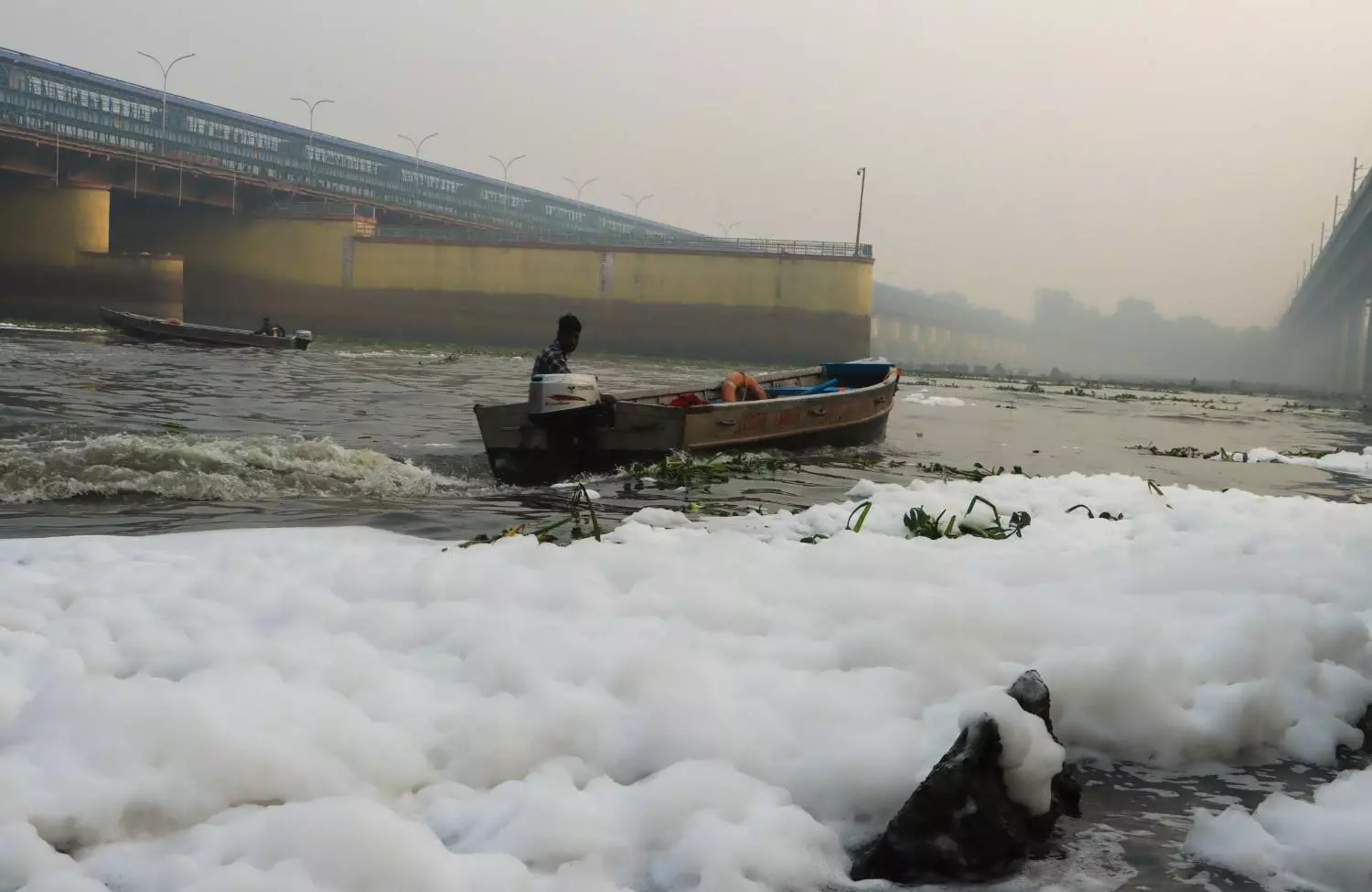
Supreme Court warns states and districts of penalties if Yamuna pollution worsens
The court flagged 520 drains discharging wastewater into the river and found that none of Delhi's 37 existing sewage treatment plants met all prescribed standards

The Supreme Court has warned that concerned authorities in states and districts along the Yamuna River will face penalties if pollution levels rise within their boundaries. The court instructed the Central Pollution Control Board (CPCB) to devise a formula for recovering compensation from polluters and officials found negligent after an inquiry.
“If the water quality deteriorates on any parameter while flowing through, or exiting a State/Union Territory or a District therein, then that State/Union Territory or District within the State/Union Territory shall be held accountable and penalised,” a bench of Justice Manoj Misra and Justice Manmohan said as quoted by Live Law.
CPCB tasked with monitoring pollution levels
The CPCB must check the river and major drains where they enter and leave each state, Union Territory and district, stated the bench.
The bench said the Yamuna's poor condition reflected failures in civic administration across settlements along its banks. Pointing out that 520 drains carry wastewater into the river, the top court said that despite large sums spent on its cleanup, pollution has continued to rise.
Also Read: Dead fish, fishermen’s woes: Cruise sets off before Yamuna clean-up | Ground report
“This Court is of the opinion that 'everything that is wrong with civic administration in the towns, cities and villages situated along the banks of the river is reflected in the poor health of the river and in the 520 (five hundred twenty) drains' that discharge wastewater into the Yamuna. This is why, despite huge sums being spent on cleaning the river, pollution in the Yamuna has only increased,” stated the bench.
Court flags untreated sewage and STP failures
The court said industrial waste and untreated sewage must be stopped at the source, adding that more sewage treatment plants (STPs) alone would not clean the river.
It also found discrepancies in Delhi's Yamuna Action Plan. According to the plan, there were no encroachments on 35 water bodies and wetlands in Zone 'O'. Yet the Delhi government's own annexure marked every one of them as encroached. None of Delhi's 37 existing STPs met all prescribed standards.
Also Read: Yamuna fish deaths trigger political row as BJP accuses AAP of staging incident
The court directed STPs, Common Effluent Treatment Plants and government-commissioned biogas plants to install tamper-proof smart energy meters within one month. They must upload live operating data and details of their discharges.
The CPCB will carry out surprise inspections every quarter. Authorities can recover environmental compensation for each day a plant fails to comply.
States told to share responsibility for river pollution
The bench invoked the doctrine of Common But Differentiated Responsibilities. States sharing the Yamuna must treat it as one continuous river system. Their duties will depend on how much they contribute to pollution and their capacity to address it.
Delhi's Zone 'O' must remain a green zone. Existing structures are to be removed in accordance with law, with rehabilitation for occupants entitled to it, the court said.
Also Read: Toxic foam resurfaces in Yamuna, cleaning underway
The court also directed central and state bodies to provide the CPCB with administrative and technical assistance. Treatment plant operators must grant inspection teams access to their premises and records. Police and district officials must provide assistance when requested. Each basin state and Union Territory must appoint a senior nodal officer within two weeks to coordinate compliance, stated the bench.