Dead fish, fishermen’s woes: Cruise sets off before Yamuna clean-up | Ground report
From allegations of chemical discharge to toxic floodplain vegetables, concerns persist over the river's health as the government promises a cleanup by May 2029

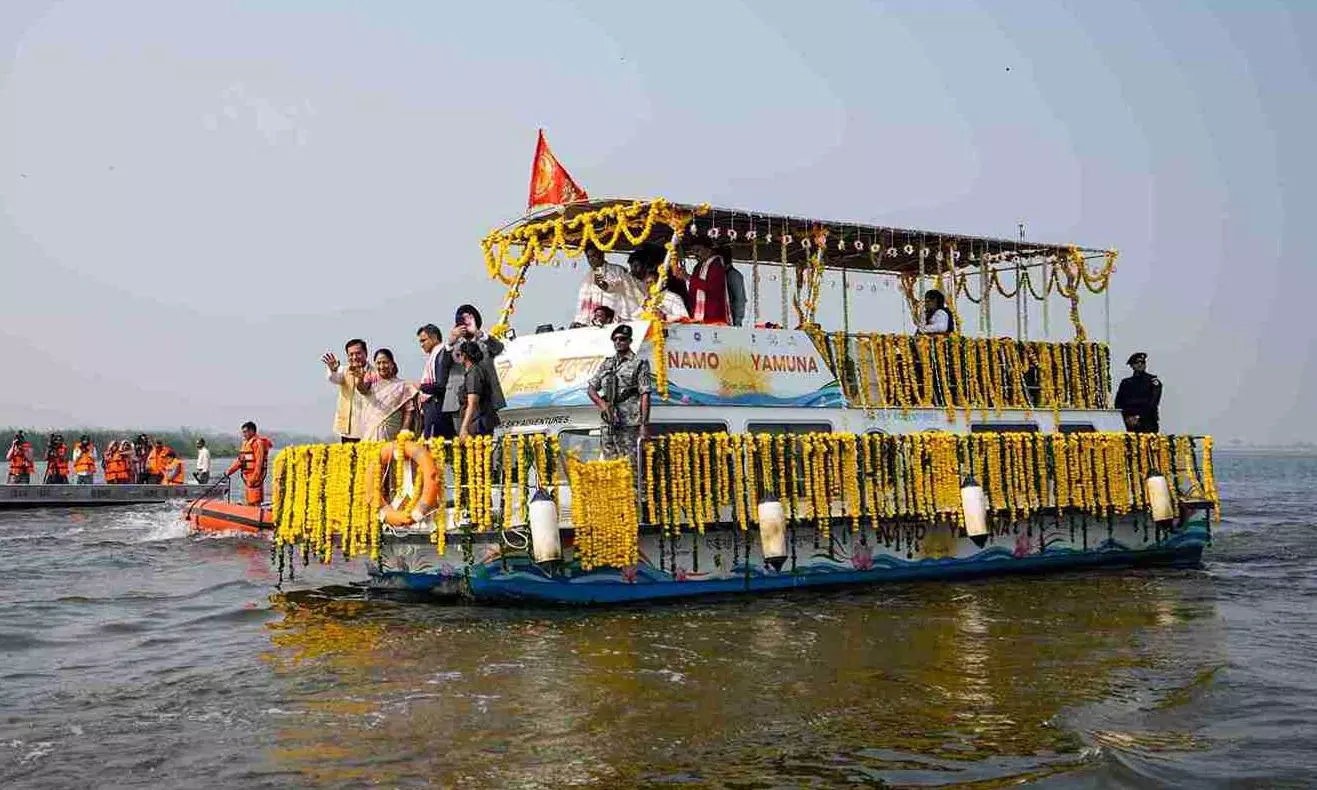
Delhi launched its first Yamuna cruise, the Namo Yamuna River Safari, with much fanfare on November 10. However, days after the launch, fishermen at Wazirabad claim they have been noticing dead fish, a shrinking catch, and polluted water.
The BJP government has promised a full clean-up of the much-polluted river by May 2029 and set aside Rs 500 crore. But the first thing it has launched is not a treatment plant. It is a leisurely cruise that offers an electric boat, a musical fountain, and a promise of getting close to the holy river.
Critics say the cruise gives the impression that the river is perfectly fine. However, it is not.
Cruise launch
On November 10, Union minister Sarbananda Sonowal and Chief Minister Rekha Gupta inaugurated the Namo Yamuna River Safari. It is a 30-seater electric vessel that runs a 35- to 45-minute ride between Sonia Vihar and Jagatpur. The project was reported to cost around ₹20 crore.
Also Read: Yamuna fish deaths trigger political row as BJP accuses AAP of staging incident
Environmental activist Diwan Singh called it an attempt to make people believe all is well. He pointed out that it runs on a short stretch where the water looks cleaner.
Water conservationist Dr Rajendra Singh has said the Yamuna is not fit for cruise operations and must be made healthy first. The cruise sails on a stretch of river that is cleaner than what lies downstream.
Fishermen’s view
Fisherman Mohammad Rafiz Ahmed said that the money should have gone into cleaning the river. “If they (government) wanted to spend money on Yamuna, they should’ve used it for cleaning. It should be clean and have dustbins,” he added.
Also Read: Sonowal inaugurates Yamuna cruise service in Delhi to boost river tourism
Boatman Anil said that the water was clean earlier. “Earlier, discharge water (from slaughterhouse) wasn’t there; the water was clean,” he added. According to him, the discharge began only in the last 10 to 15 years.
Anil alleged that factory owners are behind the pollution. “They (factory owners) are bribing the government; that is why it is still happening. Otherwise, it would’ve been stopped. They are bribing the government; that is why the polluted water reaches here every 2-3 days,” he added.
Not clean water
Rafiz Ahmed said the water cannot be called clean by any standards. “This is not clean water. Look at Himachal, Bhakra dam, look at Haryana. You see blue water from a distance. You feel like looking at it,” he says.
A day after the cruise launch, a large number of dead fish were found near Sonia Vihar. This came less than a month after hundreds were found at Burari.
The fishermen sniff something more sinister behind it; some said that the government may have sprayed chemicals to make the water look cleaner when the cruise was launched. However, the government has denied the allegation.
Blame game
Water Minister Parvesh Verma alleged that dead fish were bought from the market and dumped in the river by the Aam Aadmi Party to defame the government. The police have registered an FIR against unknown persons. Denying the allegation, the AAP blamed pollution. Some locals also suspect tannery discharge.
Also Read: Toxic foam resurfaces in Yamuna, cleaning underway
The fishermen further alleged that two men who spoke to the media about this were picked up by police the next day and beaten at the police station. Because of this fear, many here refused to speak on record.
Rafiz Ahmed said that the fish have been dying for the last two days. “For the last two days, the fish have been dead in the river. If it’s because of the chemicals, we do not know. But a lot of media people are saying it’s been released from the shore,” he added.
Chemical fears
“But it’s not the truth. Someone has put chemicals in the water, due to which the fish have died. A lot of fish died,” Rafiz Ahmed said.
Anil claimed he knew what happened to the fish. “As soon as fish drink the chemical, they faint and float on the water,” he said.
Rafiz Ahmed said fishermen do not touch dead fish. “Dead fish may have diseases we don’t know about. Let’s say I take it and eat it. What if I die? We only catch fish that is alive,” he says. “Dead fish is eaten by hawks and crows," he added.
Health risk
Some boatmen may sell dead fish in the market. “A lot of people who are greedy for money, like other boatmen, may sell them in the market. Customers don’t know how the fish died,” Rafiz Ahmed said.
Also Read: Why Delhi’s Yamuna remains filthy despite ₹7,000 crore spent on cleanup
“Anything can happen to people if they eat dead fish. They may die. If the fish died due to the chemical, obviously the person eating it will fall sick too. They can even die,” he added.
For those who depend on this river, the damage is long-term. As of December 2024, 3,346 fishermen were registered in Delhi, but far fewer actually cast nets.
Shrinking catch
Anil says the fish are vanishing. “Fish have reduced. A lot of fish that used to come here before don’t anymore,” he said. “About 25-27 years ago those fish were still there. Now they’ve disappeared. Even their eggs are not there," he added.
One fisherman said he once caught 40 kilos in a day and now struggles to get 10.
A Delhi government official told The Print that they are encouraging fishermen to move away from fishing in the Delhi stretch of the Yamuna. So the government’s own advice to fishermen is to leave the river.
Toxic spillover
The pollution doesn’t stop at the water’s edge. A NEERI study ordered by the National Green Tribunal found lead in floodplain vegetables at 2.8 to 13.8 milligrams per kilo, against a food-safety limit of 2.5. Farming continued despite the NGT’s 2015 ban on growing edible crops on the floodplain. The metals can damage organs and, with long exposure, may cause cancer.
Also Read: Ganesh Puja done, Navaratri coming; is River Yamuna ready?
Thick toxic foam was seen at Kalindi Kunj on November 2, and the Jal Board sprays chemical de-foaming agents there every winter. Experts said that this removes the froth, not the ammonia, phosphates and bacteria behind it.
Garbage problem
Anil said that people throw plastic into the river despite attempts to stop them. “It is wrong that they throw plastic in it. Even when we try to stop them, they misbehave with us, so now we don’t say anything. We have tried to stop them a lot of times. They get into an argument with us,” he said.
Rafiz Ahmed said the dumping is open and well known. “People throw garbage here, and the whole world sees it. They dump it from the bridge too. Everyone knows it, the media shows it, but they continue to do it. If you want garbage to stop, the gate should be closed. Look at them throwing garbage. Who will stop them? This is the government’s work. Cleanliness needs to be maintained here so residents of Delhi and people living around Yamuna don’t have to suffer,” he said.
Surface or depth
A cruise shows you the river from the surface. The fishermen, the farmers and residents see what’s inside it.
The government has until May 2029 to prove the river is clean. Until then, the question is whether Delhi is actually cleaning the Yamuna, or just giving people an illusion of a clear river.