



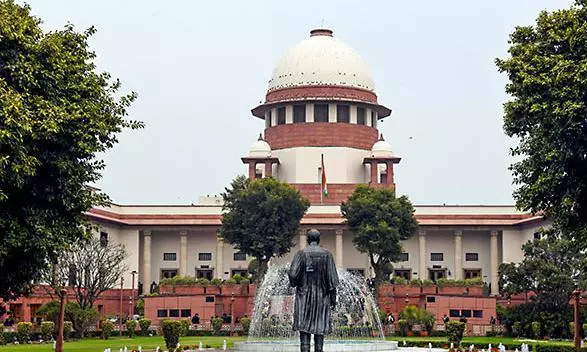
Supreme Court says SIR is legally valid, doesn't violate constitutional provision
The Supreme Court upheld the Election Commission’s Special Intensive Revision process, saying it aligns with constitutional and legal provisions

The Supreme Court on Wednesday (May 27) said that the Special Intensive Revision (SIR) of the electoral rolls conducted by the Election Commission (EC) is legally valid, adding that the process advances the Constitutional imperative of free and fair elections.
The verdict by the bench of Chief Justice Surya Kant and Justice Joymalya Bagchi further stated that the EC is empowered to conduct SIR under Article 324 of the Constitution, read with the Representation of the People Act, 1950, and the Rules made thereunder, as reported by Live Law.
Statutory backing for SIR
"When the statute itself authorises a special revision at any time, for reasons to be recorded and in such manner as the Election Commission may deem fit, the impugned exercise cannot be invalidated merely because it does not conform in every respect to the ordinary modalities contemplated for routine revision,” stated the judgement pronounced by the CJI.
Also Read: Bengal voter purge leaves 27 lakh in panic over citizenship, welfare schemes
“In our considered opinion, the impugned SIR does not supplant the Representation of the People Act and the Rules. Rather, it breathes life into the constitutional mandate under Article 324 within the precise statutory contours provided by Section 21(3). Therefore, it cannot be said that the Commission has acted in excess of its statutory powers,” it added.
Electoral roll integrity highlighted
The Court further observed that the objective underlying the SIR had a clear and direct connection with the constitutional mandate of securing free and fair elections. It noted that the conduct of such elections was not confined merely to the act of voting but rested significantly upon the integrity, correctness and reliability of electoral rolls, which constituted the bedrock of the democratic framework.
Also Read: Election Commission announces Phase 3 of SIR across 16 states, 3 UTs
The judgment further stated that the reasons placed on record by the EC, including the lapse of over four decades since the previous intensive revision, the substantial additions and deletions carried out over time, and patterns of urbanisation and migration that could potentially result in duplication and inaccuracies in the electoral rolls, were all directed towards safeguarding that institutional foundation.
Court rejects procedural objections
The Court also repelled the contention that the procedure adopted by the EC ran contrary to the provisions of the Representation of the People Act, 1950 and the Registration of Electors Rules, 1960. It also declined to accept the argument that the process displaced the presumption of citizenship in respect of persons whose names already existed on the electoral rolls.
Also Read: SIR trims voter rolls by 10pc in 12 states, UTs; over 5.18 cr names scrapped
The Court was considering the question of whether the ECI possessed the authority under Article 324 of the Constitution, read with the Representation of the People Act, 1950, and the Rules framed thereunder, to undertake the SIR exercise in its present form.
Background and petitions
It may be noted that the Court had not stayed the SIR process, which has since been completed in Bihar, Kerala, Tamil Nadu, Puducherry and West Bengal. The exercise remains underway in several other states, including Gujarat and Rajasthan.
Also Read: In final SIR list, TN gains 27.53 lakh electors, but 70 lakh names purged in all
While permitting the process to continue, the Court had observed that it would adjudicate upon the legal issue concerning the authority of the ECI to undertake such an exercise. Judgment in the matter had been reserved on January 29 this year.
Most of the petitions were filed in June last year following the ECI's decision to initiate the SIR exercise in Bihar. The Association of Democratic Reforms, political activist Yogendra Yadav, Mahua Moitra (TMC MP), Manoj Jha (RJD MP), KC Venugopal (Congress MP) and Supriya Sule (NCP SP), among others, are among the petitioners in the matter.