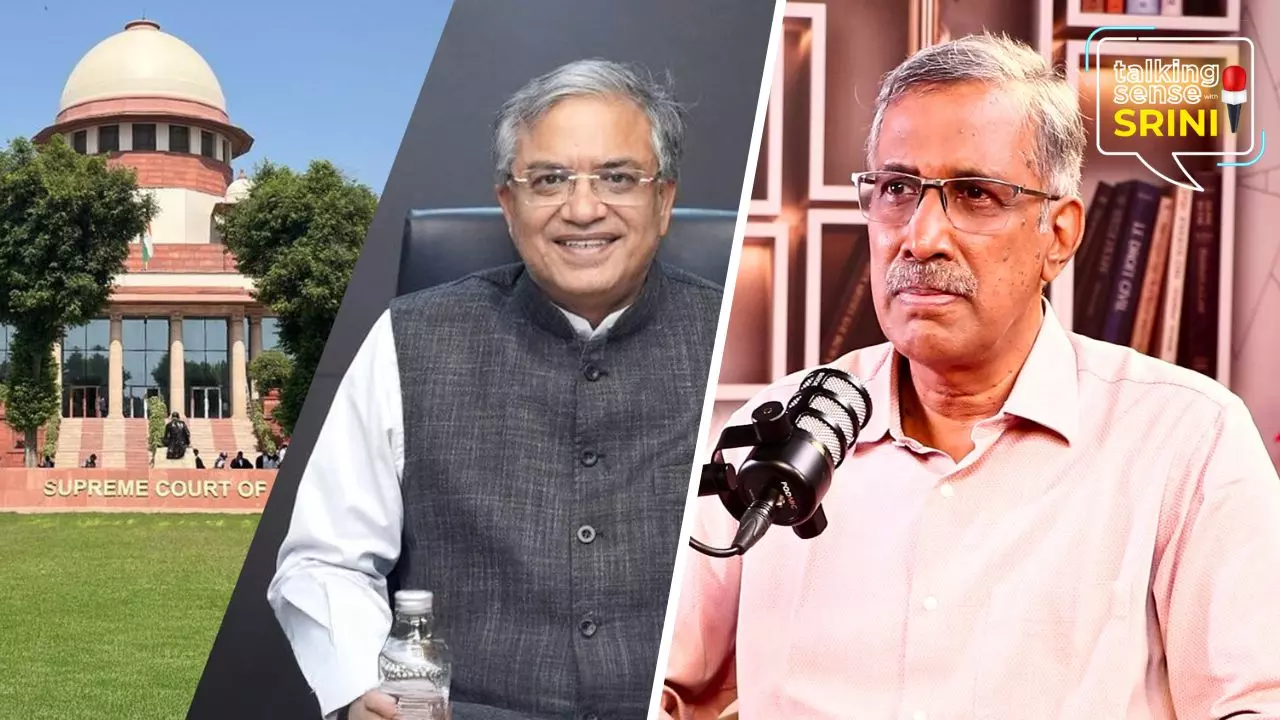
SIR row: Is Election Commission facing crisis of competence or intent?
Here's a deep dive into the Supreme Court's concerns over voter deletions, software changes and the Election Commission's powers under Article 324

A petition before the Supreme Court questioning the Election Commission's (EC) conduct of the Special Intensive Revision (SIR) of electoral rolls has brought its decision-making process, voter deletions and the use of software under scrutiny. The hearing has also raised concerns over how millions of existing voters could be forced to re-enrol to reclaim their place on the electoral rolls.
In this episode of Talking Sense with Srini, The Federal’s Editor-in-Chief S Srinivasan examines the questions raised in the petition, the Election Commission's residual powers under Article 324, and whether the controversy points to a crisis of competence or intent.
Edited excerpts:
Could you explain what the petition and the hearing are about?
The petition, filed by Rakesh Kumar Singh, essentially sought answers to questions that emerged from The Indian Express report published on September 23.
The first question was how the decisions were taken because the two Election Commissioners had written a letter complaining about 14 objections over 10 months on various issues. The Indian Express accessed this letter.
Also read: SIR explained: From voter deletions to Form 6, what has changed?
It was followed by other questions, including who made the changes to Form 6, which is filled by first-time voters. These changes were first introduced in Bihar.
The next question was who from the Election Commission appealed against 19 lakh voters who had been cleared by judicial officers in West Bengal.
The third question was who blocked access to ECINET. It is supposed to be an intranet containing electoral roll data from across the country. There was a change in the system that prevented Electoral Registration Officers (EROs) from accessing it.
Another question concerned Form 7, a form essentially used for objections and deletions. Suppose one wants to object to someone else's inclusion in the electoral roll, deletions can also be made through it, as happened in Bihar. We saw it in West Bengal and later in Delhi as well.
A large number of people were deleted, and there were several cases involving mass deletions. There were questions about these deletions.
The next issue was Form 8, used by someone who shifts from one place to another or wants to correct entries that have already been made.
The question was: How could Form 8 be used to consider those who did not fill out the forms? How could their names be deleted?
These were essentially the questions that were asked. The petition also examined certain other aspects, such as the residual powers of the Election Commission that allowed it to take these decisions.
The petition was trying to find answers to questions that became apparent after The Indian Express report. The clarification subsequently issued by the Election Commission in the form of a press note did not satisfactorily answer them.
Therefore, the petitioners wanted to get those answers through the Supreme Court. That is essentially what the petition is about.
The Supreme Court pulled up the ECI for forcing millions of existing, verified voters who may have shifted addresses to reapply using Form 6, when they should be using Form 8. Is the ECI deliberately creating a maze to keep voters away from getting back onto the electoral rolls?
One does not know whether the Election Commission is deliberately creating a maze. The Election Commission is supposed to ensure that no citizen is left out. But the decisions it was taking seem to be moving contrary to that objective.
For instance, the judges asked a question while looking at the petition, which pointed out how many people were deleted in Delhi.
Around 47.56 lakh electors did not return their enumeration forms. That was one category. Another 43 lakh were marked as shifted or absent. Then 19.34 lakh voters were flagged for logical discrepancy.
These were the three criteria under which the Election Commission was working. The Supreme Court asked why the ECI could not include another criterion. Advocate Prashant Bhushan had complained that many people were not even served notices.
How could the Commission say that 43 lakh people moved, shifted or were absent? How could it say that 47 lakh electors did not return their applications? The court therefore asked whether another category, namely those who were not served the enumeration form, could also be included.
The court was trying to ensure that it also observed that anybody whose name is not on the electoral roll should not consider that exclusion final. They could be brought back onto the electoral roll. That was the observation it made.
Also read: EC refuses to answer RTI queries on SIR, ECINET: Can SC intervene?
The larger question was: How could names simply vanish from the electoral roll? If people have shifted, their names should figure somewhere else. They should not simply be excluded because they did not file or return their enumeration forms.
These are the kinds of discussions taking place in the court. But one cannot say with finality what the outcome will be. The court is still hearing the matter, and we will know more as the proceedings continue.
The ECI is invoking its residual powers to justify reopening electoral rolls as far back as 2003. While it may have the power to do so on a one-off basis, does deleting millions of voters amount to constitutional overreach? What does residual power actually mean?
The Election Commission derives its powers from Article 324, which also gives it residual powers. The law could be incomplete. There could be rules that have not been completely framed. There could be decisions that the Election Commission has to take urgently. It cannot always go back to the government and ask it to frame laws and then come back.
Also read: SIR Form-7 row: Transparency under scanner amid community targeting allegations
For these kinds of situations, the Election Commission has been given residual powers. It means that, whatever the law is, it can interpret some provisions and get a few things moving. That is the power given to the Election Commission.
The question of residual powers actually came after the Bihar objection to Form 6. Initially, there were three questions. A fourth was subsequently added as an annexure, asking whether the applicant's parents or grandparents had participated in the 2002–2003 SIR.
According to the Election Commission, this question was added because it was trying to create a pattern to find out whether the person had been there earlier. The commission called it a mapping process.
However, the petitioners argued that adding this question amounted to changing Form 6. The court has also said that Forms 6, 7 and 8 are statutory forms, whose prescribed contents cannot be altered arbitrarily. So, had they been changed?
The answer was perhaps through residual powers. But does residual power allow the commission to make such a change?
When an exercise as extensive as SIR is undertaken across the country, how were these decisions taken, particularly when the petitioners are questioning the entire process?
Wasn't there supposed to be a meeting? Wasn't there supposed to be some discussion? Shouldn't there have been file notings?
The petitioners are also asking for all the files and all the details of the notings so that the entire trail of how these decisions were taken can be examined.
So, the question of residual powers is also being examined by the court.
With internal dissent from its own Election Commissioners, who claim they were kept in the dark about several decisions, and the Supreme Court now reprimanding the ECI, is the Election Commission facing a crisis of competence or a crisis of intent?
We will know the answer to this question with finality, but it is very obvious that there is a certain intent here.
The Election Commission is considered one of the best electoral regulators and election-conducting bodies in the world. Electoral officers would even travel several kilometres to get the vote of a single person. The Election Commission of India is famous for this all over the world.
Also read | Delhi SIR hearing: What the Supreme Court questioned, and what remains undecided
India is also one of the countries that adopted universal franchise as soon as it became independent. Even the United States took many years to do that.
Since the Election Commission began functioning in the 1950s and conducted the first general election, its record has been stellar. It has earned a formidable reputation for the way it conducts elections.
Therefore, I don't think the question of competence would arise. It is a very competent body, and it has been doing its job.
The obvious question is one of intent. Why was this being done?
That is the question being raised by the petitioners, the Opposition and civil society.