



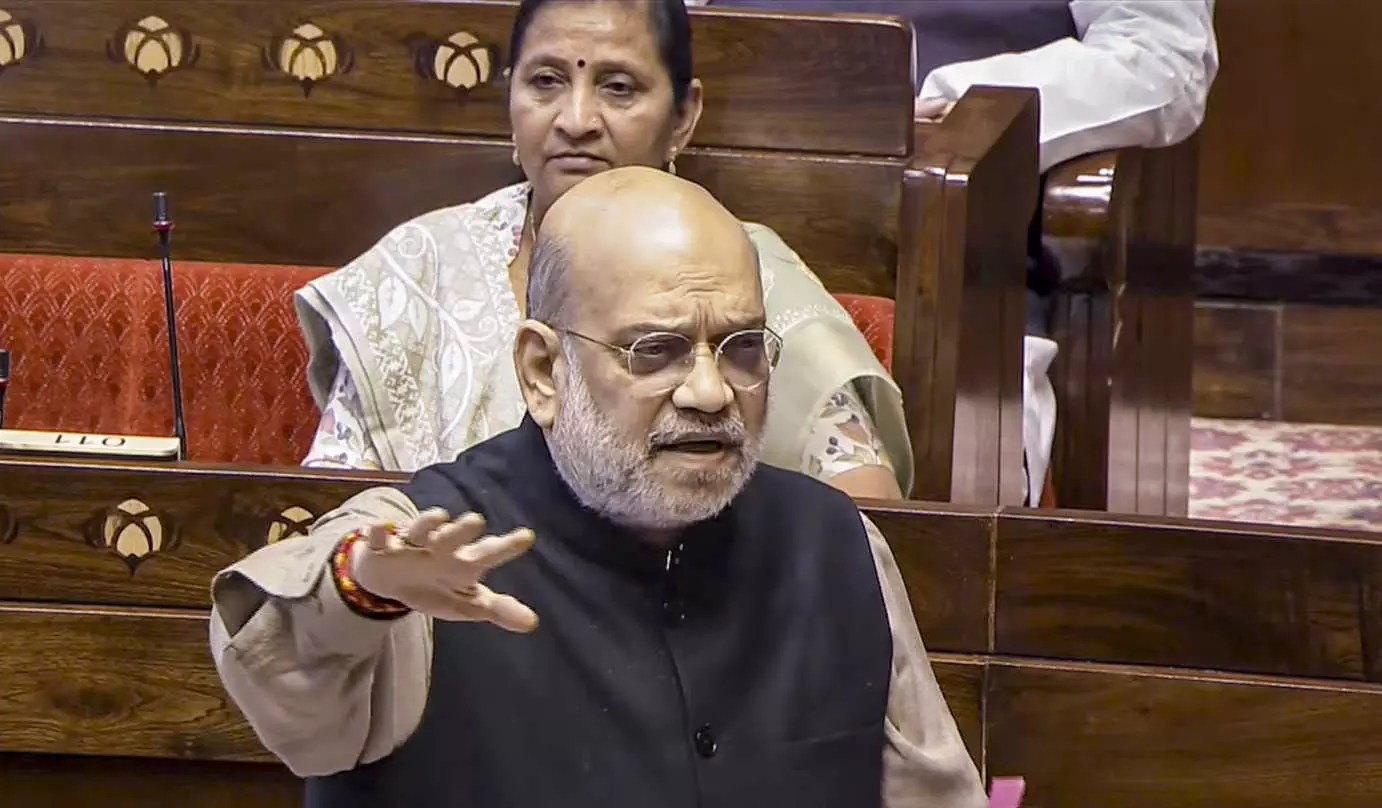
Home Minister Amit Shah speaking in the Lok Sabha on Wednesday (Dec 10). Photo: PTI
SIR debate: Amit Shah, Rahul Gandhi face off in Lok Sabha
With Rahul retorting, the Lok Sabha witnesses a heated face-off between Home minister and Oppn leader

Home Minister Amit Shah has asserted that the Special Intensive Revision (SIR) of electoral rolls cannot be discussed in Parliament because it falls exclusively within the jurisdiction of the Election Commission (EC). The Home Minister was speaking in the Lok Sabha on Wednesday (December 10) on the electoral reforms debate.
Amit Shah’s address sparked a heated confrontation with the Leader of the Opposition, Rahul Gandhi. When the Congress MP challenged him to first respond to allegations he had raised in a press conference on voter-list irregularities, Shah pushed back firmly, declaring that no one could dictate the sequence or substance of his remarks in the House.
What Shah said
Shah argued that if the Opposition raises questions on the SIR, “who will reply to it in this House?” emphasising that the matter pertains to an independent constitutional authority and not to the government or Parliament.
Shah noted that the scheduled debate was meant to focus on electoral reforms, yet most Opposition members chose to speak only about the SIR.
“Therefore, I am compelled to respond,” he said, adding that for the past four months, “lies have been spread to mislead the public.”
He stressed that he has examined the SIR in detail, along with its legal provisions and the history of similar exercises conducted in India.
EC's independence and constitutional powers
Amit Shah underlined that the Constitution clearly envisages the EC as an autonomous institution with well-defined powers.
“When the Election Commission was created and empowered, our party did not even exist,” he remarked, underscoring that the authority of the Commission is rooted in the Constitution, not in politics.
Also Read: 'SIR debate' packs no surprises as govt deflects Oppn fire with platitudes
“The job of conducting free and fair polls, preparing voter rolls, control of elections, is in the exclusive domain of the EC. The Constitution empowers, under Article 326, the EC to conduct revision of rolls and the first condition to be an eligible voter is that the voter must be Indian citizens. Article 327 gives full power to EC to prepare voter list as per voter eligibility criteria given in Article 326,” said Shah.
Shah recollects earlier SIRs
The home minister recollected the several SIRs that were conducted after Independence, “The first SIR happened in 1952 when Nehru was PM. The second one in 1957 when again Nehru was PM, the third one was in 1961 when Nehru was still PM. Similarly, SIRs happened under all Congress governments and then finally when NDA and BJP's Atal Behari Vajpayee was PM. There was also an SIR conducted when Manmohan Singh was PM in 2004 and now, after 20 years, it is being done when we are in power... in 2010, an Election Commissioner decided that a Returning Officer can't delete a voter from the voter list because of which many names remained in the voter list despite people dying or moving to some other place.”
“The SIR is to ensure that the dead are removed from the voter list, people who have turned 18 can be added to the list, people who have votes in more than one place are removed, and foreigners are removed... can this country ever accept ghuspaithiyas (illegal immigrants) voting in Indian elections?” asked Amit Shah.
Also Read: Biggest anti-national act you can do is vote chori: Rahul in Lok Sabha
Shah said, “In 1995, the SC gave a judgement in the Lal Babu Hussain case that EC is allowed to remove a voter from the voter roll if the person is not an Indian citizen. LoP Rahul Gandhi claimed in a press conference that in Haryana there are multiple voters registered in one address. When this was verified, it was found that the house number was actually for a plot owned by one family that had multiple members and for generations they had kept the same address and had been voting.”
Amid protests by Congress MPs, Shah said he will respond to any issue that the LoP wants to raise out of his address once he has finished speaking.
“In Bihar, a voter's age was registered as 124 but it was later revealed that her age was actually 24. The lady in question, Minta Devi, herself admitted that there was a mistake in filling the form. Another case was of Ranju Devi who they said was removed from the voter list wrongly. She said later that she was asked to make that statement by Congress people,” said the home minister.
‘SIR needed to correct mistakes in voter list’
“Yes, there are problems in the voter list, but that is exactly why we need SIR. If the voter list has mistakes, should we not correct it? They say our governments don't face anti-incumbency. This is also partly true. Our governments face less anti-incumbency, but we have also lost elections after 2014 in several states - Bengal, Telangana, MP, Chhattisgarh, Rajasthan. When we lose, they don't say voter list was flawed. This double standard will not be tolerated,” continued Shah.
Rahul challenges Amit Shah to a debate
LoP Rahul Gandhi interrupted the home minister, and asked him why he was not answering his question about why election commissioners were given blanket immunity.
"I also want to challenge Amit Shah to have a debate with me on my three press conferences," said Rahul.
Also Read: EC tells SC its deduplication software was ineffective; what does it mean for SIR?
Responding to Rahul's challenge, Amit Shah said, "I want to make it clear that I have been an MLA and MP for 30 years. The LoP cannot tell me that I have to respond to his questions first. I will decide how I want to speak."
Rahul Gandhi immediately replied, "Amit Shah's response is a defensive and scared response."
The home minister retaliated, “I will not be instigated by them. I will decide what to speak. Yesterday he (LoP) spoke, did I say he is lying? They keep saying “vote chori”. I will explain what is vote chori. If you are not a voter but vote, that is vote chori. If you defy the mandate, it is vote chori,” he said.
Shah gives instances of ‘vote chori’
Amit Shah continued, “The first instance of vote chori was in 1947 when the Congress had to decide who will be PM. Sardar Patel got 28 votes and Nehru got 2 votes, but Nehru was made the PM.”
Congress disrupts saying Amit Shah is calling Mahatma Gandhi vote chor because Gandhi chose Nehru as PM.
After the disruption, Shah continued speaking, “The second instance of vote chori was when Allahabad High Court ruled that Indira Gandhi won the election using unfair means. What happened after that was Indira Gandhi took immunity for herself as PM by bringing a law that gave immunity for PMs from their election being challenged and then she imposed the Emergency. She even bypassed 3 judges of the SC to appoint a CJI of her choice and then won the appeal against her conviction (in the electoral malpractice case). That was vote chori.”
Also Read: Amit Shah links division of Vande Mataram to Partition; Kharge defends Nehru
“Now a third case of vote chori. Recently a case has been filed in a court saying Sonia Gandhi became a voter before she became a citizen of India,” said Shah.
Congress MP KC Venugopal interrupted, challenging the Home Minister to prove that Sonia Gandhi voted in that election (1980), asserting she did not. Venugopal said the same case was filed in Delhi's Rouse Avenue court too (on Sonia's 1980 voter ID) and had been dismissed.
Amit Shah said the case is in court and that she has to now reply to the court notice.