Shivaji not a communal ruler, RSS narrative ‘far from truth’: Scholar
Scholar Ram Puniyani breaks down historical distortion of the Maratha icon, highlighting his Muslim generals, peasant-centric governance over communal narratives

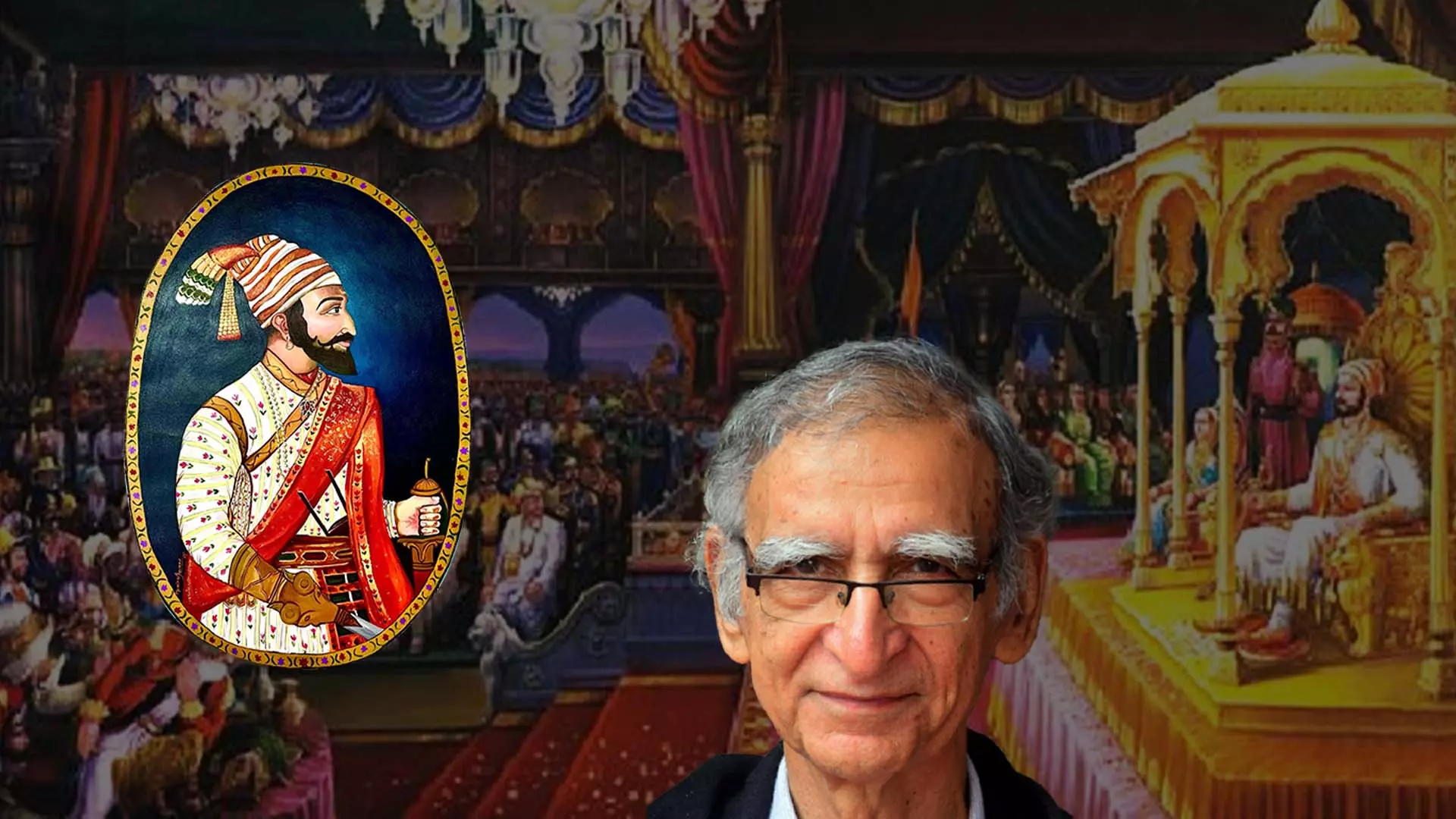
The image of Chhatrapati Shivaji as a Hindu warrior king is “very far from the truth”, said scholar Ram Puniyani, arguing that the Maratha ruler’s legacy has been reshaped through a communal lens over the past century.
The debate over Shivaji’s legacy sits at the heart of how history is interpreted in contemporary India. In this episode of RSS@100, Nilanjan Mukhopadhyay spoke to Ram Puniyani, scholar of the RSS and Sangh Parivar, on how Shivaji has been portrayed and what historical evidence suggests.
Here are excerpts from the interview:
How do you see the real image of Shivaji amid competing narratives?
Shivaji has been interpreted in many ways, and the RSS has its own interpretation, which is very far from the truth. If we go back to his background, his grandfather Maloji Rao Bhosale had no children and went to the dargah of Shah Sharif. When he had sons, he named them Shahji and Sharifji. This shows the cultural context from which Shivaji emerged.
Shivaji himself was not born a king. He saw exploitation of peasants by intermediaries between rulers and the raiyat, and he wanted to build a system that addressed this. He raised an army, initially attacking a Hindu ruler, Chandra Rao More, to establish his base.
Also read: Hindutva is a political tool, not a devout faith: Author Ashutosh
When he later sought coronation, local Brahmins refused as he was not considered a Kshatriya. Eventually, a priest from Kashi was brought in for the ceremony. All this shows the complexity of his rise and that it was not rooted in religious identity politics.
Were Shivaji’s battles religious or political in nature?
They were clearly political. The first ruler he attacked was Chandra Rao More, a Hindu king, so religion was not a factor. As his power grew, both Aurangzeb and Adil Shah of Bijapur saw him as a threat and tried to curb him.
Aurangzeb sent an army led by Raja Jai Singh, a Hindu general. At the same time, Shivaji’s army had Muslim generals like Siddi Sambal, Ibrahim, and Daulat Khan. His artillery and naval divisions were also managed by Muslims.
Even when Shivaji was imprisoned after visiting Aurangzeb’s court, a Muslim, Madari Mehtar, helped him escape. These examples show there was no Hindu-Muslim binary in these conflicts—it was about power and territorial control.
How did Shivaji come to be framed as a Hindu warrior against Muslim rule?
This interpretation began during British rule. James Mill divided Indian history into Hindu, Muslim, and British periods. After the 1857 revolt, where Hindus and Muslims fought together, the British promoted communal interpretations to divide society.
In this framework, Aurangzeb became a Muslim ruler and Shivaji a Hindu king, and their conflict was presented as religious. This narrative was later adopted by both Hindu and Muslim communal groups, each projecting their own version of superiority.
Why is Shivaji’s valour often contrasted with Gandhian non-violence?
In many communal ideologies, violence is glorified. Shivaji’s bravery is highlighted while figures like Gandhi are portrayed as weak. This is part of a broader trend where militant masculinity is celebrated.
Also read: How RSS emerged as a response to decline of Brahminical dominance 100 years ago
A similar argument is made about Ashoka—that his embrace of non-violence weakened India—despite the fact that his empire was one of the largest. These comparisons are used to push a particular ideological agenda.
Why is Shivaji repeatedly projected as a national hero by Hindutva groups?
Every ideology needs historical icons. Shivaji fits well into their narrative because of his conflicts with Aurangzeb. They present him as a Hindu king resisting Muslim rule, even though the historical reality is more complex.
For them, nationalism and kingship are intertwined. They glorify figures like Shivaji and Rana Pratap while ignoring the composite nationalism that emerged during the freedom struggle.
What is the meaning of ‘Hindavi Swaraj’—is it the same as Hindu Rashtra?
No, they are completely different. Hindavi Swaraj was a geographical concept. The term “Hindu” itself originally referred to geography, not religion.
Shivaji used it to refer to governance for all people in his territory, irrespective of religion. This is reflected in his policies—he had Muslim soldiers, built a mosque in Raigad for Muslim subjects, and ensured religious inclusivity.
Hindavi Swaraj is about inclusive governance, while Hindu Rashtra is a religious concept. They are opposites.
Is Hindavi Swaraj being used as a blueprint for Hindu Rashtra today?
Yes, selectively. Elements from history are picked, reshaped, and used to support present-day ideological goals. But Shivaji’s actual policies do not support this interpretation.
He ensured representation across communities and even wrote to Aurangzeb urging policies based on inclusivity, citing Akbar as an example.
How should Shivaji’s legacy be reclaimed from communal narratives?
We should not ignore Shivaji but reinterpret him correctly. Even today, Muslims in Maharashtra respect him, and some of the most famous depictions of Shivaji were created by Muslim artists.
Jyotirao Phule offered an important perspective. He rediscovered Shivaji’s samadhi and praised him as a “Lok Kalyankari Raja”—a ruler focussed on welfare. Phule highlighted Shivaji’s inclusiveness, his support for lower castes, and his concern for peasants.
This alternative narrative should be promoted more strongly to counter communal interpretations.
So should Shivaji be seen as an inclusive ruler rather than a religious icon?
Yes. Shivaji deserves recognition for his policies towards farmers, his inclusiveness, and his governance. He did not distinguish between Hindus and Muslims and worked for the welfare of all his subjects.
His legacy should be understood in that spirit, rather than being reduced to a symbol of religious nationalism.
The content above has been transcribed from video using a fine-tuned AI model. To ensure accuracy, quality, and editorial integrity, we employ a Human-In-The-Loop (HITL) process. While AI assists in creating the initial draft, our experienced editorial team carefully reviews, edits, and refines the content before publication. At The Federal, we combine the efficiency of AI with the expertise of human editors to deliver reliable and insightful journalism.