Debating Hindutva and India’s future
Hindutva is a political tool, not a devout faith: Author Ashutosh
Ashutosh unravels India's dominant ideology, labelling it a "carefully crafted industry product" designed for mobilisation rather than spiritual practice

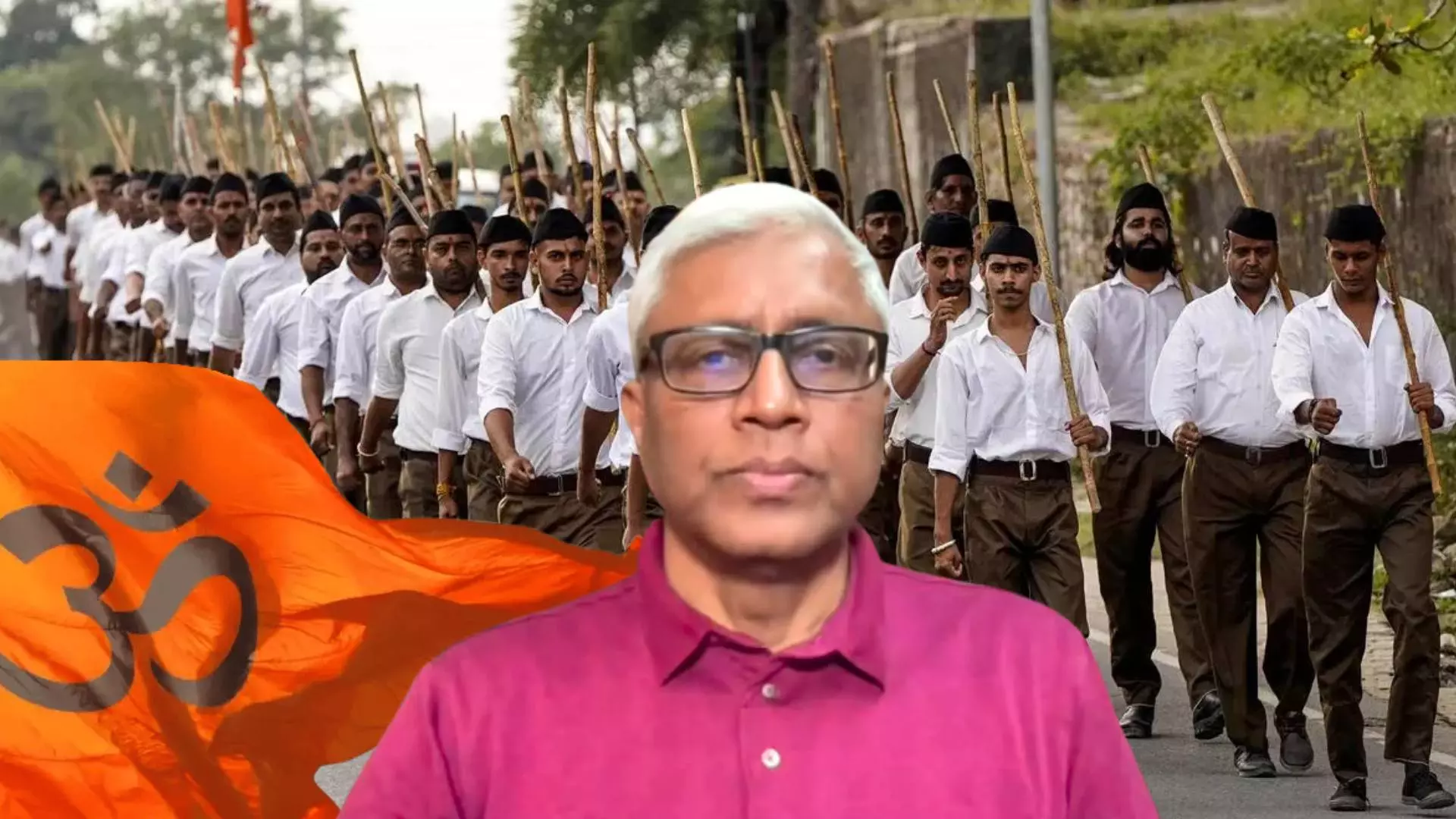
“Hindutva is nothing but a political ideology that uses religion for its own ends,” said senior journalist and author Ashutosh, offering a sharp and provocative interpretation of one of India’s most debated ideas.
As conversations around identity, nationalism, and the idea of a Hindu Rashtra intensify, The Federal spoke to Ashutosh to decode Hindutva, its distinction from Hinduism, and its political implications.
What is Hindutva, and how would you explain it to a layperson?
I think it is important to first put things in perspective. The RSS and those who subscribe to Hindutva have a tendency to blur lines and shift goalposts. They often intermix Hindutva with Hinduism and claim that any criticism of Hindutva is an insult to Hinduism.
In my view, what Savarkar defined was an attempt to give ideological legitimacy to the political use of Hindu religion. Hindutva, therefore, is essentially a political ideology that uses Hindu religion for political purposes. It is similar to how Islamists use Islam for political gains. Through religion, they seek legitimacy for their political goals.
I know some people may be upset with this comparison, but I am not comparing religions. I am drawing a parallel in how religion is used politically.
Also read: RSS doesn't practice Hindutva politics, believes in nation building: Mohan Bhagwat
If you look at key figures like Savarkar, LK Advani, and Narendra Modi, all of them played a role in shaping and expanding Hindutva. But in my opinion, none of them were deeply religious in the conventional sense. This shows that religion is being used as a tool for political mobilisation.
Was Narendra Modi’s projection as a devout Hindu a calculated political move?
We need to distinguish between being a Hindu and being a Hindutvadi. Someone can be religious without subscribing to Hindutva.
Modi is perhaps the first “industry-produced” political leader in India, where a cult has been systematically built around him.
Modi is a Hindu by birth and upbringing. But was he a devout Hindu in the strict sense? From my interactions with him when he was a BJP general secretary, I never saw that kind of religiosity. He appeared quite normal.
However, after becoming Gujarat’s Chief Minister—especially post the Gujarat riots—he realised his potential as a national leader. At that point, he began projecting himself as a Hindutva icon. This projection, in my opinion, is highly calculated.
Every aspect of his image—his actions, appearances, and messaging—has been carefully crafted. Modi is perhaps the first “industry-produced” political leader in India, where a cult has been systematically built around him. While he has his own political abilities, his public persona has been consciously constructed.
How do you distinguish between Hindu assertion and Hindutva?
There is a very fine but important distinction. A Hindu can assert their identity, values, and beliefs without being hateful towards others. That is Hindu assertion.
For example, my father was a devout Hindu. He supported the Ram temple movement, but he never hated Muslims. In fact, many of his closest friends were Muslims. That is assertion without aggression.
Also read: Gita Press and RSS: Akshaya Mukul on how ideas shaped Hindu politics for a century
Hindutva, on the other hand, is rooted in aggression. Its core value, in my opinion, is hostility towards Muslims. That is the key difference.
Assertion does not mean exclusion or hatred. Hindutva often does.
Is Hindutva fundamentally about viewing history as a Hindu-Muslim conflict?
If you look at statements by RSS leaders, including Mohan Bhagwat, there is a recurring idea that Hindus have been engaged in a 1,200-year-long war. This reflects a particular interpretation of history—one that sees continuous conflict.
This narrative aligns with earlier ideologues like Golwalkar, who spoke of internal enemies. Today, the language may be softened to “internal weaknesses,” but the underlying idea remains similar.
This historical framing shapes the ideology. It creates a sense of grievance and continuous struggle, particularly directed against Muslims.
What would a Hindu Rashtra look like? Would it mean a state religion?
The RSS claims that Hindu Rashtra is not a theocratic state. They say it will respect diversity and not discriminate against other religions. But I take this with a pinch of salt.
Also read: Move over, Sanatana, what RSS truly cares about is political power
If they gain complete control of the state, I have no doubt that Hinduism will effectively become the state religion. At present, they operate within the constitutional framework, which is secular. So, they are building an ideological structure gradually.
What we are already seeing is a subtle hierarchy—where Hinduism is treated as “first among equals.” The state increasingly appears to protect and promote Hindu practices more than others.
So, while they may not openly declare a theocracy immediately, the direction suggests a privileged status for Hinduism within the state.
Why do Hindutva proponents see Mahatma Gandhi as an adversary?
If Gandhi had endorsed violence, he would have been the biggest icon for the RSS. But he stood for non-violence and peace.
In their interpretation of history, Hindus lost power because they became non-violent and passive. They believe that embracing non-violence weakened Hindu society, making it vulnerable to invasions.
This is why Gandhi’s philosophy is seen as problematic within that framework. They view non-violence as a reason for historical subjugation, whereas Gandhi saw it as moral strength.
After the 2024 elections, is India at a point of no return on Hindutva?
I wish I had a clear answer. But let me try.
The BJP’s failure to secure a full majority in 2024 was due to resistance from within the Hindu community itself—particularly among OBCs and Dalits. These groups realised that any attempt to change the Constitution could threaten their rights and protections.
The Constitution gives them legal and political equality, even if social equality is still evolving. This is why they reacted strongly.
The challenge for Hindutva is not from minorities, but from within Hindu society. Their core support base is around 20–25 per cent. To expand beyond that, they need broader acceptance.
If they ever cross 40 per cent vote share, I believe they will attempt major constitutional changes and push decisively towards a Hindu Rashtra.
The content above has been transcribed from video using a fine-tuned AI model. To ensure accuracy, quality, and editorial integrity, we employ a Human-In-The-Loop (HITL) process. While AI assists in creating the initial draft, our experienced editorial team carefully reviews, edits, and refines the content before publication. At The Federal, we combine the efficiency of AI with the expertise of human editors to deliver reliable and insightful journalism.