



Shashi Tharoor backs Centre’s Iran war stance, calls it ‘responsible statecraft’
Shashi Tharoor supports Centre’s stance on Iran war, citing strategic interests and Nehruvian pragmatism, diverging from Congress criticism.

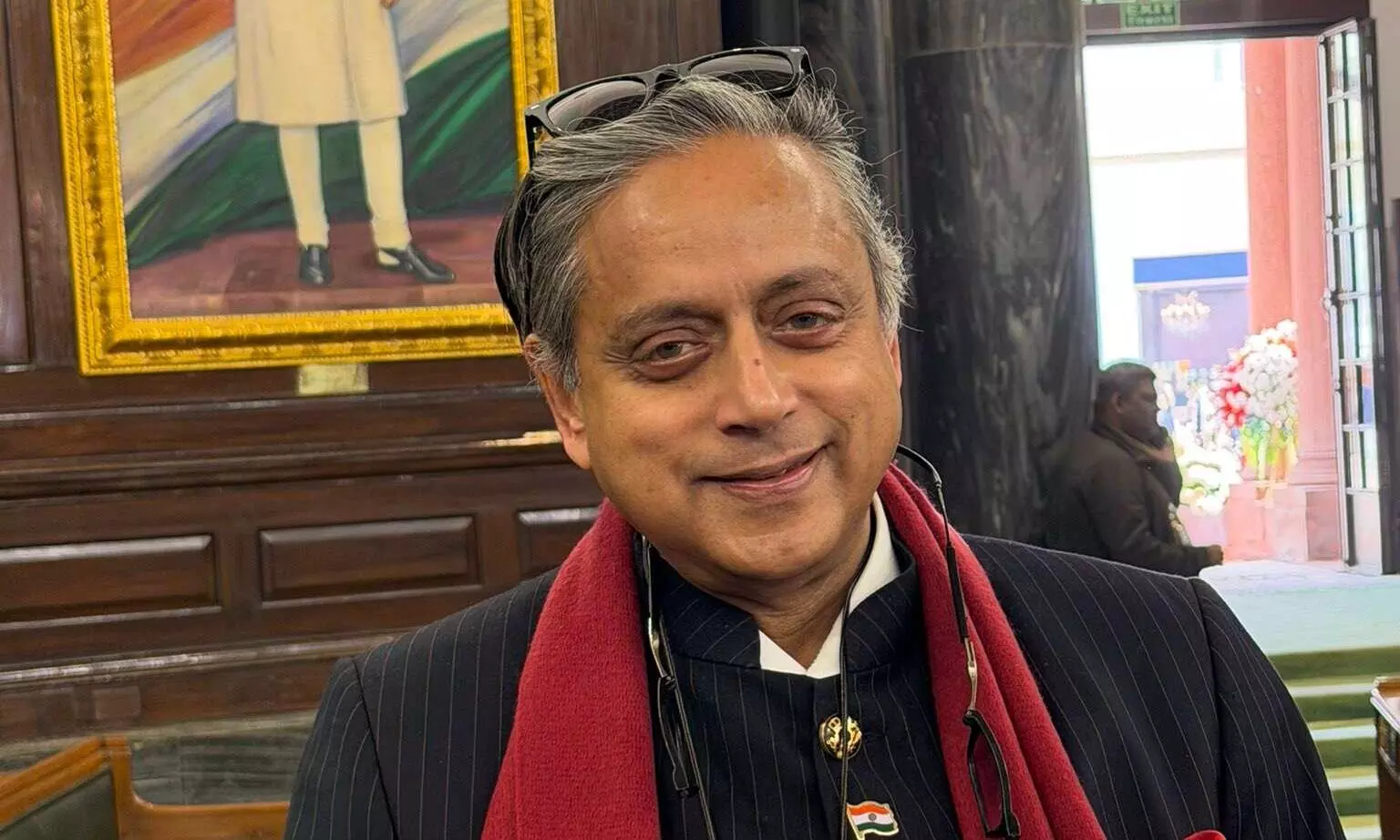
Congress MP Shashi Tharoor, in marked contrast with his party, has expressed support for the Centre’s current stand over the war between Iran-US-Israel war. While the Congress has repeatedly demanded that the Centre condemn the attack on Iran, Tharoor has described the government’s stand on the issue as “responsible statecraft” rather than a moral retreat.
Critique of ‘liberal’ response
Tharoor, in an op-ed in the Indian Express, took a dig at “Indian liberals” for lashing out at those who have not condemned the Centre’s stand on the Iran war. Pointing out that the war cannot be justified under “international law”, Tharoor stated that it violates the “very principles India has historically stood for.”
Also Read: Iran thanks India for first medical aid as war enters day 19
His position put him at odds with the Congress line. In the weeks following the US and Israeli strikes on Iran, an offensive that triggered widespread casualties and the killing of senior figures, including Ayatollah Ali Khamenei, the party has repeatedly pressed the Centre to openly criticise the military action. Tharoor has stopped short of that demand, even as others within the Congress have framed the government’s silence as unacceptable.
Nehruvian precedent invoked
However, the former diplomat made it clear that he would not condemn the government’s stand on the war. “But I will not condemn the government for choosing silence over confrontation,” he added.
Also Read: India rejects Iran tanker swap claim, calls reports ‘baseless’ amid Hormuz tensions
Referring to Jawaharlal Nehru’s policy of non-alignment during the Cold War, Tharoor said that it was not a refusal to take a moral stand, but a “recognition” of the fact that India’s sovereignty and survival depended on pragmatically avoiding the hostilities of that era.
Historical justification
"Critics forget that India has often chosen silence when principles collided with national interest. We were reluctant to condemn the Soviet Union’s flagrant violations of international law in Hungary (1956), Czechoslovakia (1968), and Afghanistan (1979). Why? Because we rightly judged that we had too much at stake in our relationship with Moscow to antagonise it with a moralistic stand,” stated Tharoor.
“The Soviet Union was our principal arms supplier, a crucial diplomatic partner, and a counterweight to Western hostility,” he added.
Present-day stakes
Elaborating further, he argued that the same logic now applies to the Iran war and said that India has high stakes not only in the US but also in the Gulf states currently facing Iranian missile attacks. He pointed out that oil and gas imports from the Gulf states play a key role in ensuring India’s energy security.
Also Read: Iran war: Second LPG tanker reaches India after crossing Strait of Hormuz
“India has far too much at stake, not only in the US, but in the Gulf Arab states currently facing Iranian missile and drone attacks. Nearly $200 billion in annual trade flows through this region. Our energy security depends on Gulf oil and gas. And the well-being of some 9 million Indian workers and residents in the Gulf is directly tied to regional stability,” stated Tharoor.
“To indulge in sanctimonious moralising by condemning the US-Israeli war on Iran would risk destabilising these relationships,” he added.