



SC questions West Bengal on Mamata's alleged interference in ED's I-PAC raids
Supreme Court questions West Bengal on Mamata Banerjee’s alleged obstruction of ED raids, calling it an “unusual situation”. Next hearing set for March 24

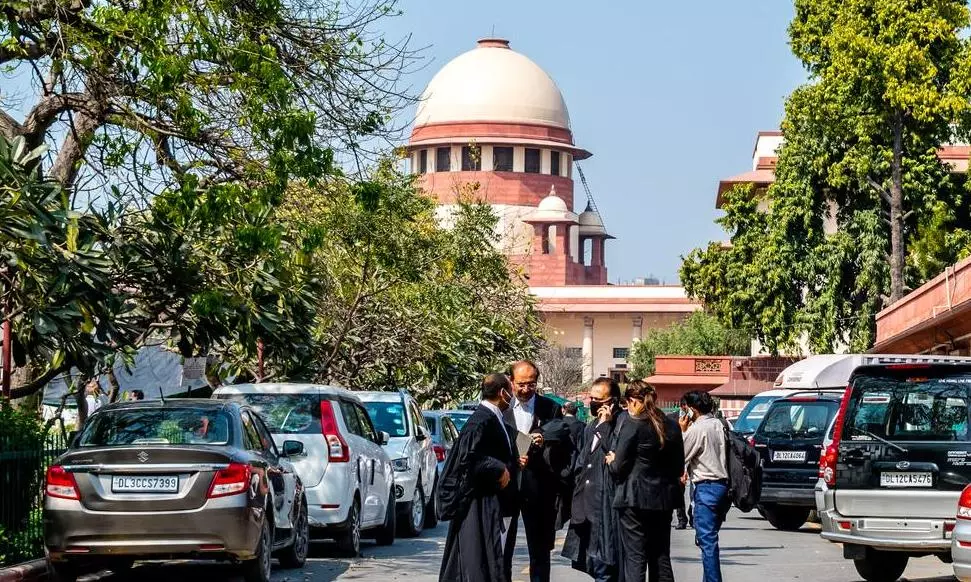
The Supreme Court on Wednesday (March 18) asked the West Bengal government whether the Enforcement Directorate (ED) was expected to be a mere mute spectator and only “look and watch” when Chief Minister Mamata Banerjee barged in and obstructed ongoing raids by the central agency at the offices of the political consultancy firm I-PAC at Kolkata in January.
The remark was made by Justice Prashant Kumar Mishra, who headed the concerned bench, in response to the state government’s argument that since the ED was neither a “body corporate” nor a “legal or natural person” and hence could not move the top court under Article 32 of the Constitution, claiming that its “fundamental rights” had been violated.
The preliminary objections were raised by the West Bengal government, represented by Shyam Divan, challenging the maintainability of the ED’s plea seeking a Central Bureau of Investigation (CBI) probe against Banerjee and senior police officials who were with her at the time of the incident.
Bench flags ‘unusual situation’
“If a Chief Minister, according to the ED, barges in and obstructs statutory work, is it that the ED cannot move either this court under Article 32 or the High Court under Article 226. So, will the ED be left remediless? This (Banerjee’s alleged actions) is an unusual situation, an unhappy situation. This has not happened before,” said Justice Mishra as quoted by The Hindu.
Also Read: I-PAC case: Legal implications of SC order and impact of Centre-state tussle
The judge also asked what the situation would be if other Chief Ministers resorted to similar actions, emulating Banerjee. “The law has to evolve according to new situations. There cannot be a vacuum. It cannot be that there is no remedy in law to a situation,” said Justice Mishra.
“The Chief Minister, who is the head of the government in the State, hindered a lawful ongoing investigation being conducted in the larger public interest,” said Solicitor General Tushar Mehta, appearing for the ED.
Divan contests ED’s right to sue
However, Divan argued that as per the Prevention of Money Laundering Act (PMLA) which governs the ED, did not give it the “right to sue”.
“There is no question of the civil liberty or rights of the ED which is being trampled upon here. If the ED had a complaint, the Union government can invoke the original jurisdiction of the Supreme Court under Article 131 of the Constitution and approach the Supreme Court directly,” he added.
Sibal questions Article 32 route
Senior advocate Kapil Sibal, appearing for Banerjee, told the court that an ED officer did not have a “fundamental right” to investigate, submitting that the agency’s authority flowed from the PMLA.
Also Read: SC disturbed by Calcutta HC chaos, calls ED charges against Mamata ‘very serious’
Sibal argued that the Centre could not invoke Article 32 by projecting the ED as a petitioner, maintaining that the provision was meant for individuals seeking relief against violations of civil rights by the state and its instrumentalities.
Federalism concerns raised
“The principle of federalism, a basic feature of the Constitution, would be in tatters. States are not mere appendages to the Centre. Courts must be on guard against the conscious whittling down of the power of the States by the Union government,” argued Divan.
Also Read: ED moves SC seeking FIR against Mamata Banerjee, flags obstruction in I-PAC probe
Arguing that the ED’s petition be dismissed as not maintainable, the senior advocate contended that the agency, being part of the state machinery, could not approach the court claiming that another state had infringed upon its fundamental rights.
“If Parliament wants to confer an agency the power to sue, it would confer the power specifically. Investigation agencies are not ‘body corporates’ with a power to sue,” Divan said, requesting the apex court to refer the matter to a Constitution Bench.
Next hearing on March 24
The court posted the matter for further hearing on March 24.
Earlier, on January 15, the apex court had stayed the Kolkata Police probe against ED officers who carried out the raids. The state police action was based on allegations that sensitive election-related records of the ruling Trinamool Congress, which engages I-PAC for political strategy, were “stolen” by central agency officials during the searches.
The Bench had earlier observed that the case raises “serious” questions concerning the extent of investigations by central agencies, including the ED, and the scope of interference by state authorities.