



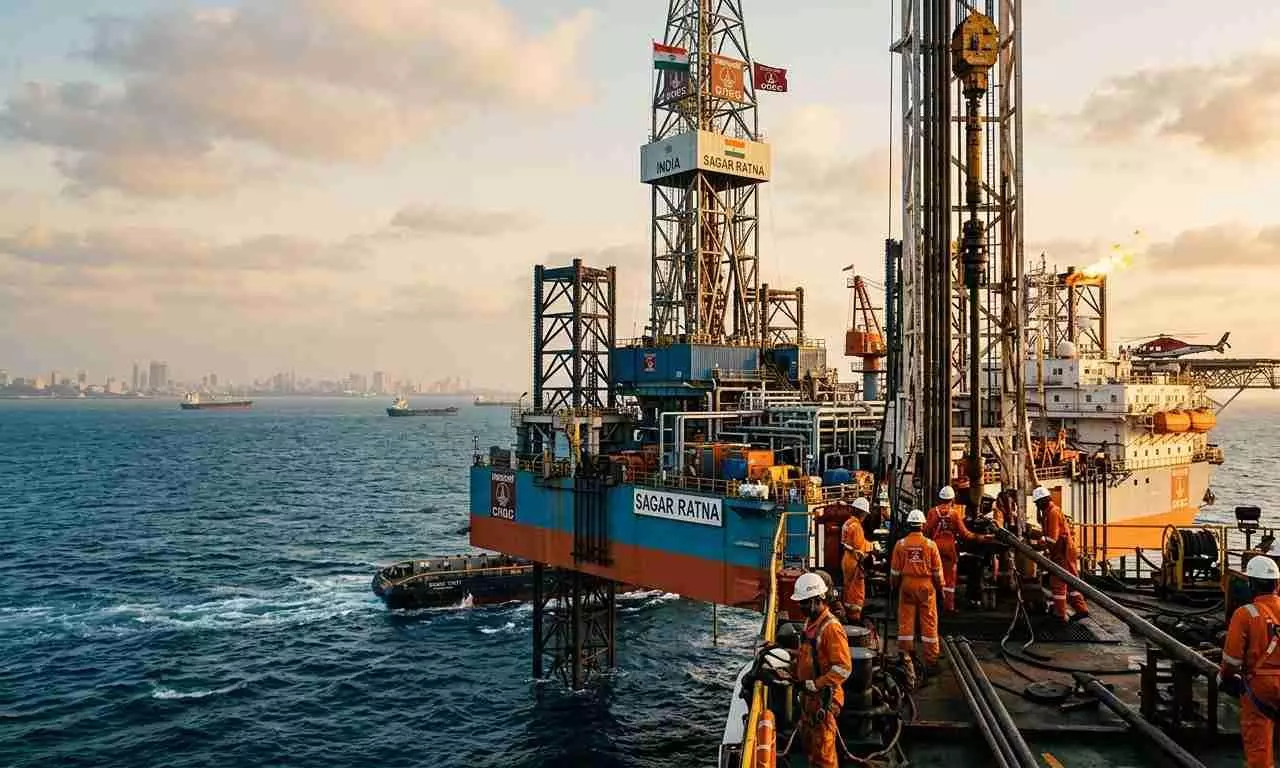
The Samudra Manthan programme is closely linked to India's broader energy security strategy built around Strategic Petroleum Reserves. AI-generated image for representative purpose.
Centre fast-tracks Samudra Manthan amid fuel crisis; what's this project?
With the Strait of Hormuz crisis exposing energy vulnerabilities, India is pushing its deep-sea exploration to strengthen long-term energy resilience

With disruptions around the Strait of Hormuz sending global crude prices sharply higher, India is accelerating one of its most ambitious energy programmes, Samudra Manthan — a large-scale offshore exploration mission aimed at reshaping the country’s long-term energy security.
What is the project all about? Let's address a set of questions.
What is the Samudra Manthan project?
Samudra Manthan is India’s national deep-water exploration mission, first announced by Prime Minister Narendra Modi during his Independence Day address in August 2025. The programme focuses on intensive offshore exploration to identify untapped reserves of crude oil, natural gas and critical minerals beneath the seabed using advanced survey technology and international partnerships.
Also read: How refining boom masks India’s falling crude and gas production
The mission is being positioned as a long-term energy security initiative that could reduce India’s dependence on imported fuel while serving as a bridge during the country’s transition towards cleaner energy sources.
What's the scale of the surveys?
The government is now preparing one of the largest offshore geological survey drives undertaken in recent years. Survey vessels are expected to scan vast stretches of the Bay of Bengal and adjoining offshore regions to identify potential hydrocarbon reserves.
According to government plans, the exploration will cover multiple offshore basins, including the Bengal-Purnea, Mahanadi, Krishna-Godavari, Cauvery and Andaman offshore basins.
The scale of the proposed surveys is massive. The Bengal-Purnea and Mahanadi offshore surveys alone are expected to cover nearly 45,000 line kilometres. The Andaman Basin survey will span another 43,000 line kilometres, along with additional mapping in the Krishna-Godavari Basin. The Cauvery Basin exploration is expected to add another 30,000 line kilometres. Taken together, the surveys are likely to continue for nearly two years.
How does the exploration work?
The exploration process involves specialised survey vessels towing long cable-like instruments known as streamers. These instruments transmit sound waves deep beneath the seabed and record the echoes reflected from underground rock formations.
Also read: India pivots to Russian crude as Hormuz Strait blockade chokes supply: Report
Scientists then process the data to generate highly detailed subsurface images several kilometres below the ocean floor. These images help identify geological structures where oil and gas could be trapped beneath layers of sediment and rock formed over millions of years.
The surveys are expected to provide critical information about tectonic structures, sediment deposition patterns and deepwater hydrocarbon systems across India’s offshore basins.
Which basins are considered high-potential?
The Bengal Offshore Basin is viewed as particularly promising because of sedimentary layers extending beyond 10 kilometres in thickness. Significant Miocene-age deposits in the region are being considered major exploration targets.
The Mahanadi Basin has also attracted attention for its deepwater reservoirs and biogenic gas potential.
Among all the regions, the Andaman Basin is emerging as one of the most strategically important. Energy experts believe the basin could hold massive untapped gas reserves because of its geological similarity to gas-producing regions in Myanmar and Indonesia.
Also read: Why UAE's choice to quit OPEC spells good news for India, other markets
The Krishna-Godavari Basin, already among India’s key offshore gas-producing regions, is also expected to witness renewed deepwater exploration activity. The Cauvery Basin is similarly being explored for deeper offshore hydrocarbon potential.
On the marine biotechnology front, Odisha’s Ganjam coast has emerged as one of the first field locations under the broader framework, with teams from IIT-Bhubaneswar and NIT-Rourkela collecting marine samples to build biodiversity and genomic databases.
What about the allocation and strategic link?
The government has allocated around Rs 3,200 crore for exploratory activities under the programme, including seismic surveys and stratigraphic drilling under the National Seismic Programme. Oil India has also recently begun offshore drilling in the Kerala-Konkan Basin.
Also read: ‘Gas promise remains gas’: Congress hits out at PM Modi on fuel import dependence
Samudra Manthan also complements India’s Strategic Petroleum Reserve (SPR) strategy. While SPRs, including the recent UAE agreement to store 30 million barrels of crude oil in India, function as emergency buffers during supply disruptions, Samudra Manthan aims to address the long-term challenge of reducing import dependence by expanding domestic energy production.
Are environmentalists ok with this?
Despite its strategic importance, the programme has drawn criticism from environmental experts. Concerns have been raised about potential ecological damage caused by deep-sea exploration, including sediment disruption, chemical leakage, underwater noise pollution and destruction of fragile marine ecosystems such as corals and deep-sea species.