



Russian tip-off led to NIA arrest of American VanDyke and Ukrainian nationals: Report
Who is VanDyke? NIA probes "mercenary" network training Myanmar rebels, Indian insurgents in high-tech drone warfare amid deepening geopolitical tensions

A Russian tip-off reportedly led to the high-profile arrest of six Ukrainian nationals and one US citizen by the National Investigation Agency (NIA) on March 13, 2026, for allegedly training ethnic armed groups in Myanmar.
According to a Hindustan Times report, which quoted unnamed sources, said that Russian authorities shared intelligence with India regarding the activities of the suspects. This collaboration is particularly significant considering the background of the individuals involved in this case like American citizen Matthew Aaron VanDyke and the current fraught geopolitical climate.
The NIA, India’s premier anti-terror unit, has alleged that VanDyke and the other suspects entered Myanmar illegally through Indian territory. Their mission, according to the agency, was to provide military training to both Myanmar-based ethnic armed groups and several banned insurgent organisations operating within India.
A forensic analysis of VanDyke’s mobile phone and social media presence has revealed a history of involvement in various international military conflicts and paramilitary operations. Consequently, investigators are now working to reconstruct the logistics of his arrival in the North East and to determine the precise objectives of his mission.
Probe deepens
According to reports, Indian security agencies have now shifted their focus to uncovering the local support network that assisted VanDyke and the six Ukrainian nationals in their alleged clandestine movements across the North East.
Also read: American 'mercenary', 6 Ukrainians in NIA custody; what were they doing in Mizoram
Investigators are now working to identify the individuals who facilitated the group’s travel to Mizoram and their subsequent illegal crossing into Myanmar.
Reports said that officials believe the group has been making frequent trips to Myanmar since 2024. During these visits, they allegedly supplied drones and signal-jamming equipment to ethnic armed groups (EAGs) and provided specialised technical training.
Russian intelligence
Further, the reports stated that while the specific details of the intelligence shared by Russia remain classified, sources confirmed that Moscow provided critical information regarding the suspects' activities. The extent of Russia's role in the final arrests has not been publicly disclosed.
However, it is learnt that the NIA reportedly tracked the suspects for nearly three months across the North East before moving in to make the arrests. The seven suspects, VanDyke, Maksym Honcharuk, Petro Hubra, Sukmanovskyi Ivan, Stefankiv Marian, Slyviak Taras and Kaminskyi Viktor, were remanded to NIA custody till March 27 by a Delhi court.
As the six detained Ukrainians were reportedly part of a group of 14 people that had travelled to Myanmar. The authorities are currently trying to ascertain if the other eight are still in Myanmar or have left via India.
Ukraine, US responses
Notably, on Wednesday, an Indian lawyer representing the Ukrainians withdrew from the case, citing “professional exigencies”.
Ukrainian ambassador Oleksandr Polishchuk told HT that his country is ready to cooperate in the probe against the six Ukrainians and wants the process to be “objective and fair”. He wanted the process to be "open" and that the Indian side should involve Ukrainian experts.
Polishchuk told the newspaper that Ukraine is ready to cooperate under the terms of the treaty on mutual legal assistance in criminal matters that has been in effect since 2003.
While US ambassador Sergio Gor on Wednesday (March 18) said on social media that he had an “extremely fruitful meeting with National Security Advisor Ajit Doval” that covered critical security and geopolitical issues. “Strategic cooperation between the United States and India continues to advance,” he said.
NIA submission
According to NIA’s submission in court, the seven individuals allegedly entered India on tourist visas on separate dates and “flew to Guwahati and thereafter, they travelled to Mizoram without requisite documents such as the Restricted Area Permit (RAP)/Protected Area Permit (PAP)”.
The individuals also allegedly “entered Myanmar illegally and they were to conduct a pre-scheduled training for Myanmar-based ethnic armed groups, known to support terror organisations/gangs operating in India in the domain of drone warfare, drone operations, assembly and jamming technology, etc targeting the Myanmar Junta”, the NIA said.
Also read: India unveils its first counter-terrorism policy, Prahaar
The NIA has told the court that VanDyke and the six Ukrainians have admitted during questioning that they conducted training for ethnic armed groups in Myanmar on more than one occasion, in addition to “illegally importing huge consignments of drones from Europe to Myanmar via India” for use by these groups.
However, the reports also said that no evidence has been shared about the crimes that the Ukrainian nationals have been accused of.
This comes at a time when Ukraine and India are working to elevate their relations to a strategic partnership, according to a statement by the leaders of the two countries in 2024. Ukraine has also had no active contacts with Myanmar since the junta came to power, it was noted.
Who is VanDyke?
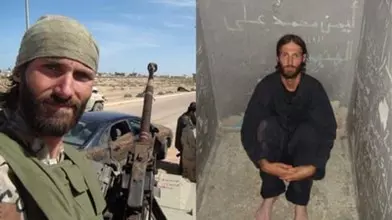
More details have emerged about the American VanDyke. According to his website, he is from Baltimore and has worked as a soldier, international businessman and war correspondent after failing to join the CIA. He claims to be a founder of a military contracting firm called Sons of Liberty International.
VanDyke identified himself as a security analyst, documentary filmmaker, and war correspondent.
Scanning his social media footage and mobile phone, officials have now found that VanDyke had previously been linked to numerous military conflicts and operations abroad. Investigators are trying to unravel what he was doing in the North East.
The American served in Iraq among other combat zones. He also provided "special forces-style" training that encompasses disciplines such as guerrilla warfare, tactical operations, drone usage, and modern warfare techniques, added the reports quoting sources.
VanDyke's early days
VanDyke first gained notoriety during the 2011 Libyan Civil War, where he fought with rebel forces, was captured for six months, and eventually escaped. Following the ISIS execution of his friends—journalists James Foley and Steven Sotloff—he shifted from documentary filmmaking to founding Sons of Liberty International (SOLI), a firm dedicated to training and advising global armed groups.
Indian investigators have recovered recordings of VanDyke advocating for global rebellions, specifically appealing for mercenaries to join insurgencies in Venezuela, Iran, and Myanmar. His mission, he claims, is to empower local populations to fight for themselves rather than bringing in foreign combatants.
VanDyke had even issued global appeals to mercenaries to join insurgent groups in Venezuela, Myanmar, and Iran.
Significance for India
His arrest in India assumes significance since he is believed to be linked to armed networks active in the North East. The NIA is currently probing three critical areas: The authorities are investigating whether Indian territory, particularly the North East, has been systematically used as a "transit corridor" for foreign mercenaries to reach Myanmar. Secondly, they are exploring whether the group maintained direct links with anti-India and proscribed militant organisations, potentially providing them with the same high-tech training and equipment intended for Myanmar-based groups.
Or, the agency is exploring the possibility of organised espionage or intelligence-gathering missions, aimed at assessing the viability of these conflict zones for broader geopolitical objectives.
Other analysts are suggesting that VanDyke's involvement could either point to a larger international initiative to destablise India or could be linked to the geopolitical tensions surrounding the Russia-Ukraine war, possibly as a consequence of India buying Russian oil during the Ukraine war and maintaining strategic ties with the country.