Can Haldwani ‘shuddhikaran’ row be a durable electoral issue for Congress in 2027 polls?
The controversy over the purification ritual has revived debate on untouchability, Dalit dignity, constitutional rights and the Congress’s electoral strategy

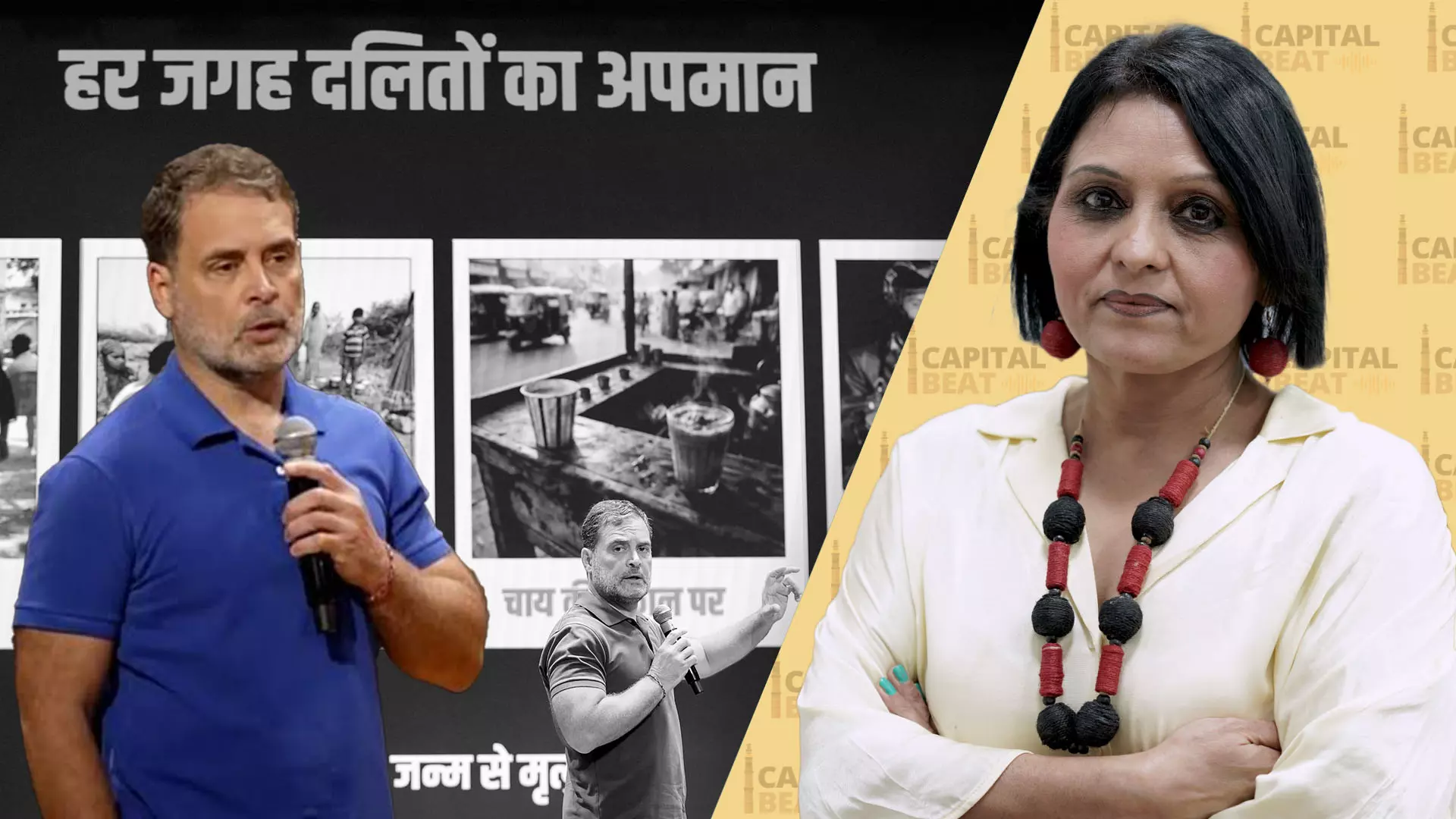
“The law has to be implemented rather than merely invoked,” argued Delhi University professor Tanvir Aeijaz, as the Haldwani “shuddhikaran” row triggered a wider discussion on untouchability, caste discrimination and the SC/ST (Prevention of Atrocities) Act. He argued that the controversy goes beyond Rahul Gandhi and the Congress to the persistence of caste discrimination and the state’s responsibility to act against it. But the intervention has also opened a political debate over the Congress’s Dalit outreach and whether caste and constitutional rights could become a sharper part of its electoral messaging.
Speaking to The Federal on Capital Beat, Aeijaz said the issue should not be treated merely as political rhetoric, pointing to Article 17 of the Constitution and the SC/ST (Prevention of Atrocities) Act. He questioned whether the focus should only be on registering an FIR, arguing that officials who allegedly failed to act promptly should also face scrutiny.
Also read | Rahul accuses BJP-RSS of legitimising untouchability, seeks FIR for Kharge ‘purification’
For Aeijaz, the failure to respond to an alleged discriminatory act raises a larger question about the responsibility of the state. He argued that the significance of the controversy lies in bringing an issue often discussed within the framework of caste politics into mainstream public discourse.
He said the debate could also make more people aware of the legal protections available against caste-based atrocities, shifting the conversation from political rhetoric to the question of how effectively those protections are enforced.
Congress finds political opening
The political significance of the Haldwani controversy changed after Uttarakhand BJP president Mahendra Bhatt publicly defended the purification ritual. Bhatt, who is also a Rajya Sabha MP, said the venue had been “polluted” by slogans and that it was subsequently purified.
The Federal’s Political Editor Puneet Nicholas Yadav said Bhatt’s statement gave the Congress a direct political opening to pursue the issue. He described Rahul Gandhi’s intervention as part of a continuing Dalit outreach rather than an entirely new political theme. He said the Haldwani episode gave the Congress an opportunity to reinforce Rahul Gandhi’s long-running contrast between constitutional values and what he describes as the “Manuvadi” ideology associated with the BJP and Sangh Parivar.
Yadav also pointed to the absence of an FIR despite assurances given in Parliament, saying the delay gives the Congress another line of attack. For him, the controversy is no longer confined to what happened at the Haldwani venue but raises a larger question: if a senior Dalit leader such as Mallikarjun Kharge could be subjected to an alleged act of untouchability, what does that say about the experiences of ordinary Dalits?
The political debate also drew a response from Union minister and Lok Janshakti Party (Ram Vilas) leader Chirag Paswan, who questioned why Congress governments had failed to eliminate caste discrimination despite ruling the country for decades. Yadav rejected Paswan’s argument as “whataboutery”, saying the focus should remain on the allegation of caste discrimination rather than be shifted to the Congress’s record in power.
Dalit outreach meets electoral test
He also questioned the silence of other Dalit political leaders, particularly Mayawati. For Yadav, the Haldwani episode should not be reduced to a contest between individual leaders but should be treated as a larger question of Dalit dignity and constitutional rights.
The controversy could acquire greater political significance as elections approach, particularly in states with substantial Dalit populations. Yadav identified Punjab, Uttar Pradesh and Uttarakhand as potential arenas where the Congress could sharpen its Dalit messaging.
He also said the silence of parties and leaders who traditionally claim the mantle of social justice could become politically relevant. For Aeijaz, however, the larger significance lies beyond whether the Congress can convert the issue into electoral gains. The controversy, he argued, has brought untouchability, caste atrocity and the application of the SC/ST law into mainstream public discourse.
Senior journalist TK Rajalakshmi argued that the issue should be raised regardless of its electoral consequences. She said that even if political parties pursue such questions for electoral reasons, discrimination and untouchability are issues that deserve to be publicly condemned.
Constitution takes centre stage
She said she was struck by what she described as the sincerity of Rahul Gandhi’s intervention. According to her, the Congress leader kept the Constitution at the centre of his argument and focused on the alleged illegality rather than allowing the discussion to move towards other political issues.
Also read | Dalit honour: Proposed by Constitution, disposed by Indian caste system
She also pointed to the broader history of caste discrimination, saying the ideas of “purity” and “pollution” have historically been connected to the caste system. She said Rahul Gandhi was taking the issue head-on by arguing that both untouchability and the act of purification were unacceptable.
Rajalakshmi also noted that similar incidents involving Dalit political figures had occurred in the past, citing the case of Rajasthan Leader of Opposition Tika Ram Jully. She also recalled the case of Jitan Ram Manjhi, who had spoken publicly about a temple being cleansed after his visit.
The panel also cautioned against reducing the debate entirely to electoral calculations. The Haldwani controversy, therefore, sits at the intersection of two narratives: the Congress’s attempt to expand its social-justice politics and a broader constitutional argument against caste discrimination. Whether it becomes a durable electoral issue in Uttar Pradesh, Punjab and Uttarakhand remains uncertain, but the Haldwani row has put caste, untouchability and Dalit dignity back at the centre of political debate.