As Kharge's Haldwani experience shows, political power doesn't shield Dalits from caste prejudice; electoral politics chases votes, not social equality
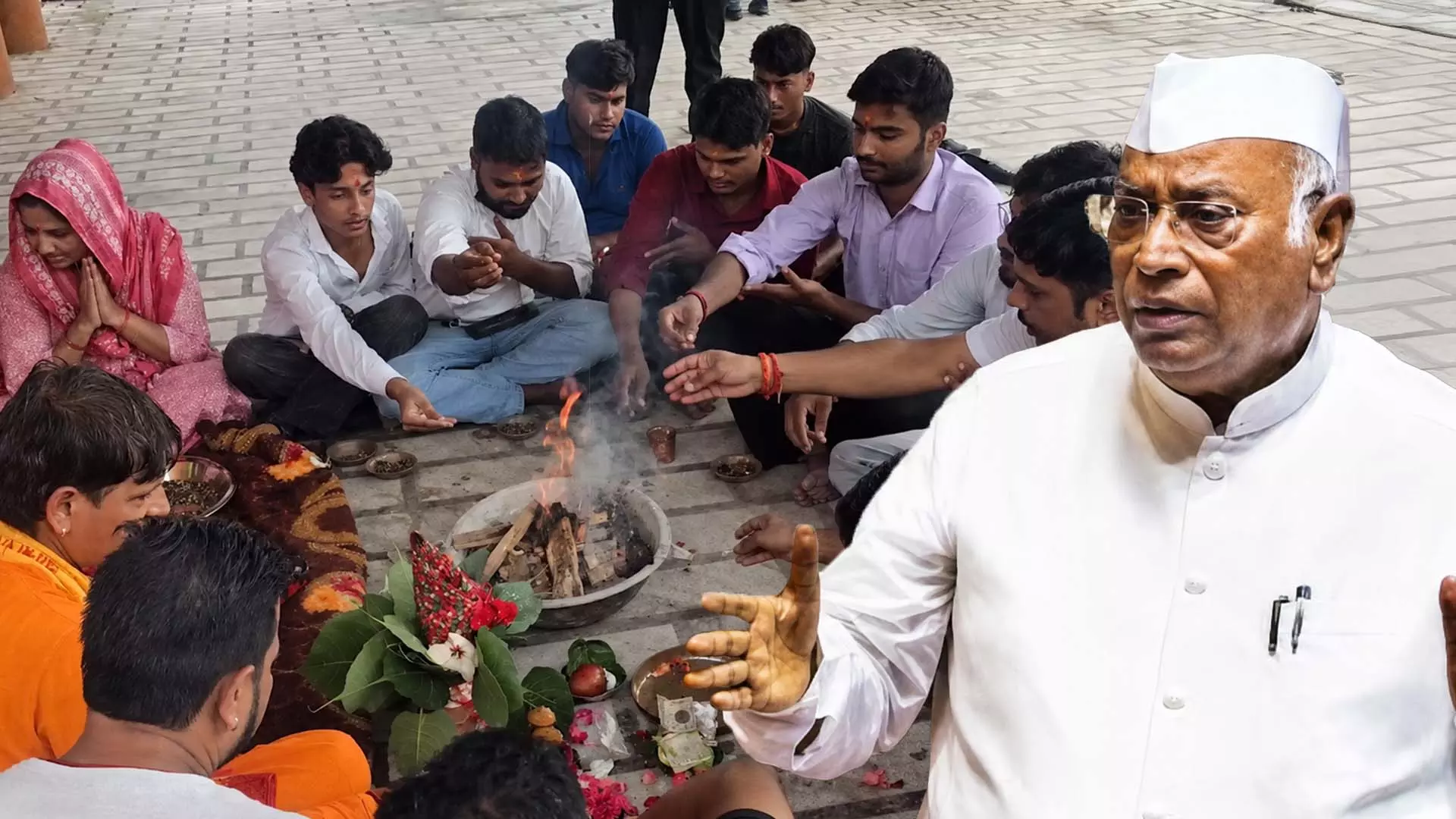
Mallikarjun Kharge is the president of the Congress and one of the most senior political leaders in India. Yet, after he addressed a rally in Haldwani on August 8, members of a right-wing group allegedly linked to the BJP conducted a shuddhikaran (cleansing) ritual at the venue.
Kharge raised the issue in the Rajya Sabha, saying the incident had reminded him of the pain of untouchability. The BJP denied responsibility, and its president, JP Nadda, condemned the act and promised a probe.
More than the political dispute, the question is what the incident says about caste in India. Kharge has been a Union minister, has served in Parliament for decades, and now heads the principal Opposition party. But none of these positions could prevent his caste identity from being used to assign a different status to his physical presence.
A pattern beyond one incident
This is not an isolated contradiction. In April 2025, Rajasthan Opposition Leader Tika Ram Jully, a Dalit, attended the consecration of a Ram temple in Alwar. Former BJP MLA Gyan Dev Ahuja subsequently sprinkled Gangajal inside the temple to purify it, saying that “some impure people” had entered the temple.
Also Read: How Kharge's Manusmriti citation turned into a 20-min Rajya Sabha storm
In 2009, Odisha minister Pramila Mallick, a Dalit, entered the sanctum of the Akhandalamani temple. Priests subsequently closed the temple and performed a purification ritual. The chief priest said Dalits were not allowed to enter the sanctum.
In 2014, Bihar Chief Minister Jitan Ram Manjhi alleged that a temple and its idol had been washed after his visit because he was a Dalit.
Recent incidents raise a question that Indian politics rarely confronts directly: what really changes when a person placed at the bottom of the caste hierarchy acquires political power?
All these incidents raise a question that Indian politics rarely confronts directly: what really changes when a person placed at the bottom of the caste hierarchy acquires political power?
Political power, social status
The answer is quite embarrassing. Political power can change a Dalit’s position within the state without necessarily changing the social meaning attached to the Dalit body. Indian democracy has been more successful in changing who can exercise political power than in changing who is regarded as worthy of equal social status.
India has made substantial progress in political representation. Dalits have held the offices of President, Chief Minister, Union Minister, Speaker, and party president. However, political representation and social equality are not the same thing.
Also Read: Kharge sparks row over ‘terrorist’ remark on PM Modi, later clarifies
A Dalit can be elected to Parliament without being accepted as a social equal. A Dalit minister can exercise authority over senior officials while facing discrimination outside the office. A Dalit leader can command votes from people. Electoral democracy can require people to recognise a Dalit as their political representative without requiring them to recognise that person as their social equal.
It's left to society
In other words, the state can confer office, authority, and constitutional rights. It cannot by itself change the social attitudes through which people judge one another. Why, then, has this gap persisted after nearly eight decades of constitutional democracy?
Parties have strong incentives to mobilise caste groups and accommodate their interests, but fewer incentives to challenge the social hierarchies on which those identities are based.
Part of the answer lies in the different capacities of the state and society. The Constitution can abolish untouchability, provide legal equality, and create avenues for political representation. It cannot, by itself, transform the everyday relationships through which caste is reproduced, in marriage, residence, religious practice, occupation, and social interaction.
Electoral politics creates another complication. Parties have strong incentives to mobilise caste groups and accommodate their interests, but fewer incentives to challenge the social hierarchies on which those identities are based.
Dalit representation has therefore increased political bargaining power without necessarily dismantling the social relations that sustain caste.
The purification message
The purification incidents make this distinction unusually clear because they are not merely about exclusion. They are about pollution.
If a person is prevented from entering a temple, the argument can be presented as a question of access or custom. If a place is purified after a Dalit has left, the message is different. It suggests that the person’s presence itself has altered the status of the space. That is why the Haldwani incident deserves attention.
Also Read: Kharge says Congress opposed delimitation, not Women’s Quota Bill, slams Modi
There is also a danger in reducing such incidents to the ideology of one political party. The Rajasthan case involved a BJP leader. The Haldwani controversy has produced accusations against people associated with a Hindutva organisation, while the BJP has denied responsibility.
But caste discrimination cannot be explained only through party politics. Untouchability is older than the present political system. Its survival also cuts across party boundaries and regions.
Governments led by parties committed to social justice have expanded welfare, reservations, and political representation, but have not eliminated caste prejudice in everyday social life.
Representation vs transformation
Representation nevertheless matters. A political system in which Dalits remain absent from positions of authority would be worse. However, representation should not be mistaken for social transformation.
The problem is particularly visible when Dalit leaders enter spaces controlled by dominant social groups. Their political status may be recognised while their caste status remains decisive.
Electoral politics needs their votes and organisations. Political parties need Dalit candidates and representatives. Governments need their participation in institutions. But social equality requires something more difficult: recognition of Dalits as equals in ordinary social relations.
Also Read: Opposition backs women’s quota, opposes delimitation move: Kharge
That transformation has been much slower. It explains why symbolic gestures can coexist with deeply unequal social relations. Political parties can celebrate Ambedkar, garland his statue and invoke the Constitution. Governments can announce welfare programmes and expand representation.
However, the assumption that some bodies, occupations, and communities are socially inferior can persist despite these acts.
Test of emancipation
The question, therefore, is not whether India has Dalit leaders. It clearly does. The question is whether Indian society has accepted what their political equality actually means. The real test of Dalit emancipation is not whether a Dalit can reach the top of the political hierarchy. It is whether a Dalit at the top is accepted as a social equal rather than seen as a challenge to the existing social hierarchy.
Indian democracy has been more successful in changing who can exercise political power than in changing who is regarded as worthy of equal social status.
Kharge’s experience at Haldwani, like the incidents involving Jully and Mallick before it, suggests that India has travelled a considerable distance towards political equality but has not travelled as far towards social equality. That gap cannot be closed by representation alone.
Representation has changed the distribution of political power. It has been less successful in changing the social relations through which status is assigned. Until that happens, India will continue to produce a peculiar form of equality: Dalits can occupy the highest offices of the state, while sections of society continue to question their right to occupy the same social space.
(The Federal seeks to present views and opinions from all sides of the spectrum. The information, ideas, or opinions in the articles are of the author and do not necessarily reflect the views of The Federal.)