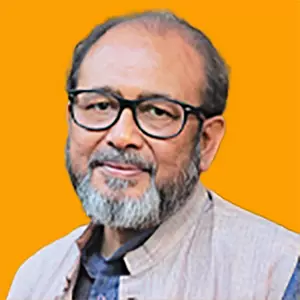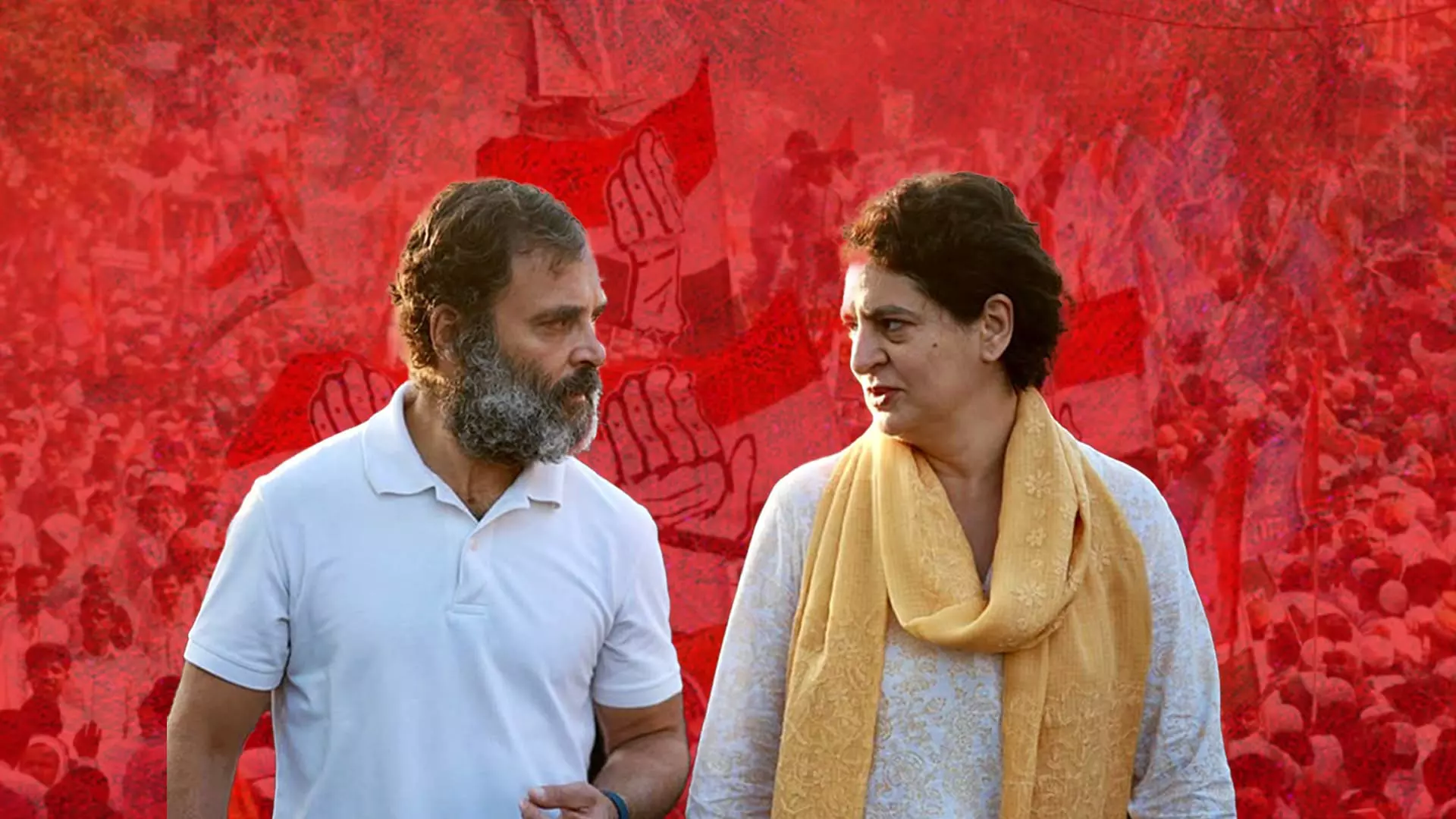
Priyanka should lead Congress, Rahul must be its ideological crusader: Sanjay Jha
Former Congress spokesperson Sanjay Jha tells The Federal why leadership restructuring, alliance humility, and a renewed hunger to win are essential for Congress’ survival

After the 2024 Lok Sabha elections raised hopes of an Opposition resurgence, the Congress has struggled to sustain momentum through successive state polls. On Off The Beaten Track, Sanjay Jha offers a candid assessment of why the party keeps faltering, how leadership roles need redefinition, and why political power remains central to defending democratic values.
Indian politics appeared to change after the 2024 Lok Sabha elections, yet the Congress seems to have lost ground again. What went wrong?
I think that is a multi-layered question, and I wish there were one simple response. But if I had to encapsulate everything into one defining attribute, it would be the Congress party’s hunger to win elections — or the lack of it.
In politics, you can lose one election and come back after a cycle. That is how the BJP has operated. The Congress, however, seems to slip into a limbo when it loses. Look at Uttar Pradesh — out of power since 1989. Bihar since 1990. That is over three decades in two states that together send around 120 MPs to Parliament.
West Bengal, Tamil Nadu — the story is even longer there. This goes beyond logic. The Congress has had multiple presidents and has ruled at the Centre for long periods, including between 2004 and 2014, yet it could not revive itself. That tells me the party does not know how to function as an effective Opposition. When it is out of power, it becomes paralysed.
Also read: Shashi Tharoor says he never deviated from Congress party line
How much responsibility does Rahul Gandhi bear for this, given his central role?
Expectations from Rahul Gandhi are naturally very high. He has completed more than 20 years in politics since entering public life in 2004. For much of that time, he was seen as a part-time politician.
In 2023, beginning with the Bharat Jodo Yatra, it appeared he had turned a corner and emerged as a full-fledged politician. But after that, something happened. During crucial campaigns — Bihar being a prime example — where the voter democracy campaign was receiving a good response, Rahul Gandhi was absent for a large part of the time.
There is also a perception that the consistently angry tone he adopts in speeches may be too ideologically rigid for an Opposition party trying to broaden its appeal. These factors diluted the gains he had made.
Also read: Kerala polls: KC Venugopal warns Congress leaders against self-declaring candidatures
Was the Bharat Jodo Yatra politically underutilised?
What Rahul Gandhi did with the Bharat Jodo Yatra was extraordinary. Walking from Kanyakumari to Kashmir, and then from east to west, is not a normal political exercise. Any other leader who did something like that would probably have swept an election.
That is why the hard question is this: why was the Congress satisfied with around 100 seats? Somewhere along the line, the advantage was frittered away. It has become a nostalgic memory with residual goodwill rather than a sustained political force.
The Congress did not institutionalise the yatra. There was no documentary, no book, no comprehensive narrative of the people Rahul met and the journey itself. This should have been preserved and amplified, much like historic political journeys of the past. While the 2024 Lok Sabha elections did recognise the effort, a larger opportunity was lost.
Also read: Why 2026 could be a testing year for India
Is the Congress struggling to convert ideological issues into mass politics?
Rahul Gandhi is raising important issues — electoral integrity, voter rolls, the appointment of election commissioners, and the risk of disenfranchisement. These are serious matters.
But the problem is resonance. The Congress has not been able to take these issues to people’s homes and streets. Social media helps, but politics cannot be conducted only on Twitter, Facebook, YouTube, or Instagram.
Direct contact with people is essential. Mainstream media, however biased, remains a reality. It is easy to boycott it, but politics is about using every available platform.
If your organisational machinery cannot translate activism into electoral advantage, people will see you as activists rather than a party interested in executive power. And politics, ultimately, is about power.
Should the Congress focus more on livelihood issues instead of ideas like democracy and the Constitution?
It cannot be an either-or situation. You need both ideological battles and bread-and-butter issues — jobs, wages, food, housing, electricity, water, welfare.
India today is witnessing democratic vulnerability and the poisoning of religious harmony. This is spreading from Muslims to Christians, Dalits, and tribals. That ideological battle has to be fought.
At the same time, poverty remains a reality. Unemployment levels are extremely high. People struggling for daily wages are vulnerable, and frustration spills over into social violence.
The Congress must fight on multiple fronts and adopt a Gandhian mode of protest. It must communicate emotionally. Instead of only quoting unemployment data, tell people that their dreams are being taken away, that their future is becoming uncertain, and that they may not be able to support their families. Emotional connection matters.
Where does the INDIA alliance stand after 2024?
The real pillars of the INDIA alliance today are the DMK, the Samajwadi Party, Uddhav Thackeray’s Shiv Sena, and the RJD. The Congress remains important because of its national presence and its numbers in Parliament, which make Rahul Gandhi the Leader of the Opposition.
But this is precisely the moment for the Congress to be generous and visionary. It cannot defeat the BJP on its own and must rely on regional partners.
Rahul Gandhi should use his position to articulate the national narrative in Parliament and outside. The leadership of the INDIA alliance should be given to a regional leader such as Mamata Banerjee, Akhilesh Yadav, or MK Stalin.
That creates multiple authoritative voices. The Congress trying to monopolise leadership is politically naive. Alliances work best when leadership is shared.
Several alliance partners appear unhappy. How serious is this churn?
It is serious, and it again comes back to the hunger to win. The 2024 Lok Sabha result was a shot in the arm. Instead of building on it, complacency crept in.
Take Jammu and Kashmir. The Congress entered the campaign late, performed poorly, and missed the chance to be part of the government despite being allied with the National Conference.
Regional parties face existential battles in their states. They cannot afford to accommodate a weak Congress. Seat-sharing has to reflect ground realities, not past stature.
The Congress has repeatedly mishandled alliances through arrogance, delay, and strange strategic decisions.
What internal changes does the Congress urgently need?
Structural reform has been delayed for far too long. Announcements like “one person, one post” are made and then violated, damaging credibility.
From my experience, Priyanka Gandhi Vadra understands organisation-building. She is hands-on, operationally strong, and good at managing people and egos.
Today, the perception is that Mallikarjun Kharge is not calling the shots and that Rahul Gandhi remains the real authority. That ambiguity hurts the party. Kharge should allow Priyanka Gandhi Vadra to take over, it can happen through an election or a unanimous choice at the CWC. It is upto the Congress to decide.
Rahul Gandhi, in my view, is best suited as an ideological ambassador — a crusader who stands with the marginalised and fights for India’s founding values. That role aligns with his temperament.
The Congress must also elevate leaders like Sachin Pilot. He is a valuable asset and represents generational renewal. A combination of Priyanka Gandhi, Sachin Pilot, and Rahul Gandhi would decentralise power and demonstrate seriousness about reform.
As things stand, what is the larger risk for the Congress if it does not change course?
If the Congress does not demonstrate a clear hunger to win elections, it will continue to remain ineffective. Without political power, it will keep speaking about democracy, the Constitution, and communalism without being able to stop what is happening.
That is the hard truth. The party must learn how to convert ideas, movements, and alliances into electoral victories if it wants to play the role it believes it must play in India’s future.
(The content above has been transcribed from video using a fine-tuned AI model. To ensure accuracy, quality, and editorial integrity, we employ a Human-In-The-Loop (HITL) process. While AI assists in creating the initial draft, our experienced editorial team carefully reviews, edits, and refines the content before publication. At The Federal, we combine the efficiency of AI with the expertise of human editors to deliver reliable and insightful journalism.)