



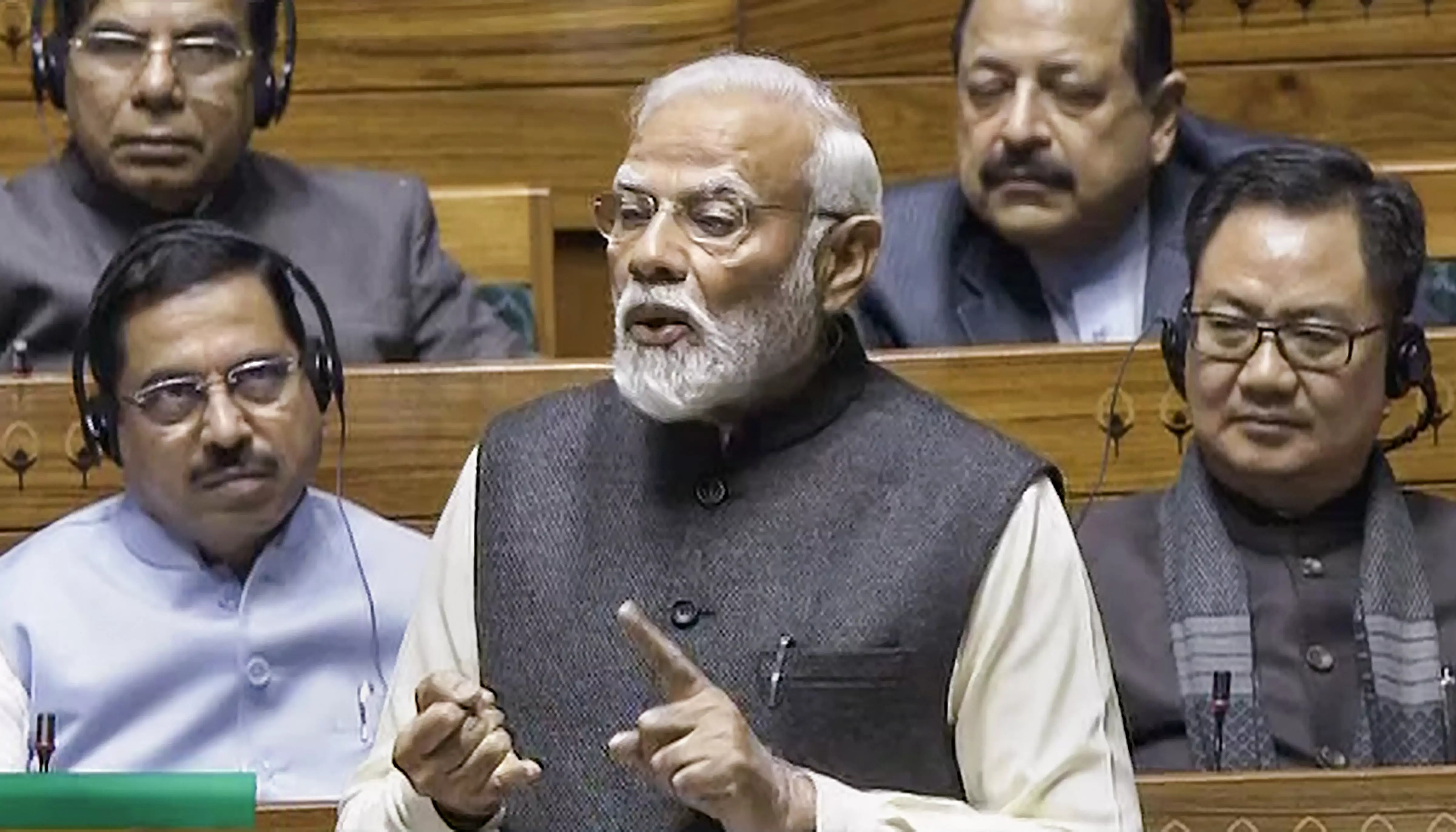
PM Modi to lead Vande Mataram debate in Lok Sabha today
The prime minister is likely to revive attack on Congress over removal of stanzas as treasury and opposition gear up for a fiery exchange

Prime Minister Narendra Modi will lead a discussion in the Lok Sabha today to mark 150 years of Vande Mataram. While Vande Mataram served as a unifying slogan during the freedom struggle, its cultural significance continues to play a central role in the BJP’s political narrative today.
Lok Sabha has listed 'Discussion on the 150th anniversary of national song Vande Mataram' on Monday and allocated 10 hours for the debate.
Defence Minister Rajnath Singh is expected to be the second speaker in the debate that will also see the participation of Congress deputy leader in the Lok Sabha Gaurav Gogoi and Priyanka Gandhi Vadra among other members.
Also read | PM Modi links omission of ‘Vande Mataram’ stanzas in 1937 to India's partition
The debate in Parliament is part of the year-long celebrations on the 150th anniversary of Vande Mataram, a song written by Bankim Chandra Chatterjee, and set to tune by Jadunath Bhattacharya.
On November 7, Modi launched year-long celebrations to commemorate the 150th year of Vande Mataram aimed especially at youth and students to deepen awareness of the song's significance.
Political tempers set to flare
The debate is expected to see sharp exchanges between the treasury and opposition benches, with both sides poised to trade barbs over the history and political significance of Vande Mataram.
Tensions escalated last month during an event marking the song’s 150th year, when PM Modi said the Congress had “removed important stanzas” from the original version of Vande Mataram at its 1937 Faizabad meeting. He argued that this decision “planted the seeds of partition” and claimed it diluted the national song’s message of unity. Modi tied this criticism to his broader vision of a “Viksit Bharat,” emphasising that cultural heritage is integral to national development.
Also read | UP CM makes Vande Mataram compulsory in all schools; 'no new Jinnahs should emerge'
The Congress firmly rejected these allegations. Citing The Collected Works of Mahatma Gandhi (Vol. 66, p. 46), the party said the 1937 decision was not intended to divide people but to address concerns expressed by some communities. The recommendation came from a Working Committee that included key national leaders such as Mahatma Gandhi, Jawaharlal Nehru, Sardar Patel, and Subhas Chandra Bose. The committee observed that the first two stanzas were already the most commonly sung and widely accepted, while the remaining verses contained religious references that some citizens were uncomfortable with. The party also pointed out that Rabindranath Tagore had supported this approach and had himself sung Vande Mataram at the 1896 Congress session.