



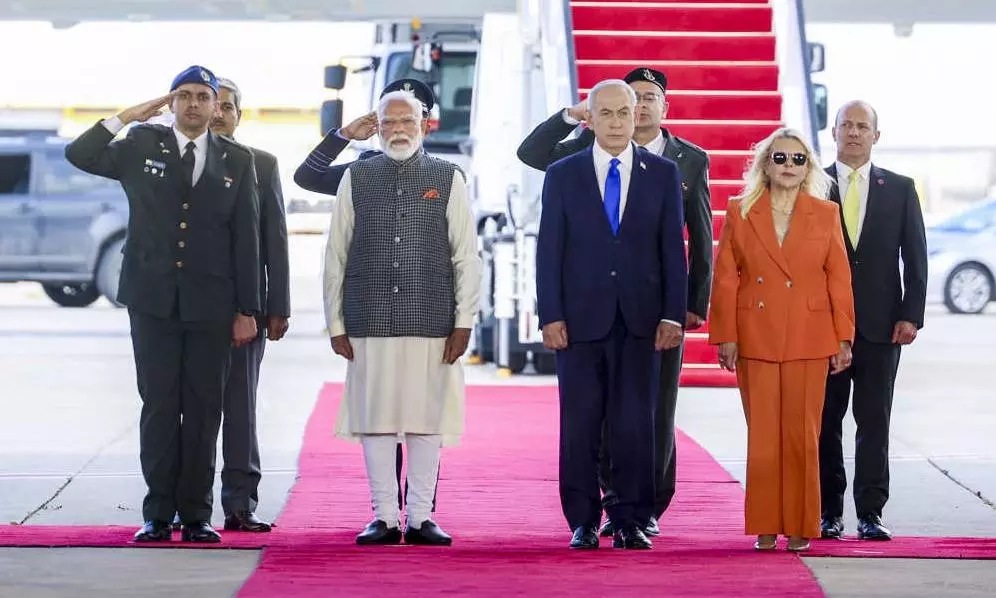
Prime Minister Narendra Modi with his Israeli counterpart Benjamin Netanyahu and his wife Sara upon arrival at the Ben Gurion airport near Tel Aviv, Israel on Wednesday (February 25). Photo: PTI
PM Modi gets red carpet welcome as he begins his second visit to Israel in 9 years
PM Narendra Modi was received by Israeli PM Benjamin Netanyahu and his wife Sara at Ben Gurion airport; defence, trade, technology, and regional security will be high on the agenda

Prime Minister Narendra Modi landed in Israel on Wednesday to a red-carpet welcome with his Israeli counterpart Benjamin Netanyahu and wife Sara receiving the Indian leader at the Ben Gurion airport.
It is PM Modi's second visit to Israel in nine years. The India-Israel relationship was elevated to the level of strategic partnership during his first visit to that country in July 2017.
Netanyahu greeted the Indian prime minister with a warm hug, following which Modi was accorded a ceremonial welcome at the airport, located 20 kms southeast of Tel Aviv.
Modi to address Israel’s Parliament
The Indian prime minister will address Israel's parliament later in the day and will have a tete-a-tete with Netanyahu. The two leaders will hold wide-ranging talks on Thursday.
In his pre-departure statement, Modi said he was confident that the visit will further consolidate the enduring bonds between India and Israel and set new goals for the strategic partnership.
"India and Israel share a robust and multifaceted strategic partnership that has witnessed remarkable growth and dynamism in recent years," Modi said.
"I look forward to my discussions with Prime Minister Netanyahu aimed at further strengthening our cooperation across various domains, including science and technology, innovation, agriculture, water management, defence and security, trade and investment, as well as people-to-people ties," he said.
Also Read: PM Modi on Israel visit: Confident my trip will consolidate 'enduring bonds'
Modi said he and Netanyahu will also exchange views on regional and global issues of mutual interest.
"I am confident that my State Visit will further consolidate the enduring bonds between the two countries, set new goals for the strategic partnership, and advance our shared vision for a resilient, innovative, and prosperous future," Modi said.
The prime minister's visit assumed greater significance as it is taking place amid the ongoing tensions in the Middle East, including deteriorating ties between the US and Iran.
Defence cooperation
There has been an upswing in India-Israel ties in the last few years, including in the areas of defence, scientific research, cybersecurity and innovation.
The defence cooperation has emerged as an important pillar of the partnership between the two sides, with Israel supplying a plethora of military platforms and weapon systems to India.
Also Read: India, Israel begin first round of FTA talks ahead of PM Modi's visit
In November last, during the visit of India's defence secretary to Israel, an important agreement on defence cooperation was signed.
As India is looking at developing an indigenous air defence shield called "Sudarshan Chakra", it is learnt that New Delhi would like to explore the possibility of incorporating certain elements from Israel's Iron Dome all-weather air defence system that can intercept and destroy missiles and artillery shells.
Steady progress in trade and investment ties
The trade and investment ties between the two sides are also witnessing steady progress.
During the visit to Israel of Commerce Minister Piyush Goyal in November, the term of reference (ToR) for the launch of Free Trade Agreement (FTA) negotiations between India and Israel was signed.
Also Read: Can Modi maintain ‘balance’ in India’s ties with Arabs, Israel?
In September, the two sides had inked a Bilateral Investment Agreement (BIA) to expand economic cooperation.
The people-to-people ties between the two countries are also an important aspect of the overall relations, with over 41,000-strong Indian diaspora playing a key role in the two-way engagement.
(With agency inputs)