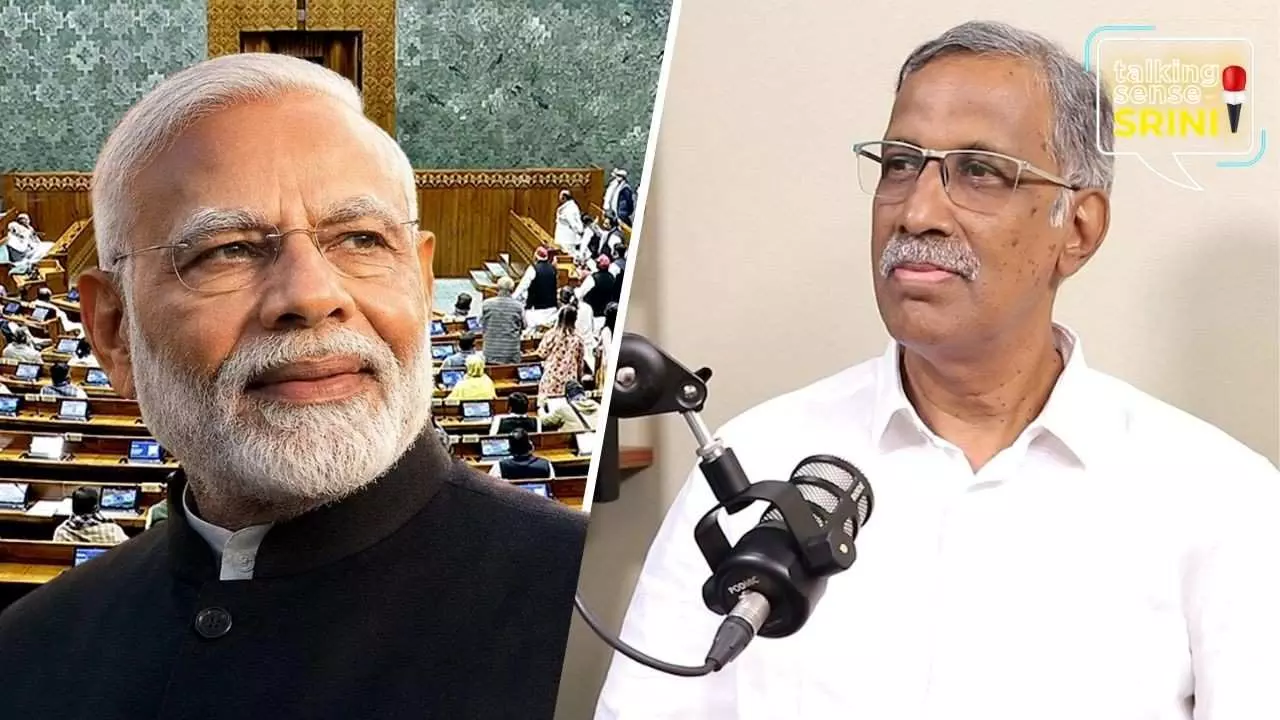
PM Modi breaks Nehru's record: What has India gained? | Talking Sense With Srini
The Federal’s Editor-in-Chief Srinivasan says Modi's most enduring impact lies in reshaping India’s political and ideological landscape, while debates continue over economic performance, foreign policy, and the future direction of the nation

As Narendra Modi became India's longest-serving elected Prime Minister, surpassing Jawaharlal Nehru's record, The Federal's Editor-in-Chief S Srinivasan said the most consequential legacy of the Modi years has been a fundamental shift in India's political and ideological landscape.
‘Civilisational transformation’
Speaking on Talking Sense With Srini, Srinivasan argued that Modi's biggest achievement was not merely electoral success but what he described as a "civilisational transformation" of India.
"From being a secular democratic republic envisioned at Independence, India has moved towards a Hindu-majoritarian mindset. Whether that transformation is complete or not remains open to debate, but it is undoubtedly the most significant political change of the Modi era," he said.
Also Read: Modi becomes India’s longest continuously serving elected PM
Assessing Modi's electoral dominance, Srinivasan noted that while the BJP suffered a setback in the 2024 Lok Sabha election by falling short of an outright majority, the party quickly regained momentum through a series of state-level victories.
"The BJP's electoral juggernaut faced its first major obstacle in 2024, but the challenge came as much from within as from the Opposition," he observed, referring to reported differences between the BJP and the RSS.
However, he said the party leadership rapidly corrected course and consolidated its position across much of the country.
‘Majoritarian nationalism’
According to Srinivasan, the Modi government has simultaneously pursued a broader ideological project through measures such as the abrogation of Article 370, the construction of the Ram Mandir, and the push for a Uniform Civil Code.
"These are all part of the same theme, transforming the Nehruvian model of secularism into a more assertive majoritarian nationalism," he said.
‘Strategic self-interest dominates foreign policy’
On foreign policy, Srinivasan argued that India today faces a far more complex geopolitical environment than in previous decades. While acknowledging challenges posed by China's rise and instability in India's neighbourhood, he questioned whether India was exercising influence commensurate with its growing stature.
Also Read: Why India's tough economic reality can't be ignored anymore | Talking Sense With Srini
"Indians may feel they command greater respect abroad, but are we punching according to our weight? I would say no," he remarked.
He contrasted contemporary foreign policy with India's earlier willingness to take moral positions on global issues, saying strategic self-interest now appears to dominate decision-making.
Economic performance
Economically, Srinivasan credited the Modi government with delivering major improvements in infrastructure, digital payments, financial inclusion, and welfare delivery. Programmes such as Jan Dhan, Aadhaar-linked direct benefit transfers, rural electrification, and toilet construction have had a tangible impact, he said.
Also Read: Congress slams Modi on PM milestone, calls him ‘millstone around India’s neck’
At the same time, he cautioned that headline GDP growth conceals deeper structural concerns.
"Aggregate GDP does not automatically translate into collective prosperity," Srinivasan said, pointing to India's relatively low per-capita income, weak manufacturing base, and persistent employment challenges.
Areas that need urgent attention
He also flagged declining foreign investment and India's lag in developing indigenous artificial intelligence capabilities as areas requiring urgent attention.
"Politically, the BJP has strengthened its position election after election. But many economists argue that the government has taken its eye off the economic ball," he said.
Also Read: Being longest-serving elected PM is not Modi’s only record; here are more
Twelve years into Modi's tenure, Srinivasan concluded, the debate over his legacy remains far from settled. What is beyond dispute, however, is that few leaders have reshaped India's political, social, and institutional landscape as profoundly.