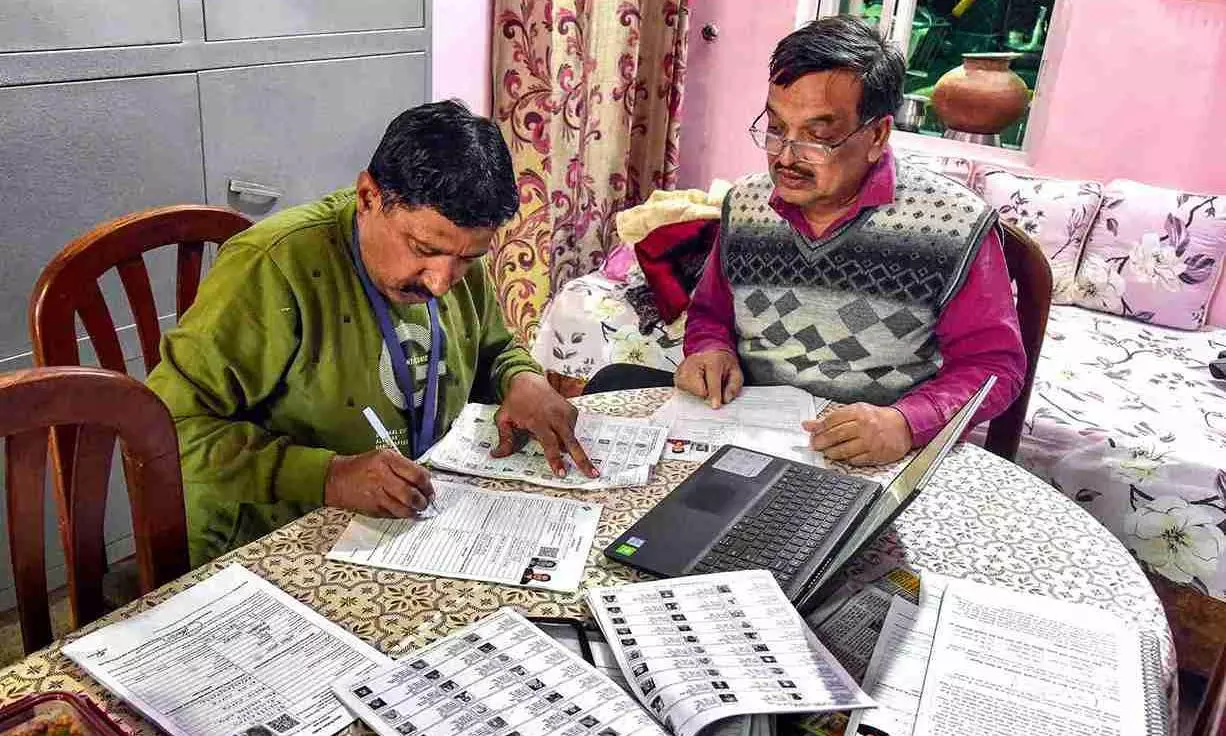
One year of SIR: Nearly 6 crore deletions, legal battle and migrants' agony
With crores of names removed and more states entering the process ahead of elections, SIR has become one of the biggest electoral roll debates in recent years

The Special Intensive Revision (SIR) of electoral rolls, which commenced on June 24 last year in Bihar, has completed one year, with the exercise continuing in 19 states and Union territories.
Following the SIR exercise, nearly six crore voters were deleted from the electoral rolls, which led to a standoff between the Opposition and the Election Commission. Nearly 65 lakh voters’ names were deleted in the pilot Bihar clean-up exercise.
Excluded from welfare benefits
The Opposition and activists alleged that the EC was working with the BJP to exclude citizens over missing documents.
Also read: BJP urges ECI to halt Karnataka SEC’s ‘parallel’ SIR exercise in Bengaluru
In March, the Supreme Court unanimously upheld the constitutional validity of the EC's move to carry out SIR.
Individuals whose names were deleted during SIR are being excluded from state welfare benefits in West Bengal and Bihar. Following recent state assembly elections, both governments announced that voter roll purification data is being linked to social security.
SIR, now part of the NCERT's Social Science textbook, describes it as an exercise to ensure that no eligible citizen is left out and no ineligible person is included in the electoral roll.
Voter deletion impact
The impact of the exercise was felt most sharply among vulnerable sections, including poor families, women, minorities and migrant workers. In West Bengal alone, around 27 lakh citizens had their names referred to tribunals for verification and adjudication.
For migrant workers, who travel to cities for daily wage employment while retaining voter registration in their native places, the process posed a difficult challenge. Many had to choose between losing several days of income to return home for physical verification or risking the deletion of their names from electoral rolls.
Also read: Prashant Bhushan interview: 'SIR exercise is illegal, targets Muslims'
Several deleted voters reported losing access to welfare benefits, ration subsidies and government assistance after their names were removed from records.
On polling days, reports emerged of voters reaching polling stations only to find that their names were missing from electoral rolls, with many claiming they had received no prior notice or personal communication about the removal.
Phase 2 of SIR
In the second phase of the exercise, announced on October 27, last year, in Uttar Pradesh, West Bengal, Tamil Nadu, Rajasthan, Chhattisgarh, Kerala, Puducherry, the Andaman and Nicobar Islands, Lakshadweep, Gujarat, Madhya Pradesh and Goa, the combined voters' list was pruned by 10.2 per cent.
The voter base before the poll roll clean-up across these states and Union territories stood at more than 50.99 crore.
Also read: SIR verdict: Operation successful, patient under observation
Post the exercise, the voters' list stands at 45.81 crore - a decline of over 5.18 crore. In percentage terms, the electoral rolls have been reduced by 10.2 per cent.
As many as 66,88,636 deceased electors were removed from the rolls, with the maximum of 25.47 lakh from Uttar Pradesh, followed by 24.16 lakh from poll-going West Bengal.
Additionally, 63.16 lakh names were deleted following objections and adjudication during the SIR exercise.
Final poll roll clean-up
The final rolls for the 12 states and Union territories were released on different dates, with Uttar Pradesh being the last to release the data.
Third phase of the SIR in 16 states and three Union territories - Andhra Pradesh, Arunachal Pradesh, Haryana, Jharkhand, Karnataka, Maharashtra, Manipur, Meghalaya, Mizoram, Nagaland, Odisha, Punjab, Sikkim, Tripura, Telangana, and Uttarakhand, National Capital Territory of Delhi, Chandigarh, and Dadra and Nagar Haveli and Daman and Diu - involving 36.73 crore voters was rolled out on May 14 and would conclude later this year.
(With agency inputs)