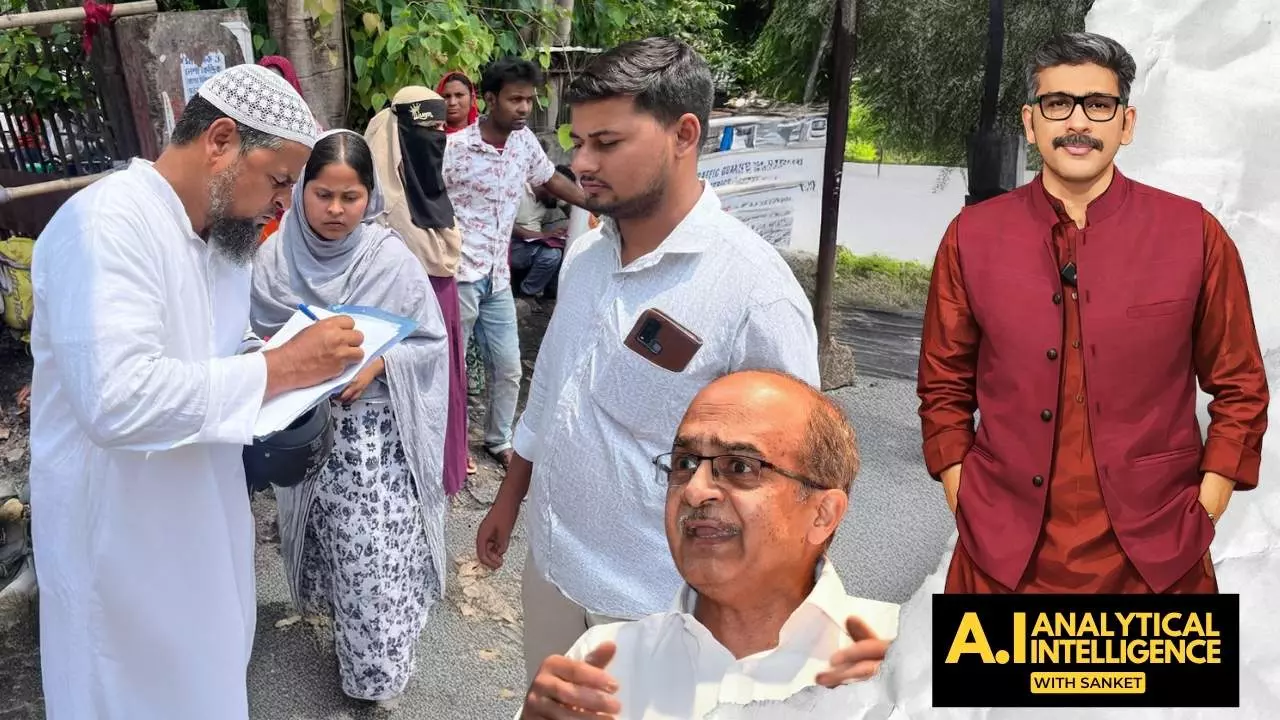
Prashant Bhushan interview: 'SIR exercise is illegal, targets Muslims'
With nearly 91 lakh deletions reported in West Bengal, questions around transparency, legality, and fairness have intensified. Senior advocate explains why he is all against

“This entire exercise is not only in violation of the law but appears designed to disproportionately target Muslims and remove them from the voters’ list,” says Prashant Bhushan, raising serious concerns over the Special Intensive Revision (SIR) of electoral rolls.
With nearly 91 lakh deletions reported in West Bengal, questions around transparency, legality, and fairness have intensified. The Federal spoke to Prashant Bhushan, senior advocate, Supreme Court of India, on why he believes the process undermines both electoral law and democratic rights.
What is your primary objection to the Special Intensive Revision exercise?
I have several objections. First, preparing a new voters’ list without referring to the old one is not contemplated by law at all. The Representation of the People Act allows for intensive revision, but only in a constituency or part of it, and for reasons recorded in writing. There is no authority for the Election Commission to prepare a completely new voters’ list de novo across an entire state or country, which is what is being done now.
Second, the manner in which this exercise is being carried out is deeply flawed. In 2003, an intensive revision was conducted through door-to-door enumeration. Booth Level Officers went house to house, verified who had moved away, who had newly arrived, and updated the list accordingly based on the old rolls.
At that speed, it is impossible to provide any meaningful hearing. In reality, no hearings were given. Yet, decisions affecting a person’s fundamental right to vote were made in this cavalier manner.
When we asked the Election Commission for the guidelines followed in 2003, they refused to provide them. Eventually, Yogendra Yadav obtained them through confidential sources, and it confirmed that the process was transparent and grounded in the existing list.
What are your concerns regarding deletion of names, especially on citizenship grounds?
The process being followed now is fundamentally flawed. Form 6, which is used for inclusion in the voter list, only requires proof of residence and age. For citizenship, it only requires a self-declaration—nothing more. No documentary proof is mandated.
In fact, when the issue of citizenship came before the Supreme Court in 1995 in the Lal Babu Husain case, the court clearly stated that inclusion in the existing voter list is prima facie evidence of citizenship. If the Election Commission doubts someone’s citizenship, it must issue a notice with reasons and provide a personal hearing where the individual can present evidence — oral or documentary.
A large number of people in India do not possess formal documents to prove citizenship. Many only have Aadhaar cards, which the Election Commission itself does not accept as proof of citizenship. At best, such individuals can submit affidavits or statements from neighbours.
Despite this, the Commission is asking everyone to fill out enumeration forms and submit one of 11–12 documents, most of which are not widely available. In our analysis in Bihar, more than 50% of people did not possess any of these documents. The only widely held document was the matriculation certificate.
How transparent is the process being followed by the Election Commission?
The Election Commission’s own manual mandates transparency. Every application for inclusion should be uploaded on the website. This is not being done at all.
The manual also requires the use of de-duplication software to identify duplicate entries—either through identical photographs or matching demographic details like name, father’s name, and address. This is also not being used.
Further, the Commission is supposed to hold booth-level or ward-level sabhas to verify voters based on the existing rolls. That is not happening either. They are not even providing the voter list in a machine-readable format, which would allow independent verification using computers.
This entire exercise is being conducted in a completely opaque, hurried, and arbitrary manner, in violation of their own rules, guidelines, and the law.
What are ‘logical discrepancies’ and why are they controversial?
The Election Commission has introduced a new category called “logical discrepancies.” In West Bengal, about 60 lakh people were removed because they did not sign enumeration forms. Another 27 lakh were removed due to these so-called discrepancies.
These include cases where more than 20 people are shown living in one house, minor differences in names between documents and voter lists, mismatched father’s names, or age gaps between parents and children being less than 20 years.
Also Read: Assam's normalisation of hate can steadily erode the very idea of India
This list of 60 lakh people was generated centrally by the Election Commission using an algorithm. It is evident that this algorithm is biased and appears designed to disproportionately target Muslims. In many cases, while Muslims make up around 30% of the population, they constitute 60%, 70%, even up to 95% of those flagged under these discrepancies—often identifiable through surnames.
This strongly suggests a mala fide intent behind the exercise.
What about the grievance redressal mechanism for those deleted from the rolls?
There is virtually no effective grievance redressal mechanism. Reports indicate that out of 27 lakh deletions, only two cases have been taken up in two weeks.
We analysed how judicial officers were handling these cases. Even if they worked 10 hours a day, seven days a week, they were disposing of cases at the rate of one every two minutes—about 300 cases per day.
At that speed, it is impossible to provide any meaningful hearing. In reality, no hearings were given. Yet, decisions affecting a person’s fundamental right to vote were made in this cavalier manner.
The list of “logical discrepancies” was prepared centrally, and judicial officers were simply asked to process them at impossible speeds. This makes the entire exercise mechanical and unjust.
Do you believe legal intervention is necessary at this stage? What can be done?
Absolutely. The Election Commission’s own manual states that an intensive revision cannot be completed in less than six months. Yet, this is being done in three to four months in states like Bihar and West Bengal.
The Supreme Court should have intervened and halted the process, directing that it be carried out properly with adequate time and safeguards. Instead, it has allowed the exercise to continue, effectively enabling an illegal process to become a fait accompli.
Legal challenges are ongoing, and lawyers representing political parties have raised these issues. However, unless the court steps in decisively, the damage may already be done.
The content above has been transcribed from video using a fine-tuned AI model. To ensure accuracy, quality, and editorial integrity, we employ a Human-In-The-Loop (HITL) process. While AI assists in creating the initial draft, our experienced editorial team carefully reviews, edits, and refines the content before publication. At The Federal, we combine the efficiency of AI with the expertise of human editors to deliver reliable and insightful journalism.