







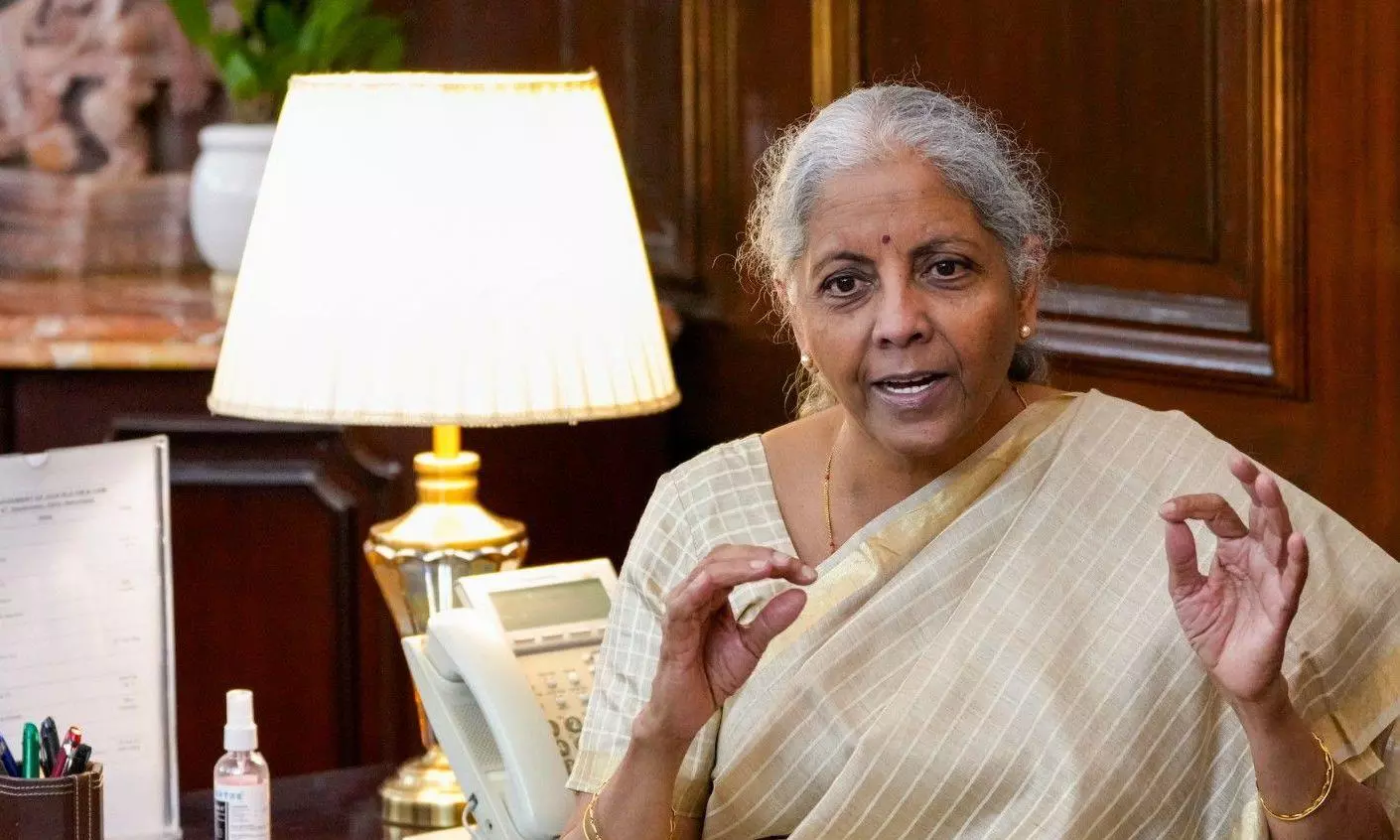
Nirmala Sitharaman calls for wider access to finance, digital economy to fight poverty
The Finance Minister says the next phase of poverty reduction must focus on expanding economic opportunities and ensuring those lifted out of poverty do not slip back

Finance Minister Nirmala Sitharaman on Monday (November 23) said wider access to finance, markets and the digital economy would be key to eradicating poverty and ensuring those lifted out of it do not slip back.
Citing the World Bank's Poverty and Equity Brief on India, she said nearly 50 crore Indians had moved out of poverty between 2011 and 2023, while extreme poverty had been almost eradicated. Sitharaman said the Narendra Modi government had focused on targeted interventions, measurable outcomes and schemes tailored to address specific deprivations.
The World Bank's October 2026 report estimated that the share of India's population living below the lower-middle-income poverty line of $4.20 a day, measured at 2021 purchasing power parity (PPP), fell from 57.7 per cent in 2011 to 16.1 per cent in 2023. An estimated 496 million people moved above this threshold during the period. Extreme poverty, measured against the $3-a-day threshold, declined from 27.1 per cent to 2.6 per cent.
Also read: Why claims of India reducing poverty are just a clever selection of data
"Garibi is not merely a shortage of income or wages. A household without a secure roof, safe water, sanitation or healthcare remains vulnerable even when its income rises. One illness can wipe out savings and push a family back into poverty," the minister said in a LinkedIn post titled 'The Decade India Turned the Tide on Poverty'.
Welfare schemes as protection against poverty
Sitharaman said welfare schemes such as Jal Jeevan Mission, Ayushman Bharat, PM Awas Yojana, Ujjwala Yojana and Swachh Bharat were together acting as "insurance against the shocks" that once pushed families back into poverty. These interventions, she said, were also helping lower household expenditure and freeing up time for work.
She said the government's approach had shifted from providing temporary relief to addressing the underlying deprivations that kept households vulnerable.
Also read: EPFO's retirement reforms balance liquidity with long-term savings, but execution will be key
"There was no magic wand. Each scheme required careful identification of beneficiaries, effective delivery and follow-up until the last household was reached," Sitharaman said, adding that Prime Minister Modi's sustained attention had helped translate policy into tangible improvements in people's lives.
Last month, the World Bank's Poverty and Equity Brief on India reported that nearly 50 crore Indians had moved out of poverty between 2011 and 2023, while extreme poverty had fallen sharply.
Guided by Antyodaya, or the welfare of the last person in the line, the government had chosen to address deprivations household by household, ensuring development reached those who needed it most, she said.
Focus shifts to finance, livelihood opportunities
Sitharaman said the next phase of poverty reduction would involve lifting those still at the bottom of the economic ladder while ensuring that people who had already moved out of poverty continued to advance.
"The next phase builds on this progress to lift the few people still at the bottom of the ladder out of poverty, while ensuring those who have already risen keep advancing and never slip back. The protection offered via various measures must now be complemented by even wider access to finance, markets and the digital economy," she said.
She said the government was also building closer links between academia and industry through employment-linked incentives, internships and apprenticeships. Investment in infrastructure was helping connect different parts of the country, while creating opportunities beyond those who already had access to them.
Observing that welfare protection alone would not be enough to help families improve their economic position, Sitharaman said they also needed opportunities to earn and build livelihoods.
Also read: India's inflation breach: Why the RBI can't afford a timid December
"The government has created financial opportunities through schemes like MUDRA (60 crore loan accounts have been sanctioned, about two-thirds to women), while PM SVANidhi and PM Vishwakarma support street vendors and traditional artisans," she said.
She also highlighted the role of rural women's self-help groups and the Lakhpati Didi initiative in expanding livelihood opportunities. Around 10 crore rural women are part of self-help groups, while more than 3.7 crore women have become Lakhpati Didis, according to figures cited in her article.
The government, she said, was seeking to build on the gains in poverty reduction by widening access to economic opportunities as India works towards the goal of Viksit Bharat.
(With agency inputs)