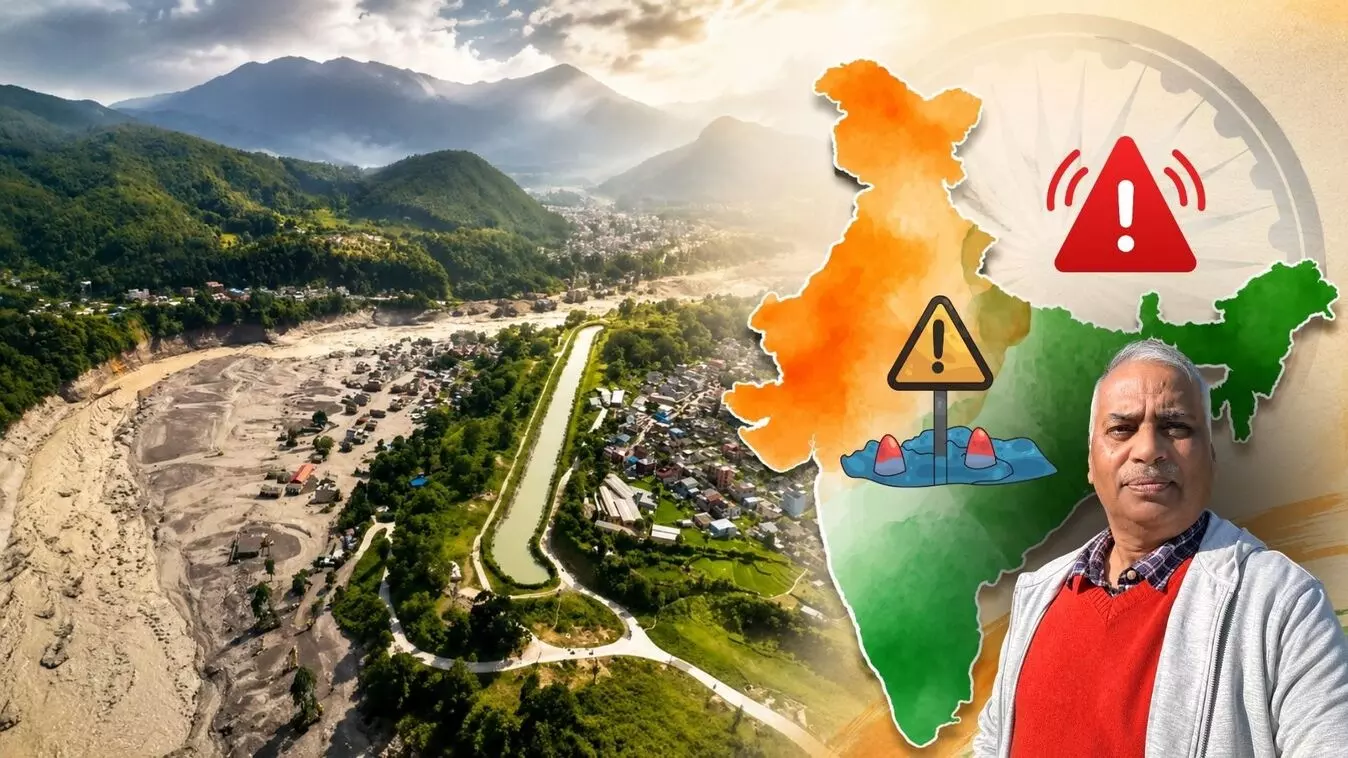
V P Upadhyay, former adviser to the Ministry of Environment, Forest and Climate Change says that in the Himalayan region, real-time information exchange from one country to another is really required.
Nepal floods: What India can learn from Himalayan disasters
Former Environment Ministry adviser says climate change, ecological damage and unregulated development are increasing Himalayan flood and landslide risks

Nepal’s devastating floods underline a larger warning for the Himalayan region, where climate change, ecological damage and unplanned development are combining to intensify the risk of floods and landslides. V P Upadhyay, former adviser to the Ministry of Environment, Forest and Climate Change, says preserving the Himalayan ecosystem must become central to development planning, with stronger cross-border early-warning systems and strict limits on construction in vulnerable areas. Speaking to The Federal, Upadhyay explains the causes of the recent disaster, India’s preparedness and the lessons New Delhi must take from Nepal.
Climate change is now an established reality. How do you assess the debate over whether the Nepal floods were caused by climate change or human activity?
Climate change is a fact now. Researchers have established that climate is changing. In the Himalayan region, the top layer of the ice is melting, indicating that the climate is changing. The melting of ice is far greater than it was before. It means climate change is a reality now.
And it is due to human development. The causes are anthropogenic. We are developing all over the world, taking a development perspective, developing industry, doing mining, and all. So, these are the activities that are affecting the Earth’s biosphere, and the temperature is changing.
Also read: Nepal floods LIVE: 700 dead; rescue teams on alert as water level rises in Bhotekoshi river
Changing temperatures are also impacting the glacial ecosystem. Ice is melting. So, this is one of the reasons why disasters in the Himalayan region may be due to more force of water coming through the Himalayan river system because of changes in the glacier ecosystem and more water coming down.
So, this is certainly a cause to worry, and we have to think about how we could develop so that the ecosystem remains intact. We should also keep the present ecosystem for the next generation. Otherwise, there will be these types of impacts — landslides, floods and loss of human life.
India has also seen major Glacial Lake Outburst Floods (GLOFs) and flash floods in the Himalayas. Is India’s preparedness keeping pace with these recurring disasters?
Cloudburst is a phenomenon that has been there in the Himalayan region for a long time. So, when there is a cloudburst at a particular place and concentrated rainfall occurs, there is a heavy flow from our streams downstream. In that process, sometimes an artificial lake is formed.
Like you are hearing today also, there are lakes that are getting disturbed, and a lot of water is coming in. In today’s three-four-day phenomenon, you might have noticed that.
So, there are many causes. The Himalayas are young mountains. The forested vegetation there, if there is a cloudburst with rainfall, can help control the impact if we have a forested ecosystem in the Himalayas.
If we are damaging, disturbing or cutting the trees, we are cutting a lot of life that is actually preserving the ecosystem and avoiding landslides.
Normally, the Himalayan ecosystem has three or four tiers of vegetation. When rainfall comes, the trees, the first tier, reduce the force of the rain.
Then, the force of the rain is reduced by the shrubs, the second tier. Then there are herbs and grasses on the ground floor, which can again reduce the intensity of the rain.
And when rain reaches the ground floor, there is litter and organic matter. They absorb the rain and it slowly percolates down. A lot of research has been done on the Himalayas. It is a subsurface-flow ecosystem.
If you move into the Himalayan region in a forested ecosystem, you will see that rain is very heavy. But when it comes to the ground floor, you don't see much overland flow from the soil. These systems take the water down, and it slowly percolates down and goes into the subsurface-flow ecosystem.
And this subsurface ecosystem later releases it. That is how you get water springs in the Himalayan region.
So, if you cut the vegetation, what happens? The rainfall directly hits the soil. There is splash erosion. There is no chance for water to percolate down to the subsurface, flow slowly, and get released.
It becomes a mass movement of water with soil and makes its own way to the rivers. Then the high flow, with the landmass, muck, and silt, goes and hits the riverbanks, cuts the riverbanks, and if there are populations on the riverbanks, they get affected.
Also read: Nepal disaster puts North Bengal’s vulnerability to Himalayan floods in focus
So, the Himalayas need a three-tier vegetation system to stop this type of landslide.
What should India do to improve preparedness, particularly on real-time information sharing with Nepal during high-altitude emergencies?
As the National Disaster Management Authority (NDMA) has rightly stated, in the Himalayan region, real-time information exchange from one country to another and from one state to another within the country is really required if you are talking about a mitigation exercise.
That information, once it reaches the authorities and mitigation authorities, gives them time to deal with that situation and prevent economic, human or ecological damage.
So it is important that across countries there has to be real-time information flow. Whether there is a disaster or there is not a disaster, it should be continuous, 24/7. That is one way we can really prevent the loss of life.
But these are all mitigation measures. There have to be some preventive measures.
The Himalayan ecosystem is a very fragile ecosystem. The soil is still not very stable, and the soil particles, when they are attacked, can protect the soil when there is rainfall. When disturbance of soil particles occurs, they start moving.
So, it means good forest and vegetation coverage should be there across the countries of the Himalayan region. Then they can reduce the fury of landslides and floods.
Second, the carrying capacity of any place in the Himalayan region, whether it is a tourist place, ecological place or any other place, should be kept in mind when planning development.
The carrying-capacity concept must be kept in mind when you are developing any development project or any ecosystem-related project.
So, another aspect is that there are a lot of exotic species and vegetation change associated with the Himalayan region. At a particular altitude, there is naturally evolved vegetation and you introduce some other vegetation there.
So, it means not only the top vegetation is getting affected. It is the vegetation from the whole soil to the top that is getting affected because the ecosystem will change. There will be a change in the diversity of species.
And if there is a thinning of species, then again you have a chance of disturbance of the soil, and again you have the chance of landslides. Restoration and rejuvenation of the natural, native ecosystem should be the priority.
Also read: Nepal floods: 5 ft from disaster, how selflessness and a saree saved Tamil Nadu pilgrims
Another issue is rivers which are flowing in the Himalayan region. Normally, the tendency of people from historical times is to make their houses near the banks of the river.
This is the historical way people stay, not only in the hills or Himalayan region but in the plains also. Most of the population makes their houses and starts building and living along the banks of the river.
But in the Himalayas, there has to be a policy of a no-development zone along both banks of the Himalayan rivers because when the flow of water increases due to ice melting or because of any force caused by heavy rains or cloudbursts, the water doesn't know to go only one way.
There are so many boulders and things coming, so water may shift and the river has a meandering impact. There are curves in the river. There are many curves in the river if you see those rivers, and if the water is eating into that curve, the people who are there are going to be affected.
There has to be a uniform policy depending on the impact that is going to be felt. It may be 50 metres, 100 metres or 200 metres, depending on the location. There has to be a no-development zone. There has to be no construction activity in this particular region.
We can save the lives of people, at least because there are many natural events where you can't do anything. But the events that are coming because of the impact of development, we can think of such mitigation measures — long-term mitigation measures — to save the public and save the people of the region.
I will tell you one example. Nowadays, roads are being made across the country. But there is a difference between roads made in the plains and roads being made in the hills, especially in the Himalayan region.
If the roads are being made semi-manually or semi-mechanically, most of the work is done manually or semi-manually, there will be less impact.
If you utilise heavy machinery and start blasting the hills, then again, the detachment of particles inside the hills and the vibration created by development activity will also accelerate landslides.
Because the soil is detached, with a little bit of force from the rain, it will start sliding down, and then there will be downstream impact. So, there are many factors.
I think policy-related parameters are required, and development-related parameters are also required to at least reduce, not stop, this type of impact, so that the ecosystem remains intact as well as the people are safe.
What is the one key lesson India should take from the way the Nepal floods have unfolded, particularly on floodplains and hill construction?
In our country, we have taken a lot of measures. Even in policy interventions, we have created no-development zones in certain areas where vulnerability is higher. We don't allow any construction. But still, there may be many areas to improve the implementation aspect.
Say, for example, nowadays tourists going to the Himalayan region is something like a population we have never imagined. Local people start building one room in their house; they start building another guest house.
Also read: Nepal journalist on the spot: 'The situation now is worse than what I saw earlier'
So, building construction should also match the surrounding landscape. Such types of materials should be used that are light and do not put much pressure.
Mining should not be done to take the material for building the house and more. So, the tourist inflow should be such that the local area can absorb it.
The capacity of the local area also changes not just in terms of living conditions, but even food. Once more people come, a lot of commercial trucks will start coming to deliver food and other items for the food and feeding and stay of the tourists.
So, the vibration from these heavy trucks also causes certain impacts along the roads.
Similarly, people should be made aware of what is needed for them as an SOP, not just dos and don'ts.
And that can come from the government side. The economy is growing, people are going to the Himalayan region, but people who are natives of the Himalayan region should also train those people who are coming from outside.
Say, for example, a ban on plastics, as these get into the river. Also, camping is now a new phenomenon on the riverbank side.
Vegetation is scraped because of camping that reduces the vegetation there, leaving a bald 10-by-15-foot area there without any vegetation. So, it means the biodiversity is gone, and the capacity of that area to absorb the shock of nature is gone.
The soil has been totally spoiled. That also creates a favourable environment for silt to flow into the river and create havoc during the rains.
If such small things are taken care of, it will have a more positive impact on the forest ecology of the Himalayan region.
What should we learn from nature’s own ability to maintain ecological balance?
We should be self-regulating. Nature is self-regulating. If you don't interfere, it will self-regulate. And it will not disturb you, and it will remain as such.
So, that self-regulating principle of nature — you said homeostasis of nature. We should learn about nature, how it has been maintaining itself through centuries. We should also at least learn something.