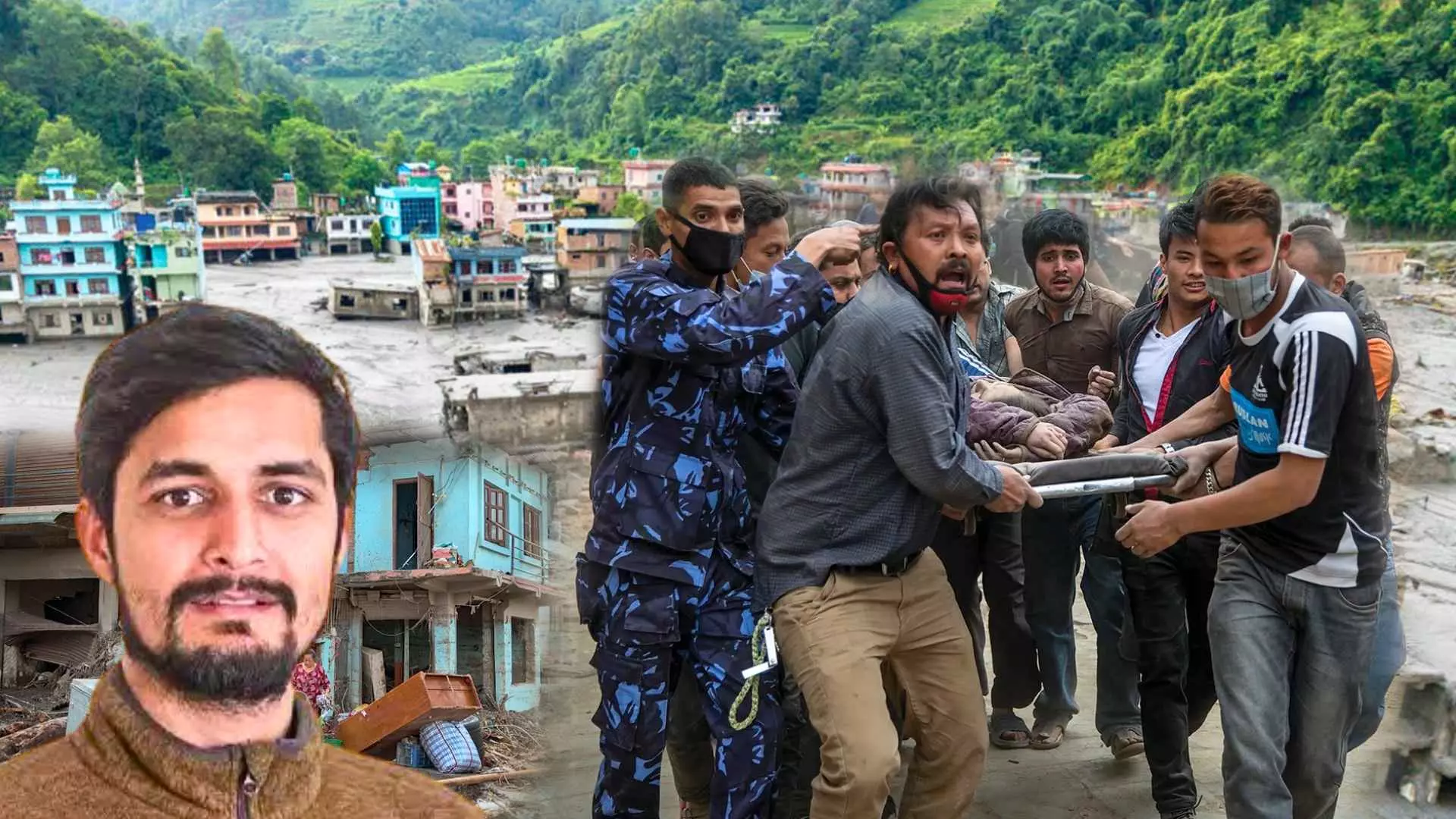
Nepal journalist on the spot: 'The situation now is worse than what I saw earlier'
With mobile networks down and entire villages inaccessible, Prabhat Khanal says the true toll of Nepal's floods may still be far from clear

Nepal’s flash floods have left entire villages and small towns devastated, while rescuers struggle to reach people trapped in remote mountainous areas. With communications down and several settlements still inaccessible, the full scale of the disaster remains unclear.
The Federal spoke to Nepal-based journalist Prabhat Khanal, who is reporting from the ground on the rescue operation, the missing people, and the conditions in some of the worst-hit areas.
You have been on the ground in some of the worst-affected areas. What have you physically witnessed over the last 24 hours?
I came here this morning. The situation today (August 28) is worse than what I had seen earlier.
If you come to the ground, you can see the devastating and real impact of the flood. People are actually searching for their family members, friends, and colleagues.
The government is actually doing a great job, especially the security personnel involved in rescuing people. They are providing aid and food. You can see the footage and videos of many people being rescued.
Also Read: India sends 11-member rescue team after Nepal's U-turn on foreign assistance
I have never seen a scenario like this in my life. The situation in the flood-affected villages and small towns is devastating. Entire small towns have been swept away by the flood.
At the Army base where people are being rescued and taken care of, you can see army personnel carrying many bodies. Helicopters fly every few minutes to rescue people and provide aid.
People are standing outside the army barricades, watching, because they are waiting for their families.
How difficult are the rescue operations now, and can rescuers reach people after the floods?
Yes, they are reaching people. The weather is good now, and because of that they are able to fly helicopters to rescue people.
They are trying to rescue more people frequently. Sometimes it rains, but given Nepal's geography, there are many mountains. You can reach some places only by helicopter.
Also Read: Scientists saw the Himalayan disaster coming, but nobody listened
Many places have no roads or bridges. The distance between two places is only 100 or 200 metres, but they are on opposite sides of the river. You cannot go by foot and there is no access to the other side.
Only one option remains: helicopter transport. That is why the rescue operation is very critical and very tough. But the rescue teams involved in this task are doing a very good job.
There are reports of people trapped in tunnels, particularly in Rasuwa. What do you know about that rescue effort?
In Rasuwa, several hydropower projects run along the Trishuli and Bhote Koshi rivers. According to the Army spokesperson, there are many people stuck in a tunnel, around 200 according to the information I have. The tunnel entrance is blocked.
They are trying to break through that blockage. Experts are in the field and are trying to open the entrance so they can rescue those people.
What can you tell us about the death toll? Is the number being reported an underestimate?
The death toll will obviously rise. They are not giving us the exact death toll. I think they either do not know the exact number or they do not want to give wrong information. But according to the local media, the death toll is increasing. This morning, I saw that more than 500 cattle had died.
An Army spokesperson told me that more than 800 people had been rescued by the Nepal Army, Armed Police Force, and Nepal Police. Among them were 56 foreigners, including 32 Indians and 16 Chinese. They are doing their best to rescue more people.
Are there specific villages or districts that have been badly affected but remain largely out of public view?
Yes, there are many villages and small towns.
We don't know what is happening in Timure, Syabrubesi in Nuwakot, the Rasuwa-Nuwakot border, and the areas near the Nepal-China border.
Also Read: Nepal floods: 77 Isha Foundation pilgrims remain untraceable
We cannot reach those places because the security personnel are not allowing us to go there. That is why we are unable to know the exact situation or the number of missing people.
Beyond the immediate rescue phase, what health and sanitation risks are emerging?
Definitely, there are risks. There are lots of bodies, and because of that we can expect many diseases. There is no proper water supply or electricity now . The government is trying to rebuild the electricity facilities and other infrastructure.
There is also no internet connection to communicate, and mobile networks are down.
If people come to an army camp or a nearby hospital, they can get health facilities. But I don't think there will be good health facilities available in the field right now.
What is the mental state of people on the ground after three days of this disaster?
They are very confused because many people are missing from families. They don't know whether they are dead or trapped somewhere. They are trying to reach out and find out about their families. The situation is very traumatic.
If you look at people's eyes, they are glued to their mobile phones, scrolling through photographs and messages from family members. They are outside the Army barracks, outside hospitals, and outside rescue camps.
Also Read: Morgues overflow in Nepal as flash flood death toll crosses 500
When a helicopter lands, their eyes go to it because they expect their family members to come. They have already given the names and details of their family members.
There have been reports that Nepal does not want help from other countries. As someone on the ground, do you think Nepal can handle this disaster on its own?
No, I don't think so. There are several countries such as the United Kingdom, China, India, and Canada, and others that are trying to help. Obviously, the government should accept that help. I don't think the government of Nepal is able to tackle this disaster alone.
Nepal needs all kinds of support for this disaster, and should accept any kind of support or help from other countries.
Is there an aspect of the crisis that is not receiving enough media or government attention?
Yes. There are many things that the media have not been able to cover. The media cannot reach the places where the floods have hit hardest.
As I already mentioned, Syabrubesi, Timure, Betrawati in Nuwakot and Rasuwa, and Rasuwagadhi are among those areas.
Also Read: Killer floods: Is Nepal underprepared for natural disasters? Yubaraj Ghimire exclusive
We don't know about the situation of the people in those areas. We are not allowed to report on who is alive, and how they are managing their food and basic needs.
The media should cover these things because then the government and international forums will know what is happening in Nepal and what needs to be done for the Nepali people and the Nepali government.